Most businesses don't use just one piece of software. They use several.
Each application may work perfectly well on its own. The problem begins when the business needs these applications to work together. An employee downloads a report from one system and uploads it into another. Someone copies customer information from the CRM into the accounting system. A spreadsheet is used to move data between two applications. A manager waits for one department to send information before another process can begin.
The software isn't necessarily the problem. The missing link is often integration. And one of the most important technologies enabling that integration is the API.
What Is an API?
API stands for Application Programming Interface. In simple terms, an API is a defined way for one software system to communicate with another. Instead of one application needing to understand everything about how another application works internally, it can use the API to request specific information or perform specific actions.
Think of an API as a controlled doorway between applications. One system asks:
"Give me this information."
The other system responds:
"Here is the information you requested."
Or one system may say "Create this record," and the other system processes the request and returns the result. APIs define the rules for these interactions and can expose selected data or functionality without exposing an application's entire internal system.
Why Does This Matter to a Business?
Because businesses don't operate in isolated departments. A customer may exist simultaneously in:
An employee may exist in:
A product may exist in:
And a recipe may exist across:
If these systems don't communicate, people often become the integration layer. And people are not particularly good integration middleware.
The Hidden Cost of Disconnected Software
Imagine a company receives a new customer. The sales team enters the information into the CRM. The finance team needs the same information in the accounting system. The operations team needs it in another application. Customer support needs it somewhere else. Without integration, someone has to repeatedly move the same information. That creates several potential problems:
The larger the organisation becomes, the more expensive these problems can become. API integration allows applications to exchange data and coordinate processes instead of relying entirely on manual transfers — the same underlying issue we explored in The Hidden Cost of Manual Business Processes.
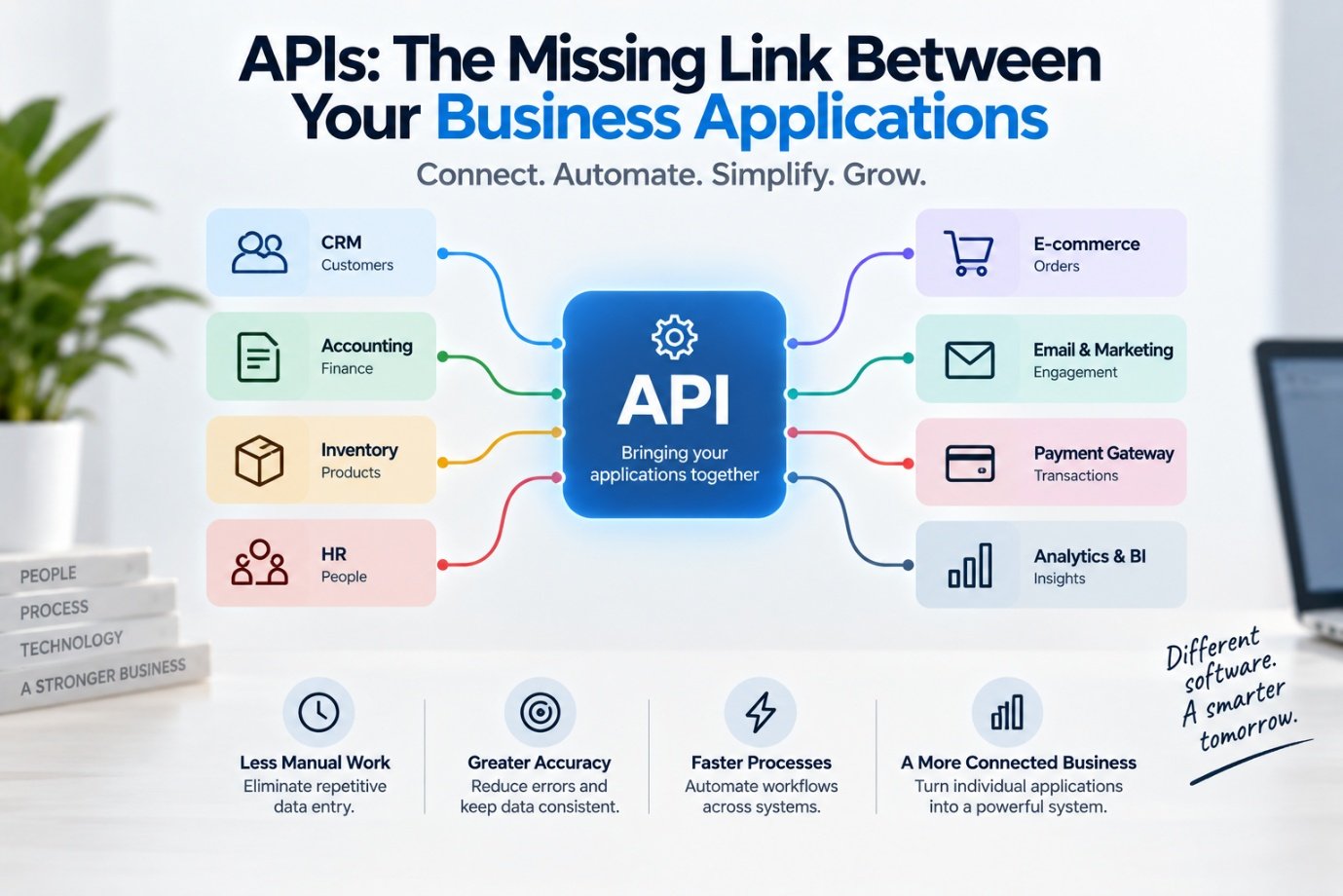
APIs Turn Software Into a Connected System
Consider a typical business technology environment. You might have:
Without integration, each system may operate as its own island. With APIs, information can move between them. For example: a customer places an order. The e-commerce system receives the order. The order information is sent to the business system. Inventory is updated. The payment status is recorded. The accounting system receives the relevant transaction information. The customer receives confirmation. A reporting system can then use the resulting data.
The customer may experience this as one simple transaction. Behind the scenes, several systems may be communicating.
APIs Are Not Just for Large Enterprises
There is a misconception that APIs are something only large technology companies need. They are useful for businesses of all sizes. A smaller company might use APIs to connect:
The objective is not to build an unnecessarily complicated architecture. It is to remove unnecessary manual connections where reliable integration is possible.
Integration Doesn't Always Mean Replacing Software
This is an important point. Businesses sometimes discover that their software systems don't work perfectly together and immediately consider replacing one of them. That may not be necessary.
Suppose a company has an accounting system that works well but doesn't provide the exact workflow its operations team needs. Instead of replacing the accounting system, the business could potentially build a custom application around it and use APIs to exchange the necessary information. The existing system continues doing what it does well. The new application handles the missing functionality. The two systems communicate.
This creates a hybrid technology environment. API integration can allow organisations to connect older systems with newer applications rather than replacing everything at once — much like the approach described in When Your Business Has Outgrown Excel.
APIs and Automation Go Together
Integration becomes even more valuable when it is combined with automation. Imagine an employee normally performs this process:
If the systems are connected appropriately, much of that workflow can happen automatically. This is one of the major business benefits of APIs. They allow systems to communicate without requiring a person to manually move information between every application. APIs are widely used as a foundation for automation because software can exchange data and trigger actions programmatically.
The Recipe Example
This becomes particularly interesting in food technology. Consider a hotel recipe platform. A recipe may contain:
That recipe data can potentially feed several systems:
- Recipe → Nutrition EngineCalculate nutritional information
- Recipe → Allergen EngineIdentify relevant allergens
- Recipe → Costing EngineCalculate ingredient and recipe cost
- Recipe → Carbon EngineEstimate environmental impact
- Recipe → Menu SystemPublish structured menu information
Instead of maintaining separate copies of the recipe for every purpose, the business can establish a central recipe data source — the same principle behind treating ingredient data as a strategic business asset — and allow connected applications to use that information. This is where APIs become particularly valuable.
APIs and AI
AI is adding another reason why connected systems matter. An AI application may need access to:
An AI model sitting completely outside the business's systems has limited context. An AI application connected to appropriate business data can potentially do much more. For example, an employee could ask "Which customers have overdue invoices?" and an AI system could potentially obtain the relevant information from the accounting system through a controlled integration.
Or "Which recipes contain this ingredient?" — a recipe intelligence application could query the underlying recipe database. Or "Which menu items have changed cost significantly this month?" — the AI layer could combine information from recipe and costing systems.
This doesn't mean every business needs an AI agent. It means that connected data becomes increasingly important as AI becomes more integrated into business workflows.
APIs Can Create a Single Source of Truth
One of the problems with disconnected systems is that the same information can exist in multiple places. Suppose a customer's address changes. The CRM is updated. But the accounting system still has the old address. The shipping system has another version. A spreadsheet has a third. Which one is correct?
A well-designed architecture can establish ownership for different types of information. For example:
- CRMCustomer Master
- ERPProduct Master
- HR SystemEmployee Master
- AccountingFinancial Transactions
Other applications can retrieve the information they need rather than maintaining independent copies wherever possible. This can improve consistency and reduce unnecessary duplication. APIs can provide controlled access to data held in different systems, helping organisations connect previously siloed information.
But APIs Are Not Magic
Adding an API doesn't automatically create a good integration. A poorly designed integration can create a new set of problems. Before connecting two systems, businesses need to understand:
- What data is being exchanged?
- Which system owns the data?
- How frequently should it move?
- Who is allowed to access it?
- How is it authenticated?
- What happens when the connection fails?
- What happens when the data is invalid?
- How are duplicates handled?
- How are changes to the API managed?
- How is the integration monitored?
These questions become increasingly important as the number of integrations grows.
Security Matters
An API creates a controlled connection between systems. That connection needs to be secured. Depending on the application, security considerations may include:
Not every system should have access to every piece of information. A good integration exposes what is required for the business process — not everything that happens to exist inside the source system. API management and governance can help organisations apply consistent security, access and monitoring policies as integrations scale.
What Happens When an API Fails?
This is another area that is easy to overlook. Suppose the payment system is temporarily unavailable. What happens to the order? Or the accounting API stops responding.
- Does the customer transaction fail?
- Does the system retry?
- Does it queue the transaction?
- Does someone receive an alert?
Good integration design needs to account for failure. A reliable system should not assume that every connected application will always be available. This is especially important when APIs become part of critical business workflows.
Avoiding API Sprawl
There is also such a thing as too much integration. A business can gradually accumulate dozens or hundreds of connections. System A connects to B. B connects to C. C connects to D. A also connects directly to D. Then someone changes one application and several other systems stop working.
This can create what is sometimes called integration or API sprawl.
As the number of integrations grows, businesses need architecture, documentation, ownership, monitoring and governance. Integration platforms and API management approaches can help organisations manage larger integration environments and connect cloud and on-premise systems more systematically.
When Should a Business Consider API Integration?
Some useful signals include:
If people regularly download, edit and upload files between applications, investigate whether the systems can communicate directly.
Duplicate customer, product, employee or recipe information can create consistency problems.
If someone spends hours every week combining data from several systems, integration may be worth investigating.
As the number of applications increases, the cost of disconnected systems can increase as well.
Automation usually requires systems to exchange information.
AI applications often become more useful when they can securely access relevant business information and services.
APIs Don't Replace Good Software Architecture
An API is a tool. It is not an architecture by itself. Good integration starts with understanding:
Only then should the technical implementation be designed. The goal isn't to connect everything to everything. The goal is to create useful connections that support important business processes — the same discipline described in Why Businesses Should Stop Buying Software and Start Building Systems.
From Software to Systems
This connects directly to a broader principle we've discussed throughout the TRUIX blog. Businesses don't really operate on individual software applications. They operate on systems. Software applications are components within those systems. APIs are one of the mechanisms that allow those components to communicate.
That means the technology architecture can evolve — much like the progression described in Digital Transformation Isn't About Buying More Software and Scalable IT Infrastructure — from:
Each step builds on the previous one.
The TRUIX Perspective
At TRUIX, we don't believe every business needs to replace its existing software. Sometimes the right answer is a new application. Sometimes it is automation. Sometimes it is better infrastructure. And sometimes the missing piece is simply integration.
APIs can connect existing systems, reduce repetitive data movement, support automation and create a foundation for more intelligent applications. The important question isn't "Which software should we buy?" It is "How should our systems work together?"
Because when software starts communicating properly, businesses can stop treating applications as isolated tools and start building something much more valuable.
A connected business system.
Related Reading
- Why Good Sustainability Reporting Starts With Good Data
- Digitisation vs Digital Transformation: What's the Difference?
- Why Businesses Don't Need More Software — They Need Better Systems
- How Technology Can Automate Carbon Accounting
- Why Your Business Data Is More Valuable Than You Think
- Cloud vs On-Premise Infrastructure: What Should Your Business Choose?
- Why Your Business Network Is the Backbone of Digital Transformation
- Why Ingredient Data Is a Strategic Business Asset
- Common CCTV Installation Mistakes Businesses Make
- How AI Can Change Recipe and Menu Management
- AI Agents vs Traditional Automation: What's the Difference?
- Network Security Starts With Infrastructure
- Why Restaurants Need More Than a Digital Recipe Book
- The AI Journey: What Businesses Should Automate First
- Building More Sustainable Menus With Better Data
- Why Businesses Should Stop Buying Software and Start Building Systems
- Digital Transformation Isn't About Buying More Software
- The Hidden Cost of Manual Business Processes
- When Your Business Has Outgrown Excel
- Scalable IT Infrastructure: Building for Growth Without Overbuilding
- Why Ingredient Data Is a Strategic Business Asset
- Software Solutions