For decades, restaurants have relied on recipe books.
Digitising these recipes is certainly an improvement. A digital recipe book makes information easier to store, search, share and update. But there is a bigger opportunity.
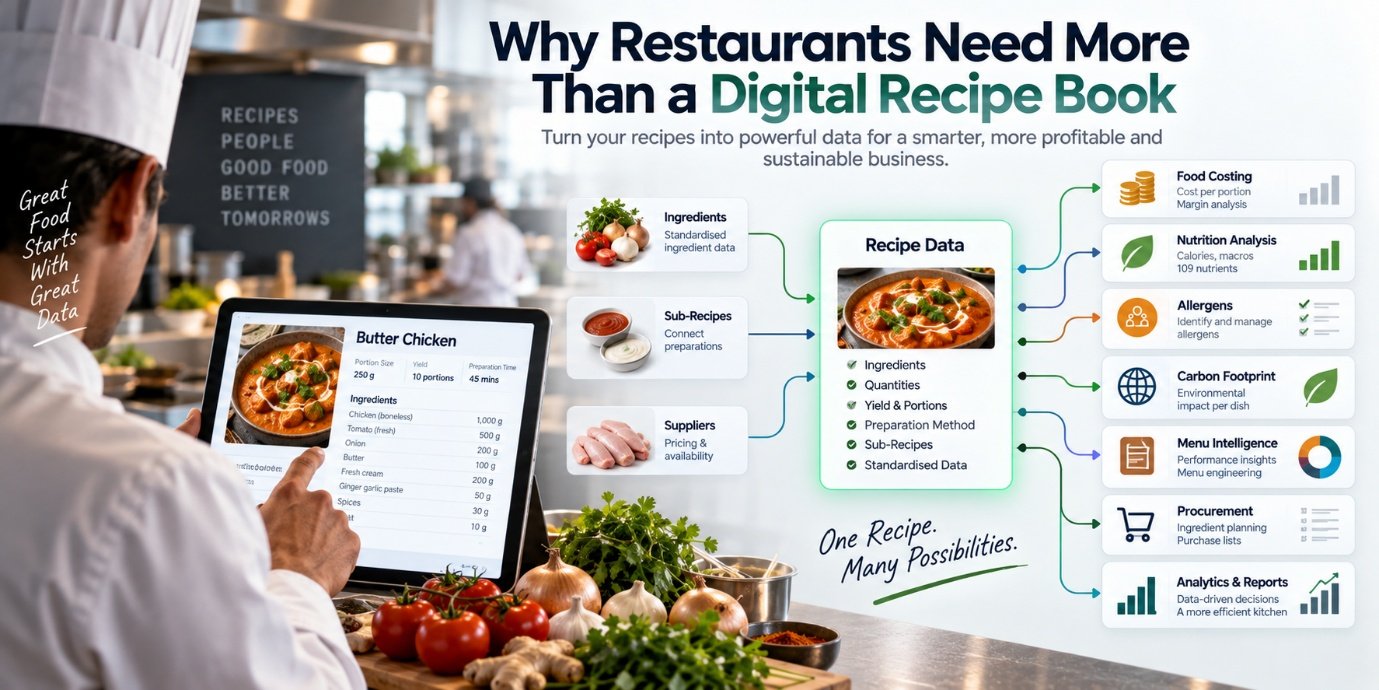
A restaurant doesn't just need digital recipes. It needs recipe data that can work for the business.
A recipe should not simply tell someone how to prepare a dish. It can also become the foundation for understanding:
This is the difference between a digital recipe book and a recipe intelligence system.
A Digital Recipe Book Is Still Just a Document
Imagine converting a paper recipe into a PDF. The recipe is now digital. But fundamentally, nothing else has changed. Someone still has to read it. Someone still has to calculate the cost. Someone else may calculate nutrition. Another person may maintain allergen information. The sustainability team may calculate carbon. The purchasing team may maintain ingredient prices separately. The finance team may have another system.
The recipe is digital — but the information surrounding it remains disconnected. This is where the real opportunity begins.
Turn the Recipe Into Structured Data
Instead of treating a recipe as a document, consider it as structured information — the same shift explored in What Happens When Recipes Become Data? For example:
- Chicken1,000 g
- Butter100 g
- Tomato500 g
- Cream200 g
- Onion200 g
- Spices50 g
- Yield10 portions
- Portion200 g
Now each ingredient can be connected to additional information. Chicken may have:
Butter may have another set of properties. Tomatoes another. Cream another. The recipe then becomes a structured collection of connected data. That data can be used by multiple parts of the business.
One Recipe Can Power Multiple Functions
This is where structured recipe data becomes much more valuable. A single recipe can potentially support:
- Recipe ManagementWhat is approved, latest, and who changed it
- Food CostingCost and cost per portion
- NutritionCalories, macros and micronutrients
- AllergensWhich ingredients carry relevant allergens
- CarbonEstimated environmental impact per portion
- Menu ManagementWhich outlets and menus use it
- ProcurementIngredients required for planned production
- AnalyticsPopularity, cost and impact comparisons
The recipe has become much more than a set of cooking instructions. It has become a business data object.
The Ingredient Is the Starting Point
Recipes don't exist in isolation. They are built from ingredients. This means the quality of recipe intelligence depends heavily on the quality of the underlying ingredient database — the same principle behind Why Ingredient Data Is a Strategic Business Asset. An ingredient record may need to contain:
This creates a foundation on which recipes can be built. If the ingredient data is inconsistent, everything built on top of it becomes harder to manage.
Standardisation Matters
Imagine one restaurant has these ingredient names:
Are these five different ingredients? Or are some simply different names for the same ingredient? Now multiply that problem across hundreds or thousands of ingredients. Without standardisation, the database becomes difficult to analyse.
The same problem occurs with units. One chef enters:
A digital recipe system should not simply store the text. It should understand the underlying measurement. This is what turns a recipe database into a usable data system.
Recipes Also Have Relationships
Consider a restaurant's tomato sauce. It may be used in:
The tomato sauce itself is a recipe. It is also a sub-recipe. If the tomato sauce changes, several menu items may be affected. A connected recipe system should be able to understand these relationships. For example:
This creates a recipe hierarchy. It also means a change at the ingredient level can potentially be traced through the recipe structure.
What Happens When an Ingredient Changes?
Suppose a restaurant changes its cooking oil. The impact may extend beyond purchasing. The change could affect:
If the recipe is simply a PDF, someone needs to find every affected document. If the recipe is structured data, the system can identify the relationships. This is a major difference between document management and data management.
Recipe Version Control Matters
Restaurants change recipes. Sometimes intentionally. Sometimes because an ingredient is unavailable. Sometimes because costs have changed. Sometimes because a chef improves the recipe. Sometimes because a supplier changes the product. But which version is the official one? A mature recipe system should be able to answer:
- What is the current recipe?
- What was the previous version?
- What changed?
- Who changed it?
- When was it changed?
- Which locations received the change?
Version control becomes particularly important for multi-outlet and multi-location businesses.
One Recipe Across Ten Locations
Imagine a restaurant group with ten outlets. The same dish is served at all ten locations. A chef changes the recipe. With a document-based approach, someone may need to:
The larger the organisation becomes, the more difficult this process becomes — the same growing pain described in When Your Business Has Outgrown Excel. A connected system can allow a recipe update to become a controlled data change that flows to the appropriate parts of the organisation. Modern restaurant software increasingly uses a central recipe source of truth to standardise recipes and distribute changes across multiple locations.
Recipe Data Can Connect Culinary and Finance
One of the biggest problems in food businesses is the gap between the kitchen and finance. The chef thinks in terms of:
Finance thinks in terms of:
Recipe data can create a bridge. If ingredient prices are connected to recipes, the business can calculate recipe cost. If recipe cost is connected to selling price, contribution can be analysed. If sales data is connected, menu performance can be evaluated. This creates a much more useful information chain:
Instead of the recipe being isolated from financial information, it becomes part of the financial system.
Nutrition Can Become Part of the Same System
Nutrition analysis is often treated as a separate service. But it doesn't have to be. If the recipe already contains structured ingredients and quantities, nutrition calculations can potentially be generated from the same underlying data — the same principle behind Nutrition Analysis Is Only Valuable When It Becomes Actionable Data. The recipe can then contain:
The exact nutrients available depend on the database and methodology being used. The important point is that nutrition becomes another data layer connected to the recipe.
Allergens Can Work the Same Way
Allergen information can also be connected to ingredient data. If an ingredient has known allergen attributes, the recipe can inherit the relevant information. When the recipe changes, the allergen analysis can be revisited. This can reduce the need for teams to maintain separate disconnected allergen documents. The same principle applies to nutrition and carbon. One structured recipe. Multiple analytical outputs.
Carbon Footprint Becomes Another Data Layer
The same recipe can also support environmental analysis. If each ingredient is connected to an appropriate emissions factor, the system can estimate the environmental impact associated with the recipe — a discipline explored in Why Food Carbon Accounting Starts With the Recipe. Again, the quality of the result depends on:
But the fundamental architecture remains the same:
This is why carbon intelligence starts with recipe intelligence.
Recipe Data Can Support Procurement
The connection becomes even more interesting when recipes are linked to purchasing. Suppose the restaurant knows the number of expected covers, recipes planned, portions required and ingredients per portion. It can potentially estimate the quantity of ingredients required. This creates a connection between:
Instead of purchasing being disconnected from culinary information, the two become connected. Modern foodservice platforms increasingly connect recipe data with purchasing, inventory and cost information for this reason.
Waste Can Become Part of the Picture
Recipe data can also support waste analysis. Suppose a recipe requires 500 g of tomatoes per batch. If production records show that large quantities are repeatedly discarded, the business has an opportunity to investigate. The issue may be:
Recipe data alone cannot answer all these questions. But it can provide the baseline required to connect recipe expectations with actual operational outcomes.
From Recipe Management to Menu Intelligence
Once recipes, ingredients, costs and sales are connected, the business can ask much more interesting questions — the same evolution described in Building More Sustainable Menus With Better Data:
- Which dishes are most profitable?
- Which dishes have high sales but low margins?
- Which ingredients appear in the greatest number of recipes?
- Which recipes are most expensive to produce?
- Which dishes have high estimated environmental impact?
- Which dishes have significant nutritional differences?
- Which recipes changed significantly over time?
- Which menu items are affected by a particular ingredient change?
This is no longer recipe management. It is menu intelligence.
AI Needs Recipe Data Too
AI is increasingly being applied to foodservice. It can potentially help with:
But AI still needs reliable information to work with — the same discipline described in The AI Journey: What Businesses Should Automate First. An AI system cannot reliably answer "Which of our recipes contain this ingredient?" if the recipes are scattered across PDFs, spreadsheets and individual computers. It cannot reliably answer "Which dishes have the highest food cost?" if the underlying cost data isn't connected.
The current restaurant-technology landscape is increasingly moving toward this model, where recipe data becomes the foundation for AI, analytics and operational workflows.
Digital Doesn't Automatically Mean Intelligent
This distinction is important. A PDF recipe is digital. A searchable recipe library is digital. A cloud-based recipe management system is digital. But intelligence comes from what the system can understand and do with the data. For example:
A digital recipe book can tell you:
"This recipe uses 200 g of chicken."
A connected recipe system can potentially tell you:
"This recipe costs ₹X, contains Y calories, has these allergens, has an estimated environmental impact of Z, is served at six locations, and its ingredient cost increased by 12% this month."
That is a completely different level of information.
The Restaurant of the Future Will Be Data-Connected
The restaurant technology ecosystem is becoming increasingly interconnected. The future may look less like:
and more like:
Connected Food Data
where the relevant systems share information. The recipe becomes one of the central objects connecting these systems.
What Should a Restaurant Look for in Recipe Software?
A restaurant considering recipe technology should look beyond whether the software can simply store recipes. Important questions include:
- Can it structure ingredients — not just store them as text?
- Can it handle units and conversions across different kitchens?
- Can it manage sub-recipes that many professional dishes depend on?
- Can it maintain versions with traceability?
- Can it support multiple locations for restaurant groups and hotels?
- Can it connect to costing so it is useful to finance?
- Can it support nutrition and allergens as downstream data layers?
- Can it integrate with other systems through APIs, preventing it from becoming another isolated application?
- Can it support analytics that help the business understand what is happening?
- Can it support AI as structured recipe data becomes a valuable foundation?
The integration question matters as much as any other — the same connective principle behind APIs: The Missing Link Between Your Business Applications.
The Goal Isn't More Software
This brings us back to a theme that runs through the TRUIX technology philosophy. The goal isn't to give restaurants another application to manage. The goal is to create a connected system that reduces unnecessary work and makes information more useful. A restaurant may already have:
The recipe platform doesn't necessarily need to replace these. It needs to fit into the ecosystem. APIs and integration can allow the recipe system to exchange relevant information with other applications. The result is a technology environment where each system does what it does best while the business benefits from connected information.
The Difference Between a Recipe Book and Recipe Intelligence
A useful way to think about the evolution is:
Information exists primarily as a physical document.
The recipe becomes a PDF, spreadsheet or digital document.
Recipes become searchable, standardised and version-controlled.
Ingredients, quantities, yields and portions become structured information.
Recipe information connects with costing, purchasing, menus, nutrition and other systems.
Analytics and AI begin turning the data into insights and recommendations.
This progression is important. A restaurant doesn't need to jump from paper directly to AI. The foundation comes first.
The TRUIX Perspective
At TRUIX, we believe restaurants need more than a digital place to store recipes. They need to turn recipes into usable business data. That data can become the foundation for:
The recipe is where the information begins. But it doesn't have to end there. When recipe data is structured, standardised and connected, it can become one of the most valuable information assets in a food business.
The future isn't simply about replacing the chef's recipe book with a tablet. It is about transforming the recipe itself into a connected source of business intelligence.
Your recipe data should help your business understand why, how much, at what cost, with what impact — and what could happen next.
Related Reading
- Why Ingredient Data Is a Strategic Business Asset
- How AI Can Change Recipe and Menu Management
- What Happens When Recipes Become Data?
- Why Ingredient Data Is a Strategic Business Asset
- Nutrition Analysis Is Only Valuable When It Becomes Actionable Data
- Why Food Carbon Accounting Starts With the Recipe
- Building More Sustainable Menus With Better Data
- APIs: The Missing Link Between Your Business Applications
- The AI Journey: What Businesses Should Automate First
- When Your Business Has Outgrown Excel
- Recipe Analytics