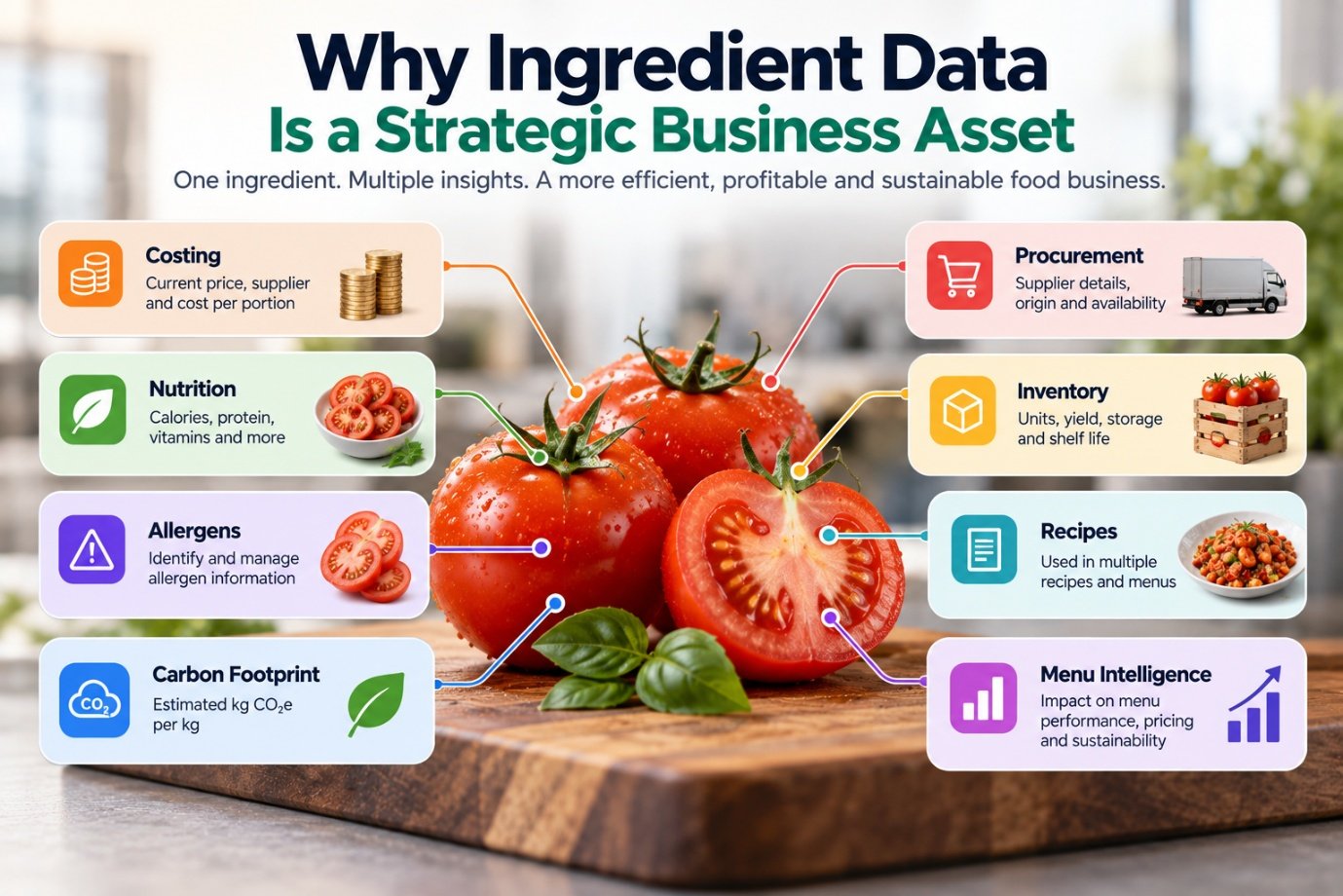
When most businesses think about ingredients, they think about products that need to be purchased, stored and used.
For a restaurant, hotel or food business, an ingredient might simply appear as:
Tomato — 500 g
But that ingredient can represent much more information — the same shift in thinking we explore in Why Restaurants Need More Than a Digital Recipe Book. It can have:
Once you look at it this way, an ingredient is no longer just something in a kitchen.
It is a data asset.
And the quality of that data can directly affect costing, nutrition analysis, allergen management, sustainability reporting, procurement and increasingly, AI-powered decision-making.
An Ingredient Is More Than a Name
Consider two entries in a database: Chicken and Chicken Breast Boneless, Chilled. At first glance, they may seem similar. But from a business-data perspective, they can represent very different products. They may have different:
If both are treated simply as "chicken", important information can be lost. This is why ingredient data needs structure.
The Ingredient Is the Building Block of the Recipe
A recipe is essentially a collection of ingredients combined in specific quantities and processes — the same foundational idea behind What Happens When Recipes Become Data?. For example:
- Ingredient A100 g
- Ingredient B50 g
- Ingredient C20 g
- Ingredient D5 g
If the underlying ingredient data is accurate, the recipe can inherit useful information from it. That can include:
The recipe therefore becomes a calculated business object rather than simply a cooking instruction. This is one of the reasons ingredient data is so important.
Poor ingredient data creates poor recipe data.
Costing Starts With Ingredient Data
Food costing is one of the most obvious examples. Suppose a recipe uses 200 g chicken. If the system knows the current cost of the ingredient, it can calculate its contribution to the recipe cost. But what happens when the supplier changes the price? If the ingredient is maintained centrally, the change can potentially flow into recipes using that ingredient. Now the business can identify:
- Which recipes have become more expensive
- How much the recipe cost has changed
- Which ingredients are driving the change
- Which menu items may be affected
The ingredient database becomes part of the financial intelligence of the kitchen.
Nutrition Depends on Ingredient Accuracy
The same principle applies to nutritional analysis, as we explore in Nutrition Analysis Is Only Valuable When It Becomes Actionable Data. If an ingredient is associated with nutritional information such as:
then those values can contribute to the nutritional profile of the recipe.
Change the ingredient. Change the quantity. Change the recipe. And the nutritional calculation can change.
This makes the ingredient database the foundation of recipe-level nutrition analysis.
Allergen Information Can Flow Through the Data
Ingredient data can also contain allergen information. For example, an ingredient may be associated with:
When that ingredient is used in a recipe, the relevant allergen information can be associated with the recipe. This becomes especially valuable when recipes contain sub-recipes. For example:
Without structured relationships, tracing that information manually can become difficult. With structured ingredient data, the relationship can be maintained systematically.
Carbon Footprint Starts With the Ingredient
Carbon footprint analysis provides another strong example, as we explore in Why Food Carbon Accounting Starts With the Recipe. A recipe's estimated carbon footprint is ultimately influenced by the ingredients it contains and the emissions factors assigned to them. For example:
Those contributions can then be aggregated to estimate the recipe's footprint — the same connected approach we describe in From Spreadsheets to Carbon Intelligence. This means carbon analysis is not simply a recipe-level calculation. It depends heavily on the quality of the underlying ingredient emissions data. If the ingredient mapping is wrong, the carbon result can also be wrong.
Ingredient Data Has Geography
Not every ingredient should be treated as if it has exactly the same environmental or commercial characteristics everywhere. An ingredient may be:
The underlying data may therefore need geographic context. For carbon analysis, this can be particularly important because agricultural practices, energy systems, processing and transportation can vary between regions. For procurement, geography can affect:
Geography is therefore another dimension of ingredient intelligence.
Ingredient Data Has a Source
A business should ideally be able to answer: Where did this information come from? For nutritional information, that could be a recognised food composition database or supplier specification. For carbon information, it could be an emissions-factor database, LCA study or supplier-specific information. For product information, it could be the manufacturer or supplier. The important point is that the value should not simply exist as an unexplained number. A robust data model can retain:
This makes the data easier to review and update.
The Problem With Ingredient Names
One of the biggest challenges in food data is naming. Consider:
Are these the same ingredient? Sometimes they may be. Sometimes they are not. The same issue can occur with:
A database that relies only on free-text ingredient names can quickly become inconsistent.
Standardisation becomes essential.
Units Matter Too
Ingredient data also needs consistent units. For example:
may represent the same quantity. But a poorly designed system can interpret these differently. Recipes can also contain:
The system needs appropriate conversion logic. This is particularly important when recipe data is being used for costing, nutrition or carbon calculations.
Yield Changes the Equation
The ingredient quantity entering a recipe is not always the same as the amount that reaches the plate. Consider an ingredient that is:
Yield can change significantly. For example:
- Raw Ingredient1 kg
- Usable Ingredient750 g
The recipe system therefore needs to distinguish between purchasing quantities, preparation quantities and usable quantities where relevant. This affects both costing and nutritional calculations. It can also affect carbon calculations depending on the methodology and system boundary being applied.
Ingredient Data Connects Procurement With Operations
A recipe system may know that a restaurant uses 500 g of Ingredient X per batch. The procurement system may know Ingredient X is purchased in 5 kg packs. The supplier system may know Supplier Y currently provides Ingredient X. These are not three separate pieces of information. They are three views of the same underlying business object — Ingredient X.
This is where structured data becomes powerful, connected through the same integration layer we describe in APIs: The Missing Link Between Your Business Applications. The same ingredient can connect:
Ingredient Data Can Help Reduce Duplication
Large food businesses often have duplicate or near-duplicate ingredients. For example:
If these represent the same product but exist as separate database records, the business may lose visibility. This can affect:
Data cleaning can therefore create value without changing a single recipe.
Sometimes the problem isn't that the business lacks data. It is that the data isn't organised properly.
One Ingredient Can Affect Hundreds of Recipes
Imagine a restaurant group has 800 recipes. One ingredient appears in 150 of them. If the ingredient's cost changes significantly, the potential impact extends across those recipes. If its nutritional data is updated, the same may be true. If its carbon factor changes, those recipes may also require recalculation. This is why ingredient data has a different level of importance from a simple recipe record.
An ingredient can be a shared dependency across the entire food operation.
This Is Where Automation Becomes Valuable
Once ingredient relationships are structured, many tasks can be automated. For example:
Instead of manually checking hundreds of recipes, the system can identify the impact of the change. This is a fundamental principle of good business software:
Change information once and propagate it where appropriate.
Ingredient Data Is Also an AI Foundation
AI is becoming increasingly useful in food and hospitality technology, as we explore in How AI Can Change Recipe and Menu Management. But AI needs reliable information. Consider asking:
- Which recipes could reduce their carbon footprint by replacing a high-impact ingredient?
- Which recipes have the highest food cost?
- Which menu items contain dairy?
For AI to answer meaningfully, it needs access to recipes, ingredients, quantities, carbon data and substitution possibilities — or reliable recipe and ingredient cost data, or structured allergen information, depending on the question. The AI may provide the intelligence. But the ingredient database provides the facts.
AI Doesn't Fix Bad Ingredient Data
This is an important distinction. Businesses sometimes assume that AI can solve their data problems. It can't. If a database contains Chicken — ₹450/kg when the actual product costs ₹650/kg, an AI system cannot magically make the underlying business information correct. Likewise, if two different ingredients have been incorrectly merged, AI may produce a sophisticated answer using the wrong data. This is why the progression should be:
Not the other way around.
Ingredient Data Can Become a Business Master Data Layer
For larger businesses, ingredient information can become part of a broader master data management strategy. A central ingredient record can contain:
- IdentityWhat exactly is this ingredient?
- Commercial InformationWho supplies it and what does it cost?
- Operational InformationHow is it purchased, stored and prepared?
- Nutritional InformationWhat nutritional values does it contain?
- Allergen InformationWhat allergens are associated with it?
- Environmental InformationWhat is its estimated carbon footprint?
- Reference InformationWhere did the data come from?
This creates a much richer information model than a simple ingredient list.
The Value Increases as the Business Grows
For a small restaurant with 50 recipes, manually maintaining ingredient information may be manageable — the same tipping point we explore in When Your Business Has Outgrown Excel. For a hotel group with:
the challenge becomes very different. The larger the operation becomes, the more valuable standardised ingredient data can become — and, connected to menu planning, the same foundation behind Building More Sustainable Menus With Better Data. This is because the same data can be reused across multiple processes.
One ingredient record can support many business functions.
The Future Is Connected Ingredient Intelligence
The future of food technology is unlikely to be a collection of isolated databases. Instead, the systems will increasingly connect. Imagine:
Now the business can ask much more meaningful questions. Not simply "What is this ingredient?" but:
- Where do we use it?
- What does it cost us?
- What is its nutritional contribution?
- Which allergens does it introduce?
- What is its estimated carbon impact?
- Which suppliers provide it?
- What happens if the price changes?
- Which recipes would be affected?
That is ingredient intelligence.
The TRUIX Perspective
At TRUIX, we believe ingredient data deserves to be treated as more than a static list inside a recipe application. It can become a foundational business data layer. When ingredient information is structured properly, it can support:
The real value doesn't come from having thousands of ingredient records. It comes from being able to connect those records to the rest of the business. Because the future of food technology isn't simply about digitising recipes. It is about turning the information behind those recipes into a strategic business asset.
But the ingredient data is what makes the system intelligent.
Related Reading
- Why Good Sustainability Reporting Starts With Good Data
- How Technology Can Automate Carbon Accounting
- Why Your Business Data Is More Valuable Than You Think
- What Happens When Recipes Become Data?
- Why Restaurants Need More Than a Digital Recipe Book
- How AI Can Change Recipe and Menu Management
- From Spreadsheets to Carbon Intelligence
- Nutrition Analysis Is Only Valuable When It Becomes Actionable Data
- Why Food Carbon Accounting Starts With the Recipe
- Building More Sustainable Menus With Better Data
- APIs: The Missing Link Between Your Business Applications
- When Your Business Has Outgrown Excel
- Recipe Analytics