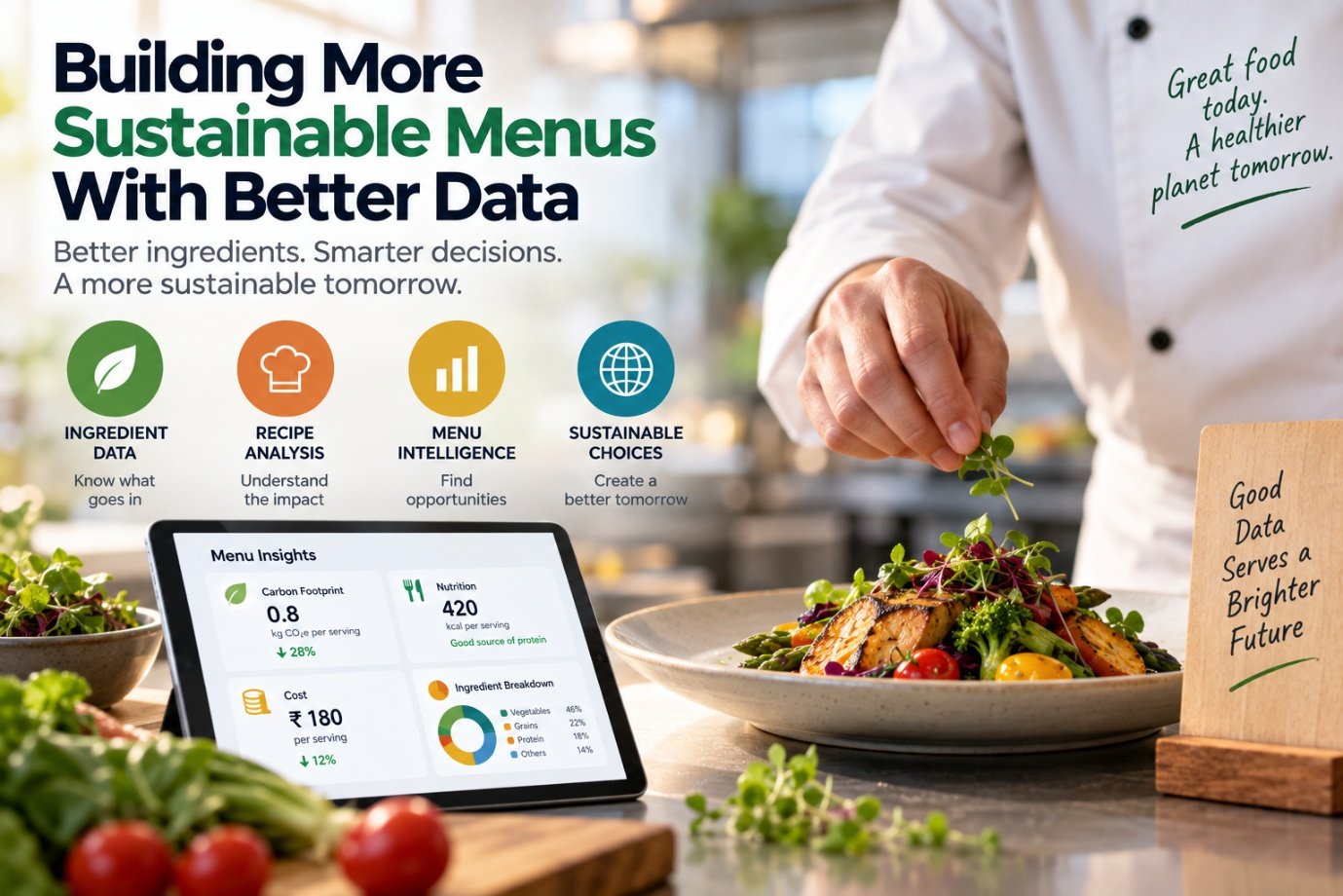
When people talk about sustainable menus, the conversation often starts with ingredients.
These can all be relevant. But there is a bigger question:
How do you know whether a menu is actually becoming more sustainable?
The answer begins with data. A menu is not just a collection of dishes. Behind every menu item are ingredients, quantities, suppliers, recipes, portions, preparation methods, costs and operational decisions.
When that information is structured properly, it becomes possible to understand a menu from several different perspectives — including its environmental impact, the question we explored in How Hotels Can Use Menu Data to Understand Environmental Impact. And that changes sustainability from a general aspiration into something that can be measured, analysed and improved.
Sustainability Starts With the Recipe
Consider a simple menu item: Grilled Chicken with Vegetables. On a menu, it is just one dish. Inside the kitchen, however, it may contain:
Each ingredient has a quantity. The recipe has a yield. The dish has a portion size. Some components may themselves be sub-recipes. Once this information is structured, the recipe can become a data object rather than simply a kitchen instruction — the same shift described in What Happens When Recipes Become Data? and rooted in why food carbon accounting starts with the recipe.
That same recipe data can then support:
- Recipe → NutritionCalculate nutritional information
- Recipe → Allergen AnalysisIdentify relevant allergens
- Recipe → CostingCalculate ingredient and recipe cost
- Recipe → Carbon AnalysisEstimate environmental impact
- Recipe → Menu IntelligencePublish structured menu information
The sustainability conversation therefore begins much earlier than the final menu. It begins with the data behind the recipe.
Better Data Creates Better Questions
A sustainability programme becomes much more useful when it can answer specific questions. Instead of asking "Is our menu sustainable?" a hotel or restaurant can ask:
- Which ingredients contribute most to estimated emissions?
- Which recipes have the highest environmental impact?
- Which dishes are most frequently sold?
- Which high-impact ingredients appear across many recipes?
- Which recipes have the greatest potential for reformulation?
- How does changing an ingredient affect the overall recipe?
- What happens to nutrition and cost when a recipe changes?
- Which menu categories have the greatest environmental impact?
These are much more actionable questions. And they require structured information.
One Menu Can Have Many Data Layers
A modern menu can potentially be analysed across several dimensions.
Financial
Nutritional
Allergen
Environmental
Operational
The power comes from connecting these layers. A chef may want to know whether a recipe works from a culinary perspective. A purchasing team may care about ingredient availability and cost. A nutrition team may care about nutrient composition — the same actionable-data principle behind Nutrition Analysis Is Only Valuable When It Becomes Actionable Data. A sustainability team may care about environmental impact. Management may care about profitability. They can all be looking at the same recipe data.
Sustainability Should Not Become Another Spreadsheet
One of the common problems with sustainability programmes is that environmental information ends up in a separate spreadsheet. The kitchen has its recipe database. Finance has its costing system. Procurement has supplier data. Nutrition information may exist somewhere else. And sustainability has another spreadsheet containing emissions factors and calculations.
This creates the same problem businesses experience when their other systems are disconnected. People become the integration layer. Data gets copied. Information becomes outdated. Changes don't flow through automatically. Reports are recreated repeatedly. A more effective approach is to connect sustainability information to the underlying operational data.
Ingredient Changes Have Multiple Consequences
Imagine a recipe currently uses one ingredient. The chef decides to replace it with another. That change may affect:
- CostThe replacement ingredient may have a different price
- NutritionIts nutrient composition may be different
- AllergensThe allergen profile may change
- CarbonThe environmental impact may change
- ProcurementThe supplier and availability may change
- Menu InformationThe published information may need updating
This is why recipe data should not be treated as an isolated culinary record. A recipe change can create a chain of downstream effects. With a connected data model, those effects can potentially be identified much more efficiently.
Carbon Data Needs Context
A carbon number by itself can be misleading. Suppose an ingredient is assigned an emissions factor of:
2.5 kg CO₂e/kg
That number needs context. Which geography? Which production system? Which dataset? Which year? Which system boundary? Does it include processing? Does it include transport? How was the value calculated? Was it measured directly or used as a proxy?
Without this information, the number can appear more precise than it actually is. Good sustainability data therefore needs provenance — the same discipline described in Understanding the Carbon Footprint of a Recipe. The business should know where the number came from and what assumptions sit behind it.
Local Data Is Valuable — but Not Always Available
Ideally, emissions factors would reflect the actual ingredients being purchased by the business. But this isn't always possible. A hotel may know the supplier but not have a supplier-specific emissions factor. An ingredient may be imported. A local dataset may not exist. A particular production method may not have a directly applicable value.
In those situations, organisations may need to use regional or broader datasets as proxies — the same challenge addressed in Better Carbon Data Starts With Better Emissions Factors. The important thing is to document the methodology. A transparent proxy can be more useful than an unexplained number presented with excessive precision.
Portion Size Matters
Sustainability data should also consider the actual serving. An ingredient may have a relatively high impact per kilogram, but the quantity used in a particular dish may be small. Another ingredient may have a lower impact per kilogram but be used in a much larger quantity. This is why menu analysis can look at:
These are different measurements answering different questions. For menu decisions, the serving-level perspective can often be particularly useful.
Recipe Yield Matters Too
The amount of raw ingredients going into a recipe isn't necessarily equal to the amount served. Cooking can change weight. Ingredients may lose moisture. Some components may be discarded. Recipes may produce a batch that is divided into multiple portions. Sub-recipes can further complicate the calculation. For example, 1 kg of raw ingredient may produce a different final quantity after preparation. Therefore, recipe yield and portion information are important components of reliable menu analysis.
Sustainable Menu Design Isn't About One Number
There is a temptation to create a single "sustainability score" and use it to classify dishes. Scores can be useful communication tools. But they should not replace the underlying information. A dish may have:
There is rarely a single number that captures everything that matters. The better approach is to provide decision-makers with multiple connected dimensions of information. Then the business can decide what matters for its particular context.
Menu Engineering Can Become More Sophisticated
Traditional menu engineering often focuses on two major questions: How popular is the dish? and How profitable is the dish? But structured food data can allow additional dimensions:
Now the menu becomes much more than a sales document. It becomes a business-information system.
A hotel might discover that one dish is extremely popular and profitable but has a relatively high estimated environmental impact. Another may have lower environmental impact but lower popularity. A third may have strong margins and nutritional characteristics but depend on an ingredient with inconsistent availability. These insights don't automatically determine what the menu should contain. They provide better information for the people making those decisions.
Don't Forget Food Waste
A menu can have relatively low estimated carbon intensity and still generate significant waste. This is why sustainability cannot stop at the recipe. Consider a buffet. If a dish has a low environmental impact per serving but is consistently overproduced, the environmental impact of the unused food still matters. This creates another important connection:
Once these systems are connected, businesses can begin asking much more useful questions:
- Which dishes are consistently overproduced?
- Which ingredients are frequently discarded?
- Which buffet items have high preparation volumes but low consumption?
- Which recipes generate avoidable waste?
The answers can influence forecasting, purchasing, production and menu planning.
Sustainable Menus Need Operational Data
A recipe alone doesn't tell the entire story. A sustainable menu strategy may eventually need information from:
This is where technology becomes important. The goal isn't necessarily to build one enormous system containing everything. The goal is to ensure the relevant systems can communicate and share the information required for decision-making.
APIs Can Connect the Pieces
This connects directly to the previous TRUIX blog about APIs: The Missing Link Between Your Business Applications. Imagine:
The systems don't necessarily need to be one application. They can be connected through APIs and other integration methods. This allows businesses to build a technology ecosystem rather than replacing every existing system.
Where AI Fits In
Once the underlying data is structured, AI can add another layer. AI could potentially help identify:
If ingredient names are inconsistent, quantities are missing, emissions factors are poorly sourced and recipes are stored in disconnected spreadsheets, adding AI does not automatically solve the problem. It may simply make the existing data easier to process. Good AI therefore starts with good data architecture.
Building a Sustainable Menu Data Model
A practical menu-data model could connect:
Each layer can contain additional information. For example, an ingredient could contain — echoing the strategic-asset framing in Why Ingredient Data Is a Strategic Business Asset:
The recipe can then inherit or calculate relevant information from the ingredient layer. This creates a much stronger foundation for menu intelligence.
From Measuring to Improving
There is an important difference between measurement and management. Measurement tells you "This recipe has an estimated footprint of X." Management asks "What can we learn from that information?" And improvement asks "What happens if we change something?"
For example:
- What if we change the ingredient?
- What if we change the portion?
- What if we change the recipe?
- What if we reduce waste?
- What if we change the preparation method?
- What if we source differently?
- What if we redesign the menu?
These questions turn environmental data into a decision-support tool.
Sustainable Doesn't Mean Simply "Plant-Based"
Plant-forward menus can be an important part of sustainability strategies, but sustainable menu design is more nuanced than simply categorising dishes as plant-based or non-plant-based. Other factors can matter too:
The data should therefore help the organisation understand its own menu rather than applying a simplistic rule to every dish.
The Human Decision Still Matters
Technology can calculate. Technology can compare. Technology can identify patterns. Technology can highlight opportunities. But chefs, nutrition professionals, procurement teams, sustainability teams and business leaders still make the decisions.
This is particularly important in hospitality. A menu is part of a guest experience. Taste, culture, availability, price, nutrition, presentation and operational feasibility all matter. Technology should provide better information — not remove the human judgement that makes hospitality what it is.
The Bigger Opportunity
The long-term opportunity isn't simply to calculate the carbon footprint of individual dishes. It is to create a connected food intelligence platform — one where the same underlying information supports:
This creates an important shift. Instead of asking "How do we calculate sustainability?" the business can ask "How do we use our food data to make better decisions?" That is a much more powerful question.
The TRUIX Perspective
At TRUIX, we believe sustainable menu development starts with something surprisingly fundamental: good data. Before a business can optimise a menu, it needs to understand what is actually in that menu. That means structured ingredients, reliable recipes, accurate quantities, consistent units, defined portions, documented emissions factors, transparent assumptions, and connected systems.
Once those foundations exist, sustainability analysis becomes part of a broader food-data ecosystem. The objective isn't to create another report that sits in a folder. It is to make environmental information available where decisions are actually made — in the kitchen, in procurement, in menu planning, in operations, and at management level.
Because the future of sustainable food isn't just about changing ingredients. It is about using better information to understand the consequences of those choices.
And better decisions can help build more sustainable menus.
Related Reading
- Why Good Sustainability Reporting Starts With Good Data
- How Technology Can Automate Carbon Accounting
- Why Ingredient Data Is a Strategic Business Asset
- From Spreadsheets to Carbon Intelligence
- Why Restaurants Need More Than a Digital Recipe Book
- Why Ingredient Data Is a Strategic Business Asset
- How Hotels Can Use Menu Data to Understand Environmental Impact
- Why Food Carbon Accounting Starts With the Recipe
- Understanding the Carbon Footprint of a Recipe
- Better Carbon Data Starts With Better Emissions Factors
- What Happens When Recipes Become Data?
- Nutrition Analysis Is Only Valuable When It Becomes Actionable Data
- APIs: The Missing Link Between Your Business Applications
- Carbon Footprint Analysis