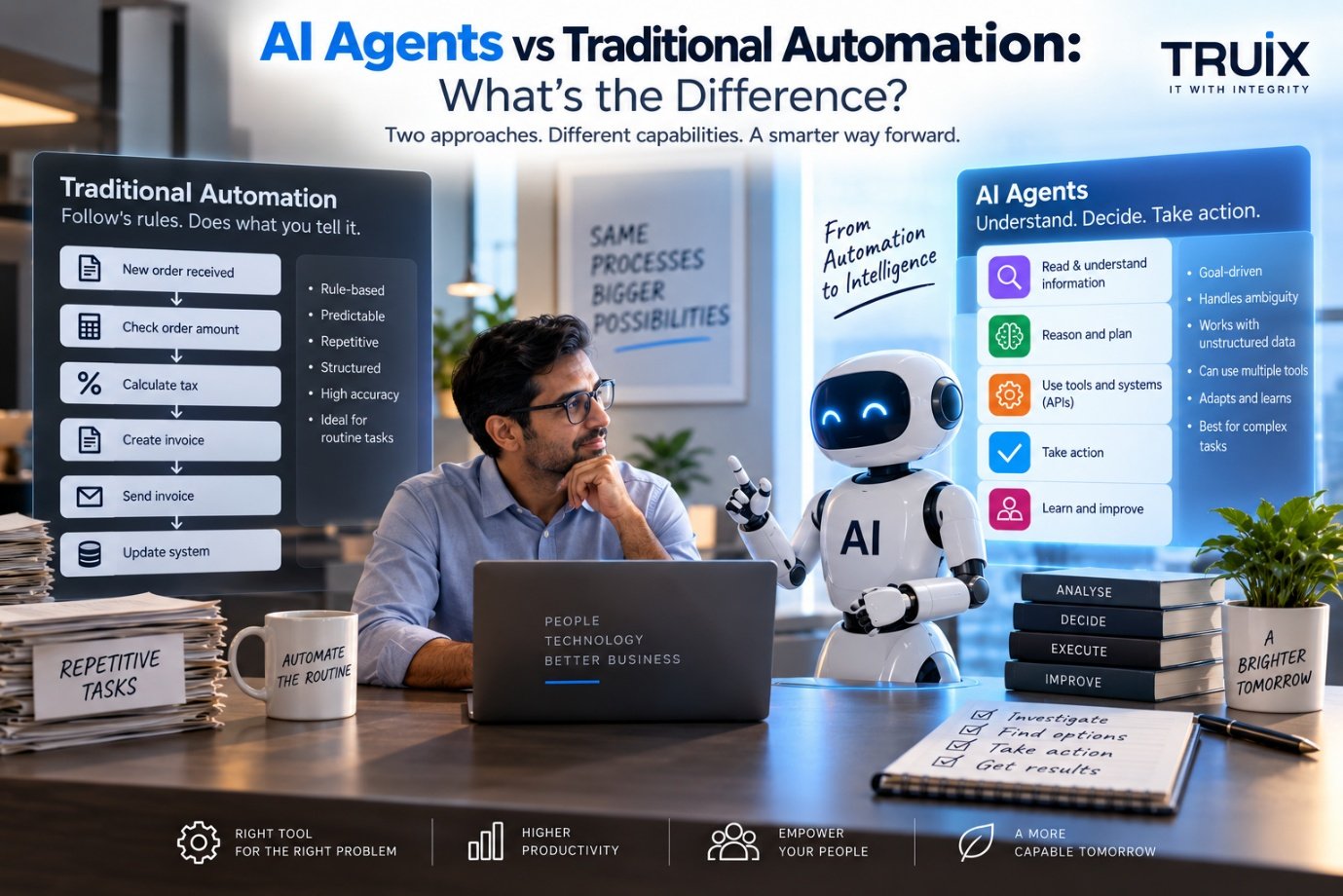
Artificial intelligence is changing the way businesses think about automation.
For years, businesses have automated repetitive processes using predefined rules:
If this happens → do that.
Today, AI introduces another possibility:
Understand what is happening → decide what should happen next → take action.
This is where the idea of AI agents comes into the conversation. But AI agents are not simply a more advanced version of traditional automation. They solve different types of problems.
Understanding the difference can help businesses decide where traditional automation makes sense, where AI can add value, and where a combination of both is the better approach.
What Is Traditional Automation?
Traditional automation follows predefined instructions. A business process is mapped out, rules are established, and software executes those rules consistently. For example:
Every step is defined. If the conditions are known, traditional automation can be extremely effective. It is particularly useful for processes that are:
Traditional automation does not need to "understand" the business problem. It simply needs to execute the instructions correctly.
What Is an AI Agent?
An AI agent introduces a different layer. Instead of following only a fixed sequence of instructions, an AI agent can interpret information, reason about a task, select appropriate actions and use available tools to complete a goal.
For example, imagine a sales team receives an email from a potential customer. A traditional automation might:
An AI-enabled system could potentially:
The important difference is not simply that AI is involved. The difference is that the system can work with information that may not follow a perfectly predictable structure.
Rules vs Goals
One of the simplest ways to understand the difference is this:
- "If X happens, do Y."Traditional Automation — Instruction-Driven
- "Achieve X within these rules and constraints."AI Agents — Goal-Driven
The agent may determine which steps are necessary to reach the goal. That does not mean an AI agent should be given unlimited freedom. In business environments, agents should operate within defined permissions, tools, policies and human oversight.
A Simple Example
Consider a business that receives supplier invoices.
Traditional automation. The workflow might be:
This works well when the invoice structure and business rules are predictable.
AI-assisted workflow. Now imagine invoices arriving in different formats, emails containing additional instructions, unusual descriptions, missing information and exceptions. An AI system could potentially:
The AI is not necessarily replacing the automation. It is helping the automation deal with variation and ambiguity.
AI Agents Do Not Replace Automation
This is an important distinction. The future is unlikely to be:
Traditional automation OR AI agents.
For many businesses, it will be:
Traditional automation + AI + APIs + business systems.
Each has a role. Traditional automation is excellent at predictable execution. AI is useful when information requires interpretation. APIs allow systems to communicate — the same connective role we describe in APIs: The Missing Link Between Your Business Applications. Databases provide structured information. Business applications provide the operating environment. AI agents can potentially coordinate these components to accomplish more complex tasks.
Where Traditional Automation Works Better
Not every process needs AI. In fact, adding AI to a simple deterministic process can introduce unnecessary complexity. Consider:
Every Friday at 6 PM → generate sales report → email management.
There is little reason for an AI agent to decide whether Friday is Friday. A simple scheduled workflow can do this reliably. Other examples include:
When the process is predictable, traditional automation may be the appropriate tool.
Where AI Can Add Value
AI becomes more interesting when the process involves interpretation. Examples include:
The important question is not:
"Can AI do this?"
"Does this process contain enough complexity or variability for AI to provide meaningful value?"
AI Agents Need Tools
An AI agent without access to business systems is limited. Imagine telling an AI agent, "Find out which customers have overdue invoices." If the agent cannot access the accounting system, it cannot complete the task. This is why AI agents increasingly need access to tools such as:
The agent provides reasoning and coordination. The tools provide access to the actual business environment.
APIs Become Even More Important
This is where AI connects directly with another important technology concept: APIs. An API allows one system to communicate with another through a defined interface. For traditional automation, APIs can connect systems together. For AI agents, APIs can become the mechanism through which an agent interacts with those systems. For example:
The agent becomes an orchestration layer between different business systems. But those connections must be properly secured and controlled.
AI Agents Need Boundaries
Giving an AI system access to business tools creates new responsibilities. An agent should not automatically have unrestricted access to everything. Businesses need to consider:
- What can the agent read?
- What can it change?
- What can it create?
- What can it delete?
- Which systems can it access?
- Which actions require human approval?
- What information can it share?
- How are actions logged?
- What happens when the agent is uncertain?
For example, an AI agent might be allowed to prepare an invoice but not approve the payment. It might be allowed to draft an email but require a person to send it. It might be allowed to identify a suspicious transaction but not automatically block an account. This creates an important principle:
AI autonomy should match business risk.
Human-in-the-Loop Still Matters
AI agents should not automatically replace human judgement in every process. Some decisions have financial, legal, operational or reputational consequences. A useful architecture may therefore look like:
The level of human involvement can vary depending on the risk of the action. Low-risk actions may be automated. Higher-risk actions may require explicit approval.
AI Agents and Traditional Automation Can Work Together
Consider a hotel receiving hundreds of guest emails. A possible architecture could be:
This combines the strengths of both approaches. AI handles the ambiguity. Automation handles predictable execution.
Another Example: Recipe Intelligence
Food businesses provide an interesting example. A traditional recipe management system may contain:
Once the recipe data is structured — the same transformation we describe in What Happens When Recipes Become Data? — traditional software can calculate:
These are largely structured calculations. AI can add another layer. For example, an AI system could potentially help a chef:
The key is that AI becomes more useful because the underlying recipe data already exists.
Good data creates the foundation for useful AI.
AI Agents Need Good Data
There is a common misconception that AI can solve poor data quality. It cannot. If customer records are duplicated, ingredient names are inconsistent — the same inconsistency problem we cover in Why Ingredient Data Is a Strategic Business Asset — product information is incomplete and business systems contain conflicting information, an AI agent may simply make decisions based on unreliable information.
That makes data quality even more important. The technology stack might look like:
AI sits on top of the underlying information architecture. It does not eliminate the need for that architecture.
Security Becomes More Important
AI agents can potentially interact with multiple systems, which means their permissions and connections need careful management. This makes security principles such as least privilege, segmentation, authentication, logging and access control increasingly important — the same architecture we cover in Network Security Starts With Infrastructure.
Network segmentation, for example, can restrict communication between different parts of an environment and limit lateral movement after a compromise. CISA describes segmentation as a way to isolate networks and control communication between segments. The same principle applies to AI-enabled environments:
An agent should have access to what it needs — not everything that exists.
Don't Start by Building an AI Agent
One of the biggest mistakes businesses can make is starting with the technology. The conversation becomes, "We need an AI agent." But the more useful question is:
"What business process are we trying to improve?"
Start by identifying — a discipline we return to often, including in Why Businesses Should Stop Buying Software and Start Building Systems:
- What is the current process?
- Where is time being wasted?
- Where are employees interpreting information manually?
- Where are systems disconnected?
- Where do repetitive decisions occur?
- Where are errors happening?
- What information does the process require?
- What actions should the system be allowed to take?
Only then should you decide whether the solution needs:
A Simple Decision Framework
The Future Is Not AI Everywhere
The goal of digital transformation should not be to put AI into every process. Some processes should remain simple. Some should be automated. Some should be integrated. Some may benefit from AI. And some may eventually benefit from AI agents. The most effective technology architecture will use the right tool for the right problem.
- Database + API + AutomationFor One Workflow
- Database + API + Automation + AI Agent + Human ApprovalFor Another
From Automation to Intelligence
The evolution can be thought of as a progression:
The goal is not necessarily to reach the final stage. The goal is to remove unnecessary work, improve accuracy, increase visibility and help people make better decisions — the same reasoning behind moving off spreadsheet-based tracking that we cover in When Your Business Has Outgrown Excel, and the same caution against treating any single tool as transformation itself that we raise in Digital Transformation Isn't About Buying More Software.
Sometimes traditional automation is the best answer. Sometimes AI is the right answer. Sometimes the best solution is a combination of both.
The TRUIX Perspective
At TRUIX, we see AI as another layer of business technology rather than a replacement for everything that came before it. A strong technology environment can bring together:
The important part is how those components work together. Before implementing an AI agent, businesses should understand their processes, organise their data, connect their systems and establish appropriate security and permissions. Then AI can be introduced where it actually creates value.
Because the objective isn't to make a business more AI-powered. The objective is to make the business more capable.
Connect everything. Keep people in control.
Related Reading
- Why Businesses Don't Need More Software — They Need Better Systems
- Why Your Business Data Is More Valuable Than You Think
- How AI Can Change Recipe and Menu Management
- The AI Journey: What Businesses Should Automate First
- APIs: The Missing Link Between Your Business Applications
- Why Businesses Should Stop Buying Software and Start Building Systems
- Digital Transformation Isn't About Buying More Software
- When Your Business Has Outgrown Excel
- What Happens When Recipes Become Data?
- Why Ingredient Data Is a Strategic Business Asset
- Network Security Starts With Infrastructure
- Software Solutions