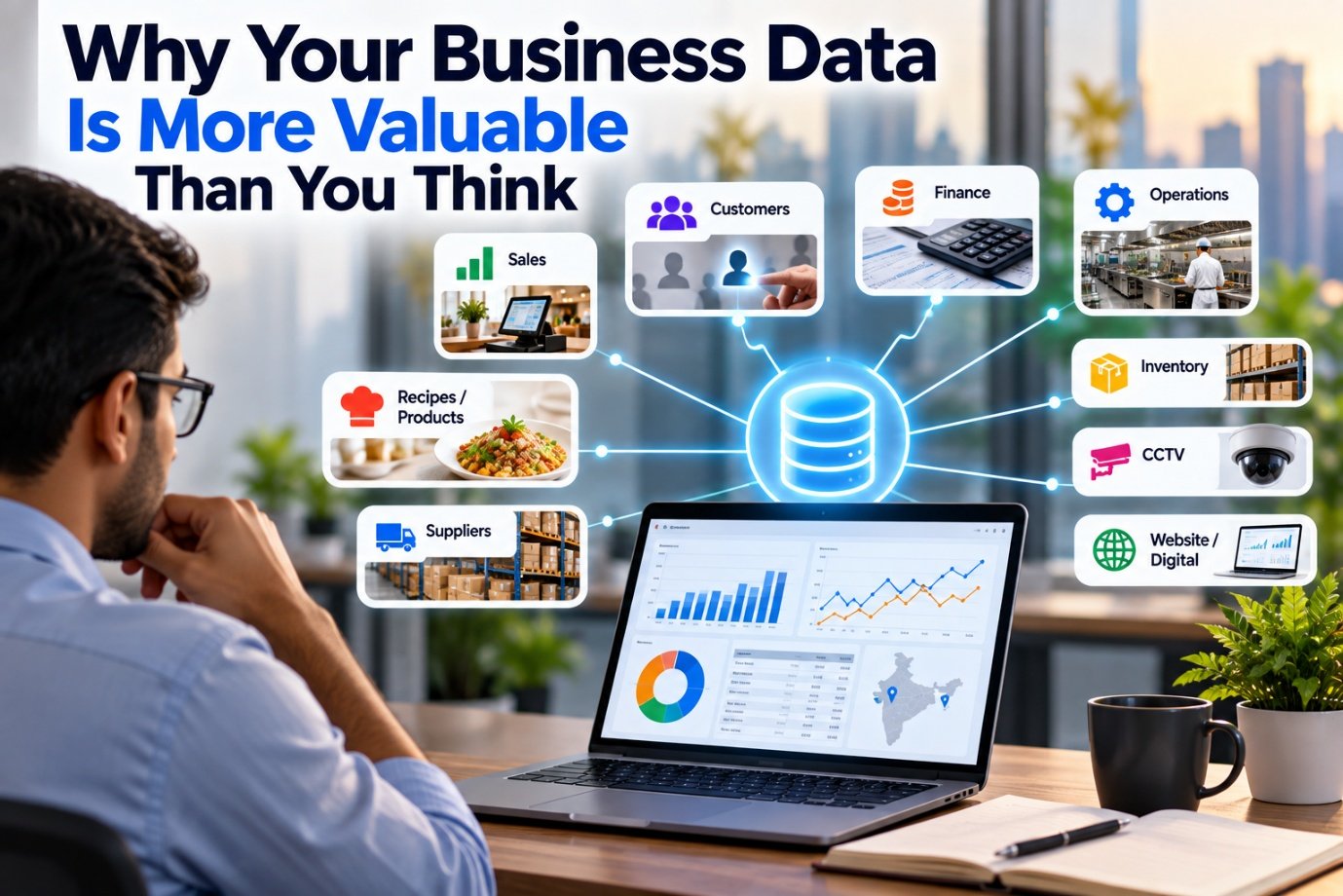
Most businesses generate enormous amounts of data every day.
Yet there is a strange contradiction.
Businesses have more data than ever, but many still struggle to use it effectively.
The problem is usually not a lack of data. The problem is that the data is scattered, inconsistent, difficult to access, stored in disconnected systems, or simply not structured in a way that allows the business to do anything useful with it.
That is why business data should not be viewed merely as information that a company stores.
Good business data is an asset.
And when properly structured, it can become the foundation for better decisions, automation, artificial intelligence, operational efficiency and competitive advantage.
Data Is More Than a Record of What Happened
Traditionally, businesses have treated data as a record-keeping requirement. A customer database stores customers. An accounting system stores transactions. An ERP stores inventory. A CRM stores leads. A recipe management system stores recipes. A CCTV system stores video. The assumption is that the primary purpose of the data is to retrieve it when someone needs it.
That view is increasingly outdated. Data can tell a business not only what happened, but also:
IBM describes data strategy as a framework for turning data assets into business value, including better decision-making, productivity, cost reduction, innovation and AI initiatives. The important word here is value.
Simply possessing data does not create value.
Using it does.
The Problem With Data Silos
Consider a typical business:
Each system may work perfectly well on its own. The problem appears when the business asks a question that crosses multiple systems. For example: which products are profitable, selling well, generating the least waste and producing the highest customer satisfaction?
Answering that question may require information from sales, purchasing, inventory, production, finance and customer feedback. If those systems do not communicate with each other, someone eventually ends up exporting spreadsheets, copying information, reconciling numbers and manually preparing a report. The business technically has the data. But it does not really have access to the intelligence contained within the data.
Data Becomes More Valuable When It Is Connected
One of the biggest opportunities for modern businesses is connecting data that previously existed independently. Imagine a hotel restaurant. A recipe contains:
That recipe can then connect to a much wider chain, as we explore in What Happens When Recipes Become Data?:
Suddenly, the recipe is no longer just a document used by a chef. It becomes a business data object. A change in an ingredient can potentially affect purchasing cost, recipe cost, nutritional information, allergen information and carbon footprint—the same strategic weight we describe in Why Ingredient Data Is a Strategic Business Asset. This is where structured data becomes significantly more powerful than documents or spreadsheets.
The same principle applies outside hospitality. A customer record can connect to sales, support, marketing and billing. An asset record can connect to maintenance, downtime, service history and replacement planning. A CCTV camera can connect to location, network infrastructure, storage, access permissions and video analytics.
The value is often not in the individual data point. It is in the relationships between data points.
Not All Data Is Valuable
It is tempting to assume that collecting more data automatically makes a company more data-driven. It doesn't. A company can have terabytes of information and still make decisions based on incomplete spreadsheets.
Data quality matters. According to IBM, useful data should be accurate, complete, consistent and fit for its intended purpose. Poor-quality data can create negative business outcomes and undermine decision-making. Consider a simple example. A business has three records for the same supplier:
A human may immediately recognise that they are the same supplier. A software system may treat them as three different entities. Now imagine the same problem occurring with:
The company technically has the data. But the data is not necessarily usable data.
The Four Questions Every Business Should Ask About Its Data
Before investing in another dashboard or AI tool, businesses should ask four simple questions.
If the underlying information is wrong, the output will also be wrong. A sophisticated dashboard cannot fix incorrect source data. Neither can AI.
Are units, names, categories, definitions and formats standardised? Is "Mumbai", "Bombay" and "Mumbai City" the same location? Consistency is essential when systems need to communicate.
Data locked inside disconnected systems has limited operational value. Businesses should be able to access appropriate data when they need it—through applications, dashboards, reports or APIs.
This is the most important question. Can the data support decision-making, automation, forecasting, reporting, AI, customer experiences, cost reduction and process improvement?
If not, the business may simply be collecting information rather than creating value from it.
Data Is Becoming the Foundation for AI
The discussion around AI often focuses on models. Which AI platform should we use? Which model is the most powerful? Should we build an AI agent? Should we use generative AI? But an equally important question is:
What information will the AI actually work with?
AI systems need relevant, accessible and reliable business context to produce useful results. IBM similarly highlights data quality and governance as critical foundations for enterprise AI—the same sequencing we lay out in The AI Journey: What Businesses Should Automate First.
Imagine asking an AI assistant: "Which of our restaurants has the highest food-cost problem?" If the AI cannot access reliable sales, recipe costing, purchasing and inventory data, it cannot provide a meaningful answer. Now imagine the underlying systems are connected. The AI could potentially analyse:
The AI is no longer simply generating text. It is working with the company's operational knowledge. That is a much more valuable application of AI.
Your Historical Data Can Become Business Intelligence
Another underused asset is historical data. Businesses often have years of information sitting in databases and spreadsheets:
The historical record can reveal patterns that are difficult to see when information is examined one transaction at a time. A retailer may discover seasonal demand patterns. A hotel may identify menu items that consistently generate high waste. A manufacturer may identify equipment conditions associated with downtime. A restaurant group may discover that the same recipe performs differently across locations. A service company may identify which types of support requests consume the most time.
The data has been sitting there. The opportunity comes from turning it into insight.
Data Can Become Automation
One of the biggest steps beyond reporting is using data to trigger actions, a shift we examine more closely in AI Agents vs Traditional Automation: What's the Difference?. Consider a simple workflow:
Or:
Or:
The common factor is structured data. Automation works best when systems know what the information means and how different pieces of information relate to each other. This is why automation is often less about buying an automation tool and more about designing the underlying data and processes correctly.
Data Can Become a Competitive Advantage
Some data is available to everyone: industry reports, public statistics, generic market information. But businesses also create their own proprietary data. This can be much more valuable. A company may have years of:
Competitors cannot simply purchase that exact history. It represents accumulated organisational knowledge. IBM's recent research on data leadership also highlights proprietary data as an important source of competitive differentiation. The strategic question therefore becomes:
Are you preserving and improving your company's knowledge, or are you allowing it to remain trapped inside disconnected systems?
The Spreadsheet Problem
Spreadsheets are not inherently bad. They are incredibly useful tools. The problem begins when spreadsheets become the primary system for managing business-critical information—the same tipping point we describe in When Your Business Has Outgrown Excel.
For example: one employee maintains the master list. Another employee copies it into another spreadsheet. Someone else changes the values. A fourth person prepares a report. Six months later, nobody knows which file is the correct version. This creates several problems:
- Duplicate information
- Version-control issues
- Manual errors
- Limited traceability
- Difficult integration
- Slow reporting
- Dependency on individuals
At some point, the question should no longer be "how can we make the spreadsheet better?" It should be:
"Should this information be managed as a proper business system?"
Turning Data Into an Asset Requires Structure
Businesses do not necessarily need to build a massive data platform. They need to start with the right foundations.
What information actually drives the business?
Define names, units, categories, identifiers and formats.
Someone should be responsible for maintaining important datasets.
Use integrations and APIs where appropriate instead of repeatedly copying information.
Security, access controls, backups and appropriate governance are essential.
Build dashboards, workflows, reports and applications around actual business needs.
Once the data is structured and accessible, automation and AI become much easier to implement responsibly.
Connecting systems and APIs is rarely a one-off project—it is part of the wider infrastructure a business needs as it grows, as we describe in Scalable IT Infrastructure: Building for Growth Without Overbuilding and APIs: The Missing Link Between Your Business Applications.
The Real Value Is Not the Data. It Is What the Data Enables.
A database by itself does not make a business smarter. A dashboard does not automatically improve performance. An AI model does not automatically create value. The real value comes from what these technologies enable the business to do:
This is why data should be treated as part of business infrastructure. Just as companies invest in buildings, networks, servers, applications and security, they increasingly need to invest in the quality and structure of the information flowing through those systems.
The TRUIX Perspective: Build Systems Around Data, Not Just Software
At TRUIX, we believe technology should solve business problems rather than simply add another application to the technology stack—the same principle behind building systems instead of accumulating software, as we explore in Why Businesses Should Stop Buying Software and Start Building Systems and Digital Transformation Isn't About Buying More Software. That starts with understanding the business:
- What information is being generated?
- Where does it live?
- Who uses it?
- How does it move between departments?
- Which processes depend on it?
- Where are the gaps?
- What could be automated?
And ultimately:
What business outcome should the data help achieve?
This approach changes how software is designed. Instead of creating isolated applications, businesses can build connected systems where data flows between processes. A recipe can become more than a recipe. A customer record can become more than a contact. A CCTV camera can become more than a camera. A network can become more than connectivity. A database can become more than storage.
Technology becomes significantly more powerful when the information inside it is structured, connected and usable.
Final Thought
Every business is already a data business. The question is whether the business is actually using its data as an asset.
The companies that gain the most value from data will not necessarily be the companies collecting the most information. They will be the companies that understand their data, structure it properly, connect it across systems and turn it into decisions, automation and intelligence.
The next step is learning how to unlock it.
Related Reading
- Why Good Sustainability Reporting Starts With Good Data
- Digitisation vs Digital Transformation: What's the Difference?
- Why Businesses Don't Need More Software — They Need Better Systems
- How Technology Can Automate Carbon Accounting
- What Happens When Recipes Become Data?
- Why Ingredient Data Is a Strategic Business Asset
- APIs: The Missing Link Between Your Business Applications
- When Your Business Has Outgrown Excel
- Digital Transformation Isn't About Buying More Software
- The AI Journey: What Businesses Should Automate First
- AI Agents vs Traditional Automation: What's the Difference?
- Why Businesses Should Stop Buying Software and Start Building Systems
- Scalable IT Infrastructure: Building for Growth Without Overbuilding
- Software Solutions