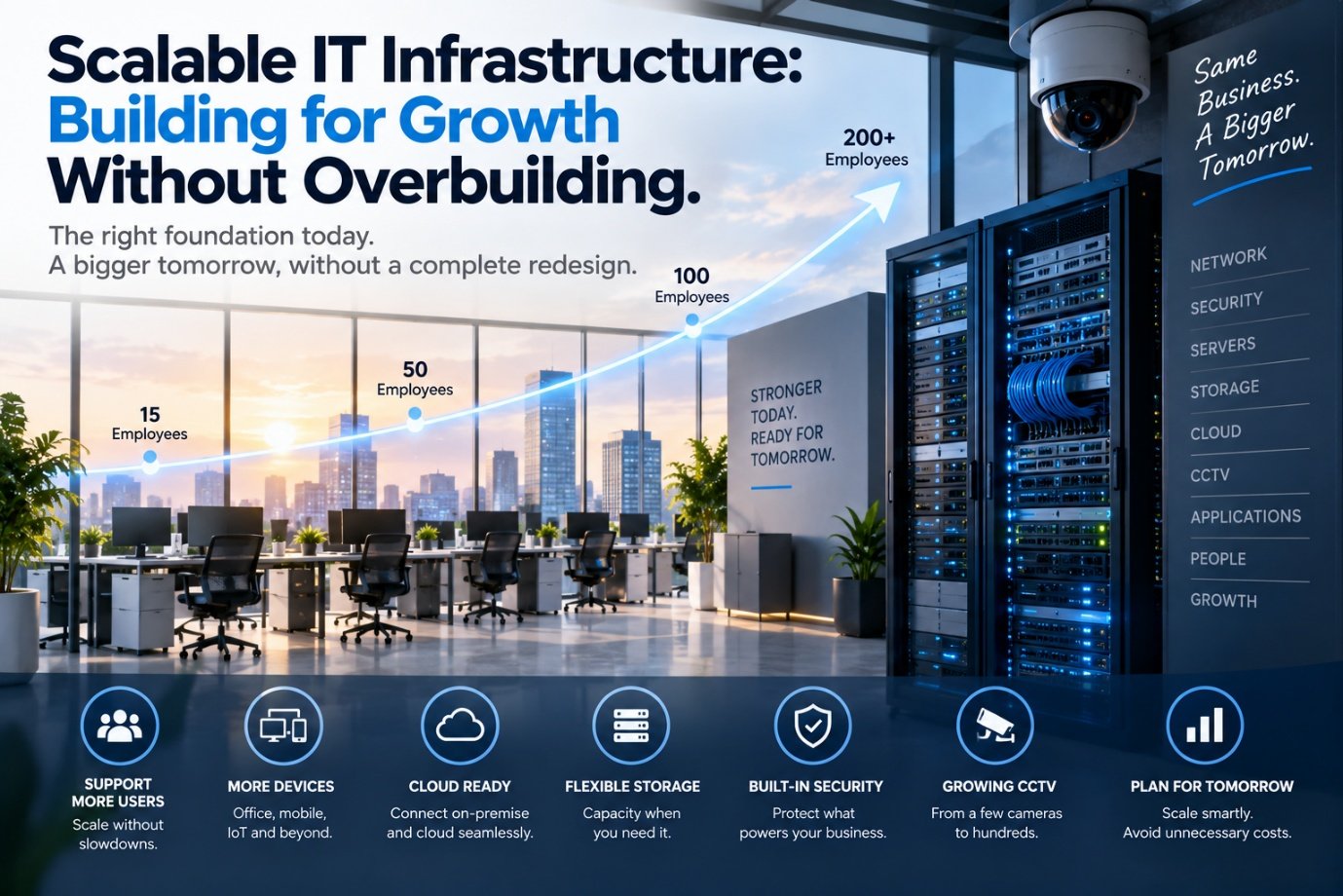
A growing business usually has a technology problem before it realises it has a technology problem.
The network that worked perfectly with 15 employees starts slowing down at 50. The Wi-Fi that was fine for a single office struggles when more devices, video calls and cloud applications are added. Storage requirements increase. CCTV systems expand. New software gets introduced. Remote users need access. Security requirements become more complex.
The natural response is often simple:
"Buy more hardware."
But scalability is not the same as buying more technology — a distinction we first raised in Why Your IT Infrastructure Matters More as Your Business Grows. A scalable IT infrastructure is one that can grow with the business without requiring a complete redesign every time it crosses another growth milestone.
The goal is not to build the biggest possible infrastructure today. The goal is to build the right infrastructure today, with a clear path to tomorrow.
What Does Scalable IT Infrastructure Actually Mean?
Scalability is often confused with capacity.
- How much your infrastructure can handle todayCapacity
- How easily and predictably it can handle more tomorrowScalability
For example, a network may currently support 50 employees. But what happens when the company grows to 100? If supporting those additional employees requires replacing the entire network, redesigning the IP structure, replacing switches and installing new security equipment, the infrastructure was not designed to scale particularly well. A scalable environment allows capacity to be added in manageable stages. This principle applies across the technology environment:
Modern infrastructure therefore needs to be treated as a connected system rather than a collection of individual purchases.
The Danger of Overbuilding
There is another side to the scalability problem. Businesses sometimes try to avoid future infrastructure problems by buying far more capacity than they currently need. A company with 30 employees may purchase enterprise hardware designed for hundreds of users simply because it wants to "future-proof" the business. That can create a different set of problems. The business may end up with:
Future-proofing does not mean predicting everything that will happen five years from now. It means creating an infrastructure that can adapt.
Start With the Business, Not the Hardware
One of the most common mistakes in IT infrastructure planning is starting with equipment. Which server should we buy? Which switch should we install? How many access points do we need? Which firewall should we choose? These are important questions — but they should come later. The first questions should be about the business:
- How many employees do you have today, and how quickly are you growing?
- Are you opening additional locations?
- How many devices does each employee use?
- Which applications are business-critical?
- How much data are you generating, and are you moving more workloads to the cloud?
- Does the business depend on video conferencing, and is CCTV part of the network?
- Do customers or visitors require Wi-Fi, and do employees work remotely?
- What happens if the internet connection, a server or the network becomes unavailable?
Infrastructure planning should begin with these requirements and then translate them into technology.
Think in Layers
A useful way to design scalable infrastructure is to think in layers rather than individual products.
Computers, laptops, mobile devices, printers, POS systems, IoT devices and other equipment. The number of devices can grow faster than the number of employees.
Switches, routers, firewalls, Wi-Fi access points, structured cabling, internet connectivity, VLANs and segmentation — able to grow without a complete redesign.
Local servers, cloud infrastructure, or a combination of both — chosen to fit the business, not because one is universally better.
Applications increasingly depend on other applications. As the number of systems grows, integration becomes increasingly important.
Firewalls, access controls, segmentation, backups, endpoint security, identity management and monitoring — part of the design from the beginning.
Applications increasingly depend on other applications: accounting may connect to banking, a CRM may connect to email, an ERP may connect to inventory, recipe management may connect to nutrition, costing and carbon data, and CCTV may connect to monitoring and analytics. When those connections are still being handled by hand in spreadsheets rather than integrated systems, the same warning signs apply that we describe in When Your Business Has Outgrown Excel. A scalable infrastructure that becomes progressively harder to secure is not truly scalable.
Design for Modularity
One of the strongest principles of scalable infrastructure is modularity. Instead of designing one massive environment, divide infrastructure into components that can grow independently. For example, a growing office may be able to add:
without replacing everything that already exists. Modular architecture makes growth more predictable and reduces the risk that one infrastructure decision becomes a bottleneck for the entire business. Current infrastructure guidance similarly highlights modularity, reuse and interoperability as important characteristics of scalable environments.
Don't Forget the Network
Network infrastructure is often where business growth becomes visible first. More employees mean more devices. More devices mean more network traffic. More cloud applications mean more internet traffic. More CCTV cameras mean more bandwidth and potentially more storage. More locations mean more connectivity requirements. And increasingly, businesses depend on video conferencing, cloud applications and remote access.
A scalable network therefore needs more than sufficient internet speed. It needs appropriate switching capacity, Wi-Fi capacity, network segmentation, security, monitoring and room for expansion — the same foundations we cover in How to Build a Reliable IT Network for a Growing Business. A network that supports today's users but requires major redesign every time the business expands can become an operational constraint, and often traces back to the same missteps described in 5 Common Networking Mistakes Growing Businesses Make.
CCTV Is Part of the Infrastructure
CCTV is another area that is often treated separately from IT. Modern IP CCTV systems are effectively networked technology, exactly as we explored in Modern CCTV Is More Than a Security Camera. Every additional camera can introduce requirements for:
A business planning for 20 cameras today and 100 cameras tomorrow should not design its network as if CCTV were an isolated system. The infrastructure needs to account for the future camera estate as well. This is one reason IT, networking and security infrastructure increasingly overlap.
Cloud Does Not Eliminate Infrastructure Planning
Moving applications to the cloud does not mean infrastructure planning disappears. It changes what needs to be planned. Instead of only thinking about local servers, businesses may need to consider:
A cloud application is still dependent on the infrastructure that allows employees and systems to reach it. For many businesses, the answer will be a hybrid environment rather than an entirely cloud or entirely on-premise architecture — a point closely related to the message in Digital Transformation Isn't About Buying More Software: moving something to the cloud isn't transformation by itself.
Build in Stages
A practical infrastructure strategy does not need to predict every requirement for the next decade. Instead, create stages.
Document the current environment — users, devices, applications, network, servers, cloud services, CCTV, security and data.
Create consistent hardware, configurations, naming, access policies and documentation wherever practical.
Don't design only for today's requirements — understand what growth from 50 to 100 employees means for the network, Wi-Fi, devices, applications and security.
Where possible, expand individual components instead of replacing the entire environment.
Observe infrastructure continuously so performance trends reveal when resources are approaching their limits.
Regular architecture reviews identify redundant systems, legacy dependencies and emerging requirements before they become major problems.
Scalability Is Also About Manageability
There is another dimension of scalability that is often overlooked.
Can your team actually manage the environment as it grows?
A network with 10 devices is manageable manually. A network with 500 is a different problem.
The same applies to:
As infrastructure grows, automation and centralised management become increasingly valuable. Scalability is therefore not simply about adding hardware. It is about adding capacity without adding an equal amount of complexity.
The Best Infrastructure Is Not the Biggest
There is a temptation in technology to equate better with bigger. More powerful servers. Faster switches. More storage. More cameras. More bandwidth. More cloud resources. But infrastructure should be designed around business requirements rather than specifications alone.
- "What is the most powerful equipment we can buy?"The wrong question
- "What infrastructure will let this business operate reliably today and grow predictably tomorrow?"The right question
That difference can have a significant impact on both cost and complexity.
From Infrastructure to Business Platform
As businesses mature, IT infrastructure becomes more than a technical foundation. It becomes the platform on which business operations run.
Employees depend on the network. Applications depend on infrastructure. CCTV depends on networking and storage. Data depends on systems and connectivity. AI depends on applications and data. Automation depends on integration. And business decisions increasingly depend on the information produced by all of these systems. This means infrastructure decisions should not be made in isolation — software, hardware, networking, security, data and cloud architecture need to work together, the same systems-first thinking behind Why Businesses Should Stop Buying Software and Start Building Systems.
The TRUIX Perspective
At TRUIX, we believe scalable IT infrastructure is not about buying the maximum amount of technology today. It is about designing a technology environment that can grow without constantly starting over.
That means understanding the business first, designing the infrastructure around its requirements, standardising where possible, building modularity into the architecture and leaving room for future expansion. A good infrastructure should support growth — not become the reason growth becomes difficult.
Scale when the business needs it.
Related Reading
- Digitisation vs Digital Transformation: What's the Difference?
- Why Businesses Don't Need More Software — They Need Better Systems
- Why Your Business Data Is More Valuable Than You Think
- Cloud vs On-Premise Infrastructure: What Should Your Business Choose?
- Why Your Business Network Is the Backbone of Digital Transformation
- Common CCTV Installation Mistakes Businesses Make
- Network Security Starts With Infrastructure
- The AI Journey: What Businesses Should Automate First
- APIs: The Missing Link Between Your Business Applications
- How Hotels Can Use Menu Data to Understand Environmental Impact
- CCTV Design Mistakes That Can Cost Businesses More Than the Cameras
- Why Your IT Infrastructure Matters More as Your Business Grows
- How to Build a Reliable IT Network for a Growing Business
- 5 Common Networking Mistakes Growing Businesses Make
- Modern CCTV Is More Than a Security Camera
- Why Businesses Should Stop Buying Software and Start Building Systems
- Digital Transformation Isn't About Buying More Software
- When Your Business Has Outgrown Excel
- Networking Solutions