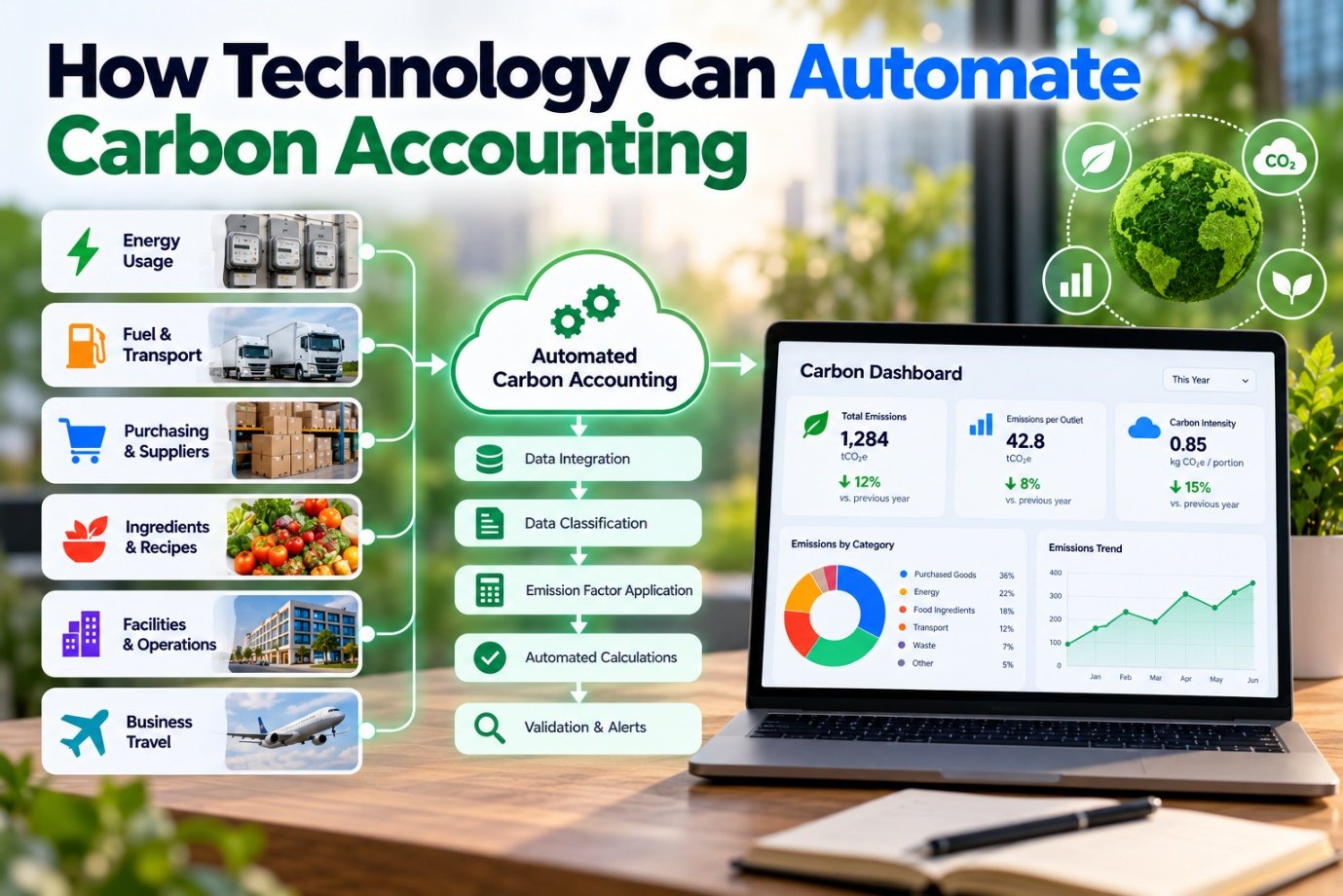
Carbon accounting is becoming an increasingly important part of how businesses understand their environmental impact. But for many organisations, the process still looks surprisingly manual.
Someone collects electricity bills. Someone downloads fuel records. Someone requests supplier information. Someone opens spreadsheets. Someone searches for emissions factors. Someone calculates emissions. Someone checks the numbers. Someone prepares a report. Then the process starts again the following month or year.
The problem is not that carbon accounting requires data.
The problem is that too much of the process is still disconnected from the systems that already generate the information.
Technology can change this. Modern carbon accounting can move from a periodic spreadsheet exercise to a connected, repeatable data process. And the opportunity goes beyond simply calculating tonnes of CO₂e—the real opportunity is to make carbon data part of everyday business intelligence.
What Is Carbon Accounting?
At its simplest, carbon accounting is the process of measuring greenhouse gas emissions associated with an organisation, product, service, activity or process. Depending on the objective and methodology, this can involve information such as:
The basic calculation often looks deceptively simple:
Activity Data × Emission Factor = Estimated Emissions
For example: 1,000 kWh of electricity × applicable emissions factor = kg CO₂e. But a real carbon accounting exercise involves much more than multiplication. You need to know:
This is where technology can make a major difference.
The Traditional Carbon Accounting Process
Imagine a business operating multiple offices, hotels, restaurants or manufacturing facilities. The sustainability team may need to collect information from dozens of sources. The process could look like this:
Every step introduces opportunities for:
The larger the organisation becomes, the harder this process becomes to manage. This is why modern carbon management platforms increasingly focus on integrating sustainability data with operational and financial systems—the same shift we describe in From Spreadsheets to Carbon Intelligence. SAP, for example, describes carbon accounting capabilities that integrate sustainability and financial data and automate data collection, calculations and reporting workflows.
Carbon accounting is moving from spreadsheets toward connected systems.
Step 1: Automate Data Collection
The first opportunity is one of the simplest:
Stop asking people to manually collect information that already exists digitally.
Electricity consumption may already exist in utility systems, ERP software, accounting systems, facility management platforms and energy management systems. Fuel information may exist in fleet management systems, expense systems, purchase records and accounting software. Procurement data may exist inside ERP systems, purchasing software and supplier portals. The first step in automation is therefore not necessarily AI. It is integration.
APIs Can Connect Carbon Accounting to Business Systems
Application Programming Interfaces, or APIs, allow software systems to exchange information—the same connective role we explore in APIs: The Missing Link Between Your Business Applications. This creates an important opportunity for carbon accounting.
Imagine an ERP system records: diesel purchased → 5,000 litres. Instead of someone manually copying that number into a carbon spreadsheet, an integrated system could pass the relevant information into a carbon calculation engine. The system can then:
Recognise what the transaction represents.
Standardise the quantity involved.
Match the activity to the correct factor.
Run the calculation automatically.
Keep a structured record of the result.
Preserve traceability back to the original data.
Feed the result into dashboards and reports.
The result is a much more repeatable process. The same architecture can potentially work with accounting software, procurement systems, inventory systems, energy systems and custom business applications.
Step 2: Automate Data Classification
Collecting data is only part of the problem. The system also needs to understand what the data represents. A line on an invoice might say "Diesel — 2,000 L". Another might say "Fuel — 2 KL". Another might say "HSD — 1,500 litres". A human can often understand the relationship. A computer needs rules, mappings or intelligent classification—the same discipline we describe for ingredients in Why Ingredient Data Is a Strategic Business Asset.
Technology can help standardise this information into a structured record:
- CategoryDiesel
- Quantity2,000
- UnitLitres
- ActivityFuel Consumption
- Emission CategoryRelevant Emissions Source
Once the information is structured, the calculation becomes much easier to automate.
Step 3: Automate Emission Factor Selection
This is one of the most important parts of carbon accounting. An emission factor converts an activity into an estimated environmental impact. But emission factors are not necessarily interchangeable—a principle we explore more closely in Better Carbon Data Starts With Better Emissions Factors. The appropriate value may depend on:
This means a carbon accounting system should not simply contain a large list of numbers. It should contain context around those numbers. A good emissions-factor database should ideally record information such as:
This creates traceability. It also makes the system easier to update when better data becomes available.
Step 4: Automate the Calculation
Once the activity data and appropriate emissions factor are available, the calculation can be automated. For example: 5,000 litres × applicable diesel emission factor = total kg CO₂e. The system can then automatically:
This eliminates repetitive manual calculations. More importantly, it creates consistency. The same rules can be applied every time.
Step 5: Automate Carbon Accounting at the Recipe Level
This becomes particularly interesting in food and hospitality—the same recipe-level approach we describe in Understanding the Carbon Footprint of a Recipe. A recipe can be treated as a structured data model:
Suppose a dish contains rice, chicken, onion, tomato, cooking oil and spices. The system can associate each ingredient with an appropriate emissions factor. The carbon footprint can then be calculated from the quantities used. A simplified model is:
Ingredient Quantity × Ingredient Emission Factor
The individual ingredient impacts can then be aggregated to estimate the footprint of the recipe. The same data can potentially be used to calculate:
This transforms carbon accounting from a separate sustainability exercise into part of recipe and menu management.
Step 6: Automate Carbon Data Validation
Automation should not simply calculate numbers. It should also identify suspicious information. Imagine a business normally consumes 8,000–10,000 kWh per month. One month the system receives 80 kWh. That may be technically valid data. But it is unusual. The system should be able to flag it. Similarly:
These situations can be flagged for human review. This creates an important principle:
Automation should reduce human workload, not eliminate human judgement.
Step 7: Automate Reporting
Once carbon information is structured, reporting becomes significantly easier. Instead of manually creating a report every reporting cycle, the system can generate views such as:
The same underlying dataset can support different audiences. The data is the same. The questions are different:
- Management: "What are our largest carbon hotspots?"
- Finance: "What is the relationship between operational spending and emissions?"
- Procurement: "Which suppliers or categories contribute most to our footprint?"
- Operations: "Where can we reduce emissions?"
- Sustainability Teams: "What changed from the previous reporting period?"
Carbon Accounting Can Become a Business Intelligence System
This is where the conversation becomes much more interesting. Carbon accounting should not necessarily end with "Your business emitted X tonnes of CO₂e." The next question should be "Why?" And then "What can we do about it?"
For example, a business may discover that a particular product has a significantly higher carbon footprint than alternatives—the same menu-level thinking we explore in Building More Sustainable Menus With Better Data. That information can influence:
Carbon data therefore becomes part of decision-making.
Connecting Carbon Data With Financial Data
One of the strongest opportunities is connecting carbon information with financial information—the same connected-asset thinking we describe in Why Your Business Data Is More Valuable Than You Think. Consider a purchasing transaction. A business already knows:
If appropriate emissions information is also available, the organisation can potentially understand:
Now management can begin asking more sophisticated questions:
This is one reason enterprise sustainability platforms increasingly connect carbon information with financial and operational data.
AI Can Take Automation Further
AI can potentially add another layer to carbon accounting—the same prioritisation we describe in The AI Journey: What Businesses Should Automate First. For example, AI could assist with:
But AI should sit on top of a reliable data architecture. If the underlying data is poorly structured, AI can make the interface more intelligent without making the underlying answer more reliable.
AI does not replace good carbon data.
It increases the value of good carbon data.
Automation Does Not Mean "Set It and Forget It"
Carbon accounting involves assumptions and methodological choices. A responsible system should therefore preserve an audit trail. For each significant calculation, businesses should ideally be able to understand:
- Where the activity data came from
- Which factor was used
- Which version of the factor was used
- What units were involved
- What assumptions were made
- When the calculation occurred
- Whether the value was estimated
- Who reviewed or changed the information
This becomes especially important when carbon information is used for formal reporting, customer communication or decision-making. Automation should improve transparency—not hide the calculation.
A Practical Architecture for Automated Carbon Accounting
A technology-driven carbon accounting system can be thought of as several layers.
ERP, accounting, procurement, utility bills, energy systems, fleet systems, supplier data, recipe databases, inventory systems.
APIs, file imports, connectors, automated document extraction, data pipelines.
Units, categories, locations, suppliers, ingredients, products, activity types.
Source, geography, dataset, year, methodology, boundary, version.
Activity Data × Emission Factor = Carbon Impact.
Dashboards, trends, hotspots, alerts, AI analysis, scenario modelling.
Management reports, sustainability reports, product information, recipe labels, customer-facing information, internal decision support.
This architecture is much more powerful than a spreadsheet because the process can be repeatable and connected.
The Biggest Mistake: Automating a Bad Process
There is an important warning here. Businesses sometimes assume that buying software automatically solves a process problem.
It doesn't.
If the underlying process is unclear, automation can simply make a bad process run faster. Before automating carbon accounting, businesses should ask:
Only then should technology be designed around the process.
From Carbon Reporting to Carbon Intelligence
There is a major difference between reporting carbon and using carbon data intelligently.
Carbon Reporting: "Our emissions were X."
Carbon Intelligence: "Our emissions increased because of these activities, these locations and these suppliers. These are the biggest hotspots, these are the potential reduction opportunities, and these changes could have the greatest impact."
The second approach is much more valuable. It turns carbon accounting into a management tool.
TRUIX Perspective: Carbon Accounting Should Be Connected to the Business
At TRUIX, we believe technology works best when it connects business processes rather than creating another isolated system. Carbon accounting is a good example. The information required to calculate environmental impact often already exists somewhere in the business—the same opportunity we describe for hotel menus in How Hotels Can Use Menu Data to Understand Environmental Impact. It may be in:
The opportunity is to connect these sources, structure the information, apply appropriate emissions data and turn the resulting information into something the business can actually use. For food and hospitality businesses, this can extend all the way from:
For other industries, the chain may look completely different. But the principle remains the same.
Carbon data should not live in isolation from business data.
It should become part of the business's information infrastructure.
Final Thought
Carbon accounting does not have to remain a manual spreadsheet exercise. Technology can automate data collection, classification, calculations, validation, reporting and analysis. But the real opportunity is bigger than automation.
When carbon data is connected to operational, financial and product data, businesses can begin using environmental information to make better decisions. The future of carbon accounting is therefore not simply about calculating emissions faster. It is about creating better carbon data, better visibility and better decisions.
That is how carbon accounting can evolve from a reporting requirement into business intelligence.
Related Reading
- Why Good Sustainability Reporting Starts With Good Data
- Why Businesses Don't Need More Software — They Need Better Systems
- Understanding the Carbon Footprint of a Recipe
- Better Carbon Data Starts With Better Emissions Factors
- From Spreadsheets to Carbon Intelligence
- Building More Sustainable Menus With Better Data
- How Hotels Can Use Menu Data to Understand Environmental Impact
- Why Ingredient Data Is a Strategic Business Asset
- APIs: The Missing Link Between Your Business Applications
- The AI Journey: What Businesses Should Automate First
- Why Your Business Data Is More Valuable Than You Think
- Carbon Footprint Analysis