Businesses today are under constant pressure to modernise.
They move documents to the cloud, replace paper forms with digital forms, adopt accounting software, introduce online customer portals and experiment with artificial intelligence.
These are useful steps. They can save time, improve accessibility and reduce manual work.
But there is an important question every business should ask:
Are we simply making our existing processes digital, or are we transforming the way our business operates?
The difference is significant.
A company can invest heavily in technology and still operate with the same inefficiencies, disconnected departments and outdated workflows it had years ago. This happens because digitisation and digital transformation are related, but they are not the same thing.
Understanding the difference helps businesses make better technology decisions, prioritise investments and avoid spending money on digital tools that deliver limited operational improvement.
1. What Is Digitisation?
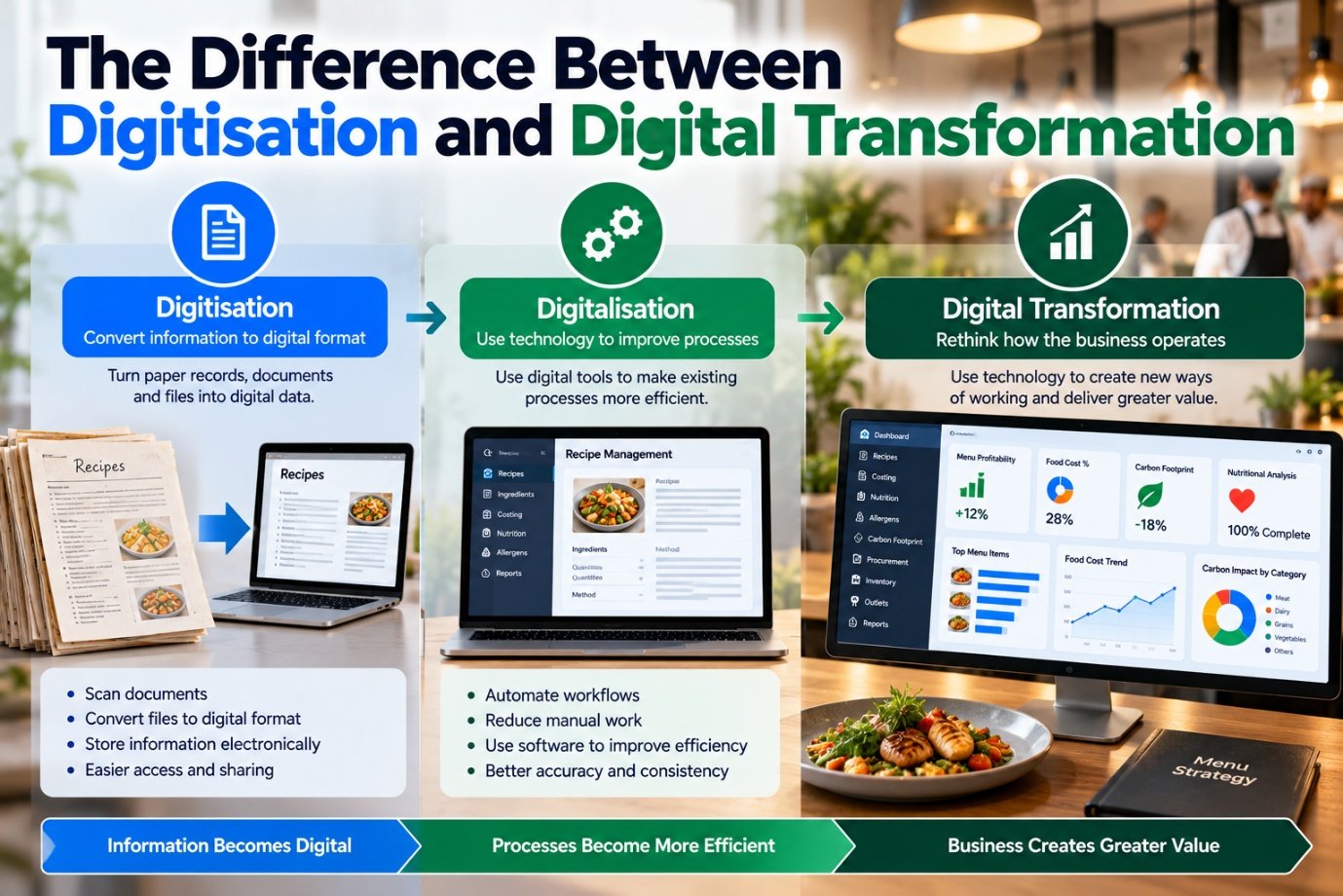
Digitisation is the process of converting information from a physical or analogue format into a digital format. It focuses primarily on information.
Examples include:
Consider a restaurant that maintains its recipes in physical files. The chef scans every recipe and saves the documents on a computer. The recipes are now digital. They can be stored, searched for and shared more conveniently.
However, the business may still have to calculate food costs separately, maintain allergen information in another document and prepare nutritional reports manually. The information has changed format, but the underlying business process has not fundamentally changed.
2. What Is Digitalisation?
Digitalisation goes a step further. It involves using digital technologies to improve existing processes and how work is performed. Instead of simply converting information into digital files, businesses use software and automation to make activities more efficient.
For example, consider a company that previously processed supplier invoices manually. The company introduces software that captures invoice information, routes invoices for approval, checks relevant purchase records and sends approved invoices into its accounting workflow. The process is now more efficient because technology is actively supporting the work.
Other examples include:
Digitalisation changes how a process operates, even if the overall business model remains largely the same.
3. What Is Digital Transformation?
Digital transformation is broader. It involves using technology to rethink how a business operates, delivers value, makes decisions and serves its customers. It may require changes to processes, organisational responsibilities, data management, customer experiences and even the business model itself.
Microsoft describes digital transformation as using digital technologies to create or modify business processes, products and customer experiences, with an emphasis on improving efficiency, agility, innovation and competitiveness — a view broadly consistent with how we approach digital transformation at TRUIX.
Consider a restaurant group that wants to improve profitability across multiple outlets. A basic digitisation project might scan all its recipes. A digitalisation project might introduce recipe costing software. A digital transformation initiative could connect recipe data with procurement, inventory, sales, nutrition, allergen information and carbon footprint analysis.
Management could then compare performance across outlets, identify costly ingredients, evaluate menu profitability and make better-informed decisions about menu design. The business is no longer simply maintaining digital recipes. It is changing how it manages menus, purchasing, profitability and sustainability.
4. The Three Stages Compared
Each stage answers a different question and produces a different kind of outcome.
Example: Scan paper invoices and store them electronically.
Outcome: Digital information.
Example: Automatically extract invoice data and route it for approval.
Outcome: A more efficient process.
Example: Connect procurement, finance, inventory and operational data to improve decisions across the business.
Outcome: A different and potentially better way of operating.
These stages are useful ways to understand the concepts, not mandatory steps that every project must follow. A business may undertake all three at once, or move directly to a more advanced solution where its foundations are already in place.
5. Why Businesses Often Confuse the Three
The confusion usually starts with the way technology investments are measured. A business might announce that it has:
These are technology initiatives. Some may be important components of digital transformation, but none automatically proves that transformation has occurred. The real question is what has changed as a result.
- Are employees spending less time on repetitive work?
- Can management make decisions using more reliable information?
- Are customers receiving better service?
- Can the business respond faster to changes in demand?
- Have unnecessary steps been removed?
- Are departments working together more effectively?
- Can the organisation introduce new products or services that were previously difficult to deliver?
If the business has adopted new technology but none of these outcomes has improved, the project may have digitised an existing process without transforming it.
6. Digital Transformation Starts With Business Problems
One of the most common mistakes is beginning a transformation project by selecting technology. A business decides to implement AI, migrate everything to the cloud or purchase an enterprise platform before defining what it wants to achieve. This can lead to expensive projects with unclear objectives.
A better approach begins with the business problem. For example:
- Reports take several days to prepare: Connect data sources and automate reporting.
- Customers receive inconsistent service: Create a connected customer-service process.
- Multiple outlets have different cost structures: Integrate operational, purchasing and financial information.
- CCTV footage is reviewed only after incidents: Introduce appropriate event-based monitoring and alerting.
- Sustainability reports require manual calculations: Connect activity data with validated emissions factors.
- Employees repeatedly enter the same information: Integrate applications and establish common data records, the same connective role explored in APIs: The Missing Link Between Your Business Applications.
The technology should follow the business requirement. This does not mean every problem requires a large transformation programme. Sometimes a small process improvement is the most sensible solution. The important point is to choose technology based on the outcome required, not simply because a product is available.
7. Data Is the Foundation of Digital Transformation
Many transformation projects fail to deliver their full potential because information remains scattered across disconnected systems. Sales has one database. Finance has another. Operations maintains spreadsheets — often the same sprawling workbooks described in When Your Business Has Outgrown Excel. Management receives periodic reports.
Each department may have useful information, but the organisation struggles to develop a consistent view of its operations. Digital transformation requires more than digitised information. It requires businesses to make relevant data accessible, reliable and useful across appropriate processes.
For example, connecting customer, sales, inventory and financial information can help management understand the relationship between demand, stock availability, revenue and profitability — the same principle we explore in Why Your Business Data Is More Valuable Than You Think.
In food and hospitality, connecting recipes, ingredient prices, nutrition, allergens and emissions factors can help a business make better-informed decisions about menus and procurement.
Microsoft's own guidance on data culture similarly emphasises trusted data, data accessibility and informed decision-making as important elements of organisational data maturity.
8. Where AI Fits Into Digital Transformation
Artificial intelligence has become a major part of the digital transformation conversation. Businesses are exploring AI for customer support, document processing, forecasting, software development, analytics and workflow automation — the same territory we map out in The AI Journey: What Businesses Should Automate First.
But introducing an AI tool does not automatically transform a business. Suppose an organisation gives every employee access to an AI assistant. Employees may become more productive at drafting emails, summarising documents and generating ideas. These can be valuable improvements. However, if the organisation's critical processes remain disconnected, its data is unreliable and approvals are still unnecessarily complicated, many of its underlying problems will remain.
A more transformative approach identifies where AI can improve a complete business process. For example:
AI becomes part of the operating system of the business rather than another isolated application. Human oversight, security, privacy and accountability remain important, especially when AI influences financial, customer or operational decisions.
9. Digital Transformation Also Requires People and Process Changes
Technology alone cannot transform an organisation. Employees need to understand new workflows, responsibilities may need to change, and management must be willing to challenge established ways of working.
Consider a company that introduces a real-time performance dashboard. The dashboard may provide accurate information, but if managers continue making decisions using old reports, the business may see little benefit. Similarly, an automated workflow may fail if employees do not understand how exceptions should be handled.
Successful transformation therefore requires attention to:
A transformation project should not be considered complete simply because the technology has been installed. It is complete only when the intended change is being used effectively and delivering meaningful results — the same shift from installed software to connected business systems we've written about before.
10. How to Measure Digital Transformation
Businesses should measure outcomes rather than counting software implementations. The appropriate metrics depend on the objective.
- Improve operational efficiency: Processing time per transaction.
- Reduce manual work: Hours spent on repetitive tasks.
- Improve data quality: Error and duplicate-record rates.
- Improve customer experience: Resolution time and customer satisfaction.
- Improve financial visibility: Time required to produce reliable reports.
- Improve inventory management: Stock accuracy and stockout frequency.
- Improve sustainability data: Completeness and traceability of activity data.
- Improve system integration: Number of manual handoffs or reconciliation steps.
Baseline measurements are important. Without knowing how a process performed before implementation, it becomes difficult to determine whether the new approach has delivered value. Businesses should also account for implementation costs, maintenance, training and ongoing support.
The goal is not to produce impressive technology statistics. It is to establish whether the business is actually performing better.
11. A Practical Roadmap for Businesses
Digital transformation does not have to begin with a large investment. A practical approach can start with one important business process.
This approach reduces unnecessary complexity and allows the organisation to build its transformation capability over time.
TRUIX Perspective: Don't Just Digitise Your Business. Improve It.
At TRUIX Technologies LLP, we believe that technology should be designed around the way businesses actually operate.
Scanning documents, adopting software and moving information online can be valuable first steps. But the larger opportunity lies in connecting information, improving processes and using technology to achieve measurable outcomes. That may involve custom software, system integration, networking, CCTV infrastructure, automation, AI or structured business data.
For food and hospitality businesses, it can also mean connecting recipe management with costing, nutritional analysis, allergen information and carbon footprint analysis.
The solution depends on the business problem. We do not believe every organisation needs a large technology overhaul. Sometimes the right answer is a focused improvement. In other cases, a more connected system can unlock benefits that isolated applications cannot deliver.
The starting point should always be the same:
Design the process. Choose the technology.
Technology should support business transformation, not become the transformation objective itself.
Final Thought
Digitisation makes information digital. Digitalisation uses technology to improve existing activities. Digital transformation rethinks how a business operates and creates value.
All three can be important, but they serve different purposes. Businesses that understand the distinction can make better investments, avoid technology for technology's sake and focus on changes that improve the way they work.
The goal is not simply to become a business that uses more digital tools. It is to become a business that operates more intelligently, responds more effectively and delivers greater value to its customers.
Don't just digitise what you do. Rethink what you can do.
Related Reading
- Why Good Sustainability Reporting Starts With Good Data
- Digital Transformation Isn't About Buying More Software
- Why Businesses Don't Need More Software — They Need Better Systems
- Why Your Business Data Is More Valuable Than You Think
- APIs: The Missing Link Between Your Business Applications
- When Your Business Has Outgrown Excel
- The AI Journey: What Businesses Should Automate First
- Scalable IT Infrastructure: Building for Growth Without Overbuilding