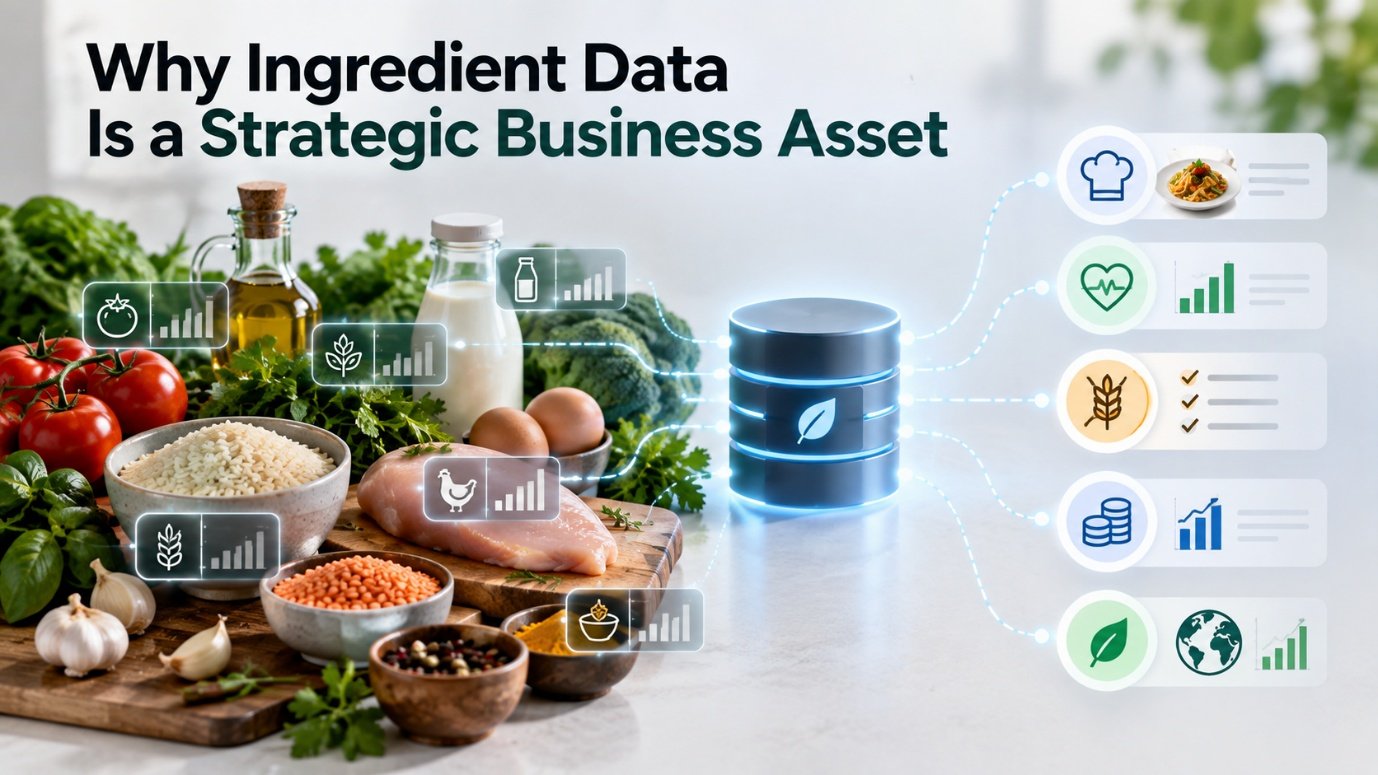
Every recipe starts with an idea. But every recipe is actually built from something far more fundamental: ingredients. Long before a dish is costed, analysed for nutrition, checked for allergens or scored for carbon impact, it depends on one thing being right — the ingredient data underneath it.
Businesses spend a great deal of time thinking about recipes. Far fewer spend the same amount of time thinking about the ingredient data that recipes are actually built from. That is a mistake, because ingredient data isn't a supporting detail. It is the foundation everything else stands on.
The Ingredient Is the Building Block
Consider a dish as familiar as Chicken Biryani. It requires chicken, rice, onions, yogurt, ginger, garlic, whole spices, ground spices, oil and herbs. Each of those is an ingredient. Each ingredient has a name, a unit of measurement, a nutritional profile, a cost, a source and — increasingly — a carbon footprint.
The recipe is simply a structured combination of ingredients and quantities. And the menu is simply a structured combination of recipes. This is why ingredient data sits at the base of a clear hierarchy, exactly as we described in What Happens When Recipes Become Data?:
If the foundation is unreliable, everything built on top of it inherits that unreliability — no matter how good the recipe management system looks on the surface.
One Ingredient Can Drive Multiple Outputs
A single, well-structured ingredient record can support far more than most businesses realise. Take something as ordinary as Whole Wheat Flour. One clean record for this ingredient can feed:
One accurate ingredient record. Six different business outputs. That is the leverage good ingredient data provides — and it is also exactly why a single error at the ingredient level can quietly distort every one of those outputs at once.
The Problem With Ingredient Names
Ingredient data starts to break down at the most basic level: naming. A single ingredient can appear in a business's records under several different names. Tomato might be entered as "Tomato," "Tomatoes," "Fresh Tomato," "Tomato (Local)" or "Tomato (Hybrid)." Milk might appear as "Milk," "Fresh Milk," "Dairy Milk" or "Cow Milk."
Each variation might be entered by a different person, in a different spreadsheet, at a different time. The consequences aren't cosmetic:
What looks like a small naming inconsistency at the data-entry stage becomes a real analytical problem once that ingredient is used across dozens or hundreds of recipes.
Standardisation Doesn't Mean Everything Is the Same
The instinct to fix naming problems is often to standardise everything into one entry. But that instinct can go too far. Standardisation means recognising the difference between ingredients that are genuinely different and ingredients that are simply named differently.
- Milk (Full Cream) vs Milk (Low Fat)Different ingredients — different records
- "Full Cream Milk" vs "Milk Full Cream"Same ingredient — one record, linked synonyms
Good ingredient data doesn't force every variant into a single generic entry. It keeps genuinely different ingredients separate, while recognising that different labels for the same thing should resolve to one underlying record.
Units Matter More Than They Appear
Quantities are another place where ingredient data quietly goes wrong. Flour might be recorded as 500g in one recipe, 0.5kg in another, "2 cups" in a third and "1 packet" in a fourth. Unless the underlying ingredient record defines a consistent base unit and reliable conversions, these entries can't be reconciled — and any calculation built on top of them, from costing to nutrition, inherits that uncertainty.
- 500gBase unit
- 0.5kgUnit conversion
- 2 cupsVolume-to-weight conversion
- 1 packetPackaging-to-weight conversion
Ingredient Data Supports Recipe Costing
Costing is one of the clearest places where ingredient data pays for itself. If Tomato is priced at ₹150 per kg and a recipe uses 400g, the calculation is straightforward — provided the ingredient price is accurate and current:
Now scale that up. If a business runs 200 recipes and Tomato's price record is wrong, every recipe containing Tomato produces an incorrect cost. It isn't one recipe with a costing error — it is a systemic costing error hiding behind 200 recipes that all look correct.
Ingredient Data Supports Nutrition Analysis
Nutrition analysis works the same way. Every ingredient carries a nutritional profile — calories, protein, fat, carbohydrates, sodium and more, all per unit weight. When quantities are applied correctly, ingredient-level nutrition rolls up into recipe-level nutrition and eventually into menu-level nutrition, the same principle explored in Nutrition Analysis Is Only Valuable When It Becomes Actionable Data:
There is no shortcut around this. Accurate menu-level nutrition simply cannot exist without accurate ingredient-level nutrition underneath it.
Ingredient Data Supports Carbon Analysis
Carbon footprint calculations follow an almost identical structure, as we explored in Why Food Carbon Accounting Starts With the Recipe. Each ingredient carries an emissions factor — its carbon impact per unit weight — and that factor, multiplied by quantity, produces the ingredient's contribution to a recipe's total footprint:
How accurate that emissions factor is — and where it comes from — matters enormously, which is precisely the question we go deeper into in Better Carbon Data Starts With Better Emissions Factors.
Ingredient Data Also Supports Allergen Management
Allergen management depends on the same underlying structure. Each ingredient is tagged with the allergens it contains or may contain. Those tags flow upward automatically, the moment the ingredient is used:
Unlike costing or carbon, allergen errors aren't just an analytical inconvenience. They are a guest-safety issue — which makes reliable ingredient-level allergen data one of the highest-stakes uses of good ingredient data.
The Same Ingredient Appears Everywhere
Here is what makes ingredient data disproportionately powerful — and disproportionately risky. A single ingredient rarely appears in just one recipe. In a hotel group running 500 recipes across multiple restaurants, an ingredient like Onion might appear in 300 of them.
- Wrong Nutrition ValueWrong nutrition on 300 recipes
- Wrong CostWrong cost on 300 recipes
- Wrong Emissions FactorWrong carbon footprint on 300 recipes
This is the scale problem we described in The Hidden Nutritional Complexity of a 5-Star Hotel Menu. A single incorrect ingredient record doesn't cause one small error. It causes the same error, silently repeated, across every recipe that touches it.
Ingredient Data Creates Relationships
Structured ingredient data does something a spreadsheet rarely does well: it makes relationships visible. "Ingredient A is used in 5 recipes." "Recipe 43 appears on 3 different menus." These relationships aren't just interesting — they are exactly what a business needs to know before changing a supplier, adjusting a price or reformulating a dish, because they show precisely what else will be affected.
Procurement and Culinary Data Can Connect
Ingredient data sits at the intersection of several departments that don't always talk to each other, even though they are working from the same underlying information:
Procurement cares about price and supplier terms. Culinary cares about taste, quality and availability. Finance cares about cost. Nutrition and sustainability care about the ingredient's composition and impact. All five are looking at different facets of the exact same ingredient record — which is precisely why that record needs to be structured, accurate and shared, rather than recreated separately in five different spreadsheets.
Supplier Changes Become Easier to Understand
When a business switches suppliers, structured ingredient data makes the impact of that change explicit — a different origin, a different price, a different packaging format, potentially even a different nutritional or carbon profile. Without structured records, a supplier change is often noticed only when something downstream — a cost, a nutrition value — quietly stops matching what it used to be.
Ingredient Substitutions Can Be More Intelligent
Substitutions happen constantly in food businesses — sunflower oil instead of vegetable oil, one brand of paneer instead of another, a seasonal vegetable instead of one that's out of stock. With structured ingredient data, the nutritional, cost and carbon impact of a substitution can be understood before it happens, rather than discovered afterwards.
Data Quality Determines the Quality of the Analysis
The most sophisticated analytics platform in the world
still produces poor decisions when it's built on poor ingredient data.
No dashboard, algorithm or AI model can compensate for an ingredient database full of duplicate names, inconsistent units, missing sources or outdated values. Data quality isn't a detail beneath the analysis. It is the ceiling on how good the analysis can ever be.
The Hidden Work Behind a Good Ingredient Database
Businesses rarely see how much structure a genuinely reliable ingredient database requires. Behind every clean ingredient record sits:
Most businesses that manage this in spreadsheets — the same warning signs we describe in When Your Business Has Outgrown Excel — maintain only a fraction of this list, and usually without anyone formally responsible for keeping it current.
Source Hierarchy Matters
Not all ingredient data is equally trustworthy. Values verified through laboratory testing or direct supplier documentation are more reliable than values pulled from a general database, which in turn are more reliable than rough estimates. A good ingredient record doesn't just store a number — it records where that number came from, so anyone using it later can judge how much confidence to place in it.
Local Data vs Global Data
This becomes especially important for businesses operating in markets where local reference data is limited. A hotel in India sourcing Tomato locally may not have a India-specific nutrition or emissions value readily available. The practical approach is a fallback hierarchy:
What matters isn't only which value is used, but that the choice is documented — so the ingredient record stays transparent about how confident it actually is, a principle we cover in more depth in Better Carbon Data Starts With Better Emissions Factors.
Ingredient Data Needs Version Control
Ingredient data changes over time — suppliers change, formulations change, testing improves. Without version control, an update silently overwrites the previous value and every historical calculation built on it becomes unexplainable.
- Version 1 (Previous Supplier)Fat 6.0% · Recorded Jan 2025
- Version 2 (Current Supplier)Fat 6.5% · Recorded Aug 2026
With version control, a business can explain exactly why a recipe's nutrition changed last August. Without it, the change simply looks like an error.
One Ingredient, Many Recipes, One Change
This is where structured ingredient data becomes genuinely powerful rather than just tidy. Correct one ingredient record — say, an updated emissions factor for Rice — and every recipe using Rice across a menu of 150 dishes updates automatically. In a spreadsheet-based process, the same correction means manually finding and updating Rice in every one of those 150 files — the exact operational burden explored in When Your Business Has Outgrown Excel. One change. One place. Every downstream calculation stays current.
Ingredient Data Can Become a Business Intelligence Layer
Once ingredient data is structured, it stops being reference material and starts answering strategic questions:
- Which ingredients contribute the most to our total food cost?
- Which ingredients carry the highest carbon footprint across our menu?
- Which ingredients appear in the largest number of recipes?
- Which ingredients depend on a single supplier?
- Which ingredients have the most volatile pricing?
- Which ingredients are most exposed to allergen risk?
- Which ingredient changes would have the widest impact if made today?
None of these questions can be answered from a folder of recipe spreadsheets. They require ingredient data that is centralised, structured and queryable.
AI Needs Good Ingredient Data Too
As food businesses begin exploring AI-assisted analysis, ingredient data becomes even more important, not less. AI can only answer questions as well as the data beneath it allows:
AI doesn't eliminate the need for good data architecture.
It increases its importance.
Ingredient Data Is More Than a Master List
Many businesses believe they already have ingredient data because they maintain a list of ingredient names. But a name is not a data asset. There's a meaningful difference between a basic list and a strategic ingredient model:
- A column of ingredient namesBasic list
- Structured, connected, governed recordsStrategic ingredient model
A strategic ingredient model captures far more than a name:
From Ingredient Database to Food Intelligence
When ingredient data is built correctly, it becomes the foundation of a much larger system — one where every layer depends reliably on the one beneath it:
Standardised, sourced and versioned.
Ingredients combined with quantities.
Recipes organised into sellable items.
Rolled up automatically from ingredients.
Flagged automatically at every level.
Calculated from live ingredient prices.
Calculated from ingredient emissions factors.
Patterns and trends across the full menu.
Decisions grounded in reliable data.
What Businesses Should Ask About Their Ingredient Data
Before assuming ingredient data is under control, it's worth asking some direct questions:
- Do we have one ingredient record per ingredient, or several duplicates under different names?
- Are units standardised and reliably convertible?
- Does every ingredient have a documented source for its nutrition and carbon values?
- Do we know when each ingredient record was last updated?
- Is there a clear owner responsible for ingredient data accuracy?
- Can we see every recipe that uses a given ingredient?
- What happens when a supplier or formulation changes?
- Do allergen tags update automatically when an ingredient changes?
- Could we answer "which ingredient drives the most cost/carbon?" today?
- Is our ingredient data centralised, or scattered across spreadsheets?
- Would our ingredient data be ready to support AI-assisted analysis?
Most businesses can answer some of these confidently. Few can answer all of them.
The Future of Food Technology Is Built From the Bottom Up
As food businesses invest in nutrition platforms, carbon-tracking tools, costing systems and AI, it's tempting to focus attention on the tools themselves. But the real foundation is quieter and less visible:
Get this foundation right, and every tool built on top of it becomes more reliable. Get it wrong, and no tool — however sophisticated — can fully compensate.
The TRUIX Perspective
At TRUIX, we believe ingredient data deserves the same attention businesses give to recipes, menus and financial systems — because it quietly underpins all of them. A single, well-governed ingredient record can support:
That is the same systems-first thinking behind Why Businesses Should Stop Buying Software and Start Building Systems — treating data as connected infrastructure rather than isolated spreadsheets. Ingredient data isn't a back-office detail. It is a strategic asset that determines how confidently a food business can understand its own recipes, costs, nutrition and environmental impact.
The ingredient data underneath it is the foundation.
Related Reading
- How AI Can Change Recipe and Menu Management
- From Spreadsheets to Carbon Intelligence
- AI Agents vs Traditional Automation: What's the Difference?
- Why Restaurants Need More Than a Digital Recipe Book
- The AI Journey: What Businesses Should Automate First
- Building More Sustainable Menus With Better Data
- APIs: The Missing Link Between Your Business Applications
- How Hotels Can Use Menu Data to Understand Environmental Impact
- What Happens When Recipes Become Data?
- Nutrition Analysis Is Only Valuable When It Becomes Actionable Data
- Why Food Carbon Accounting Starts With the Recipe
- Better Carbon Data Starts With Better Emissions Factors
- The Hidden Nutritional Complexity of a 5-Star Hotel Menu
- When Your Business Has Outgrown Excel
- Why Businesses Should Stop Buying Software and Start Building Systems
- Recipe Analytics