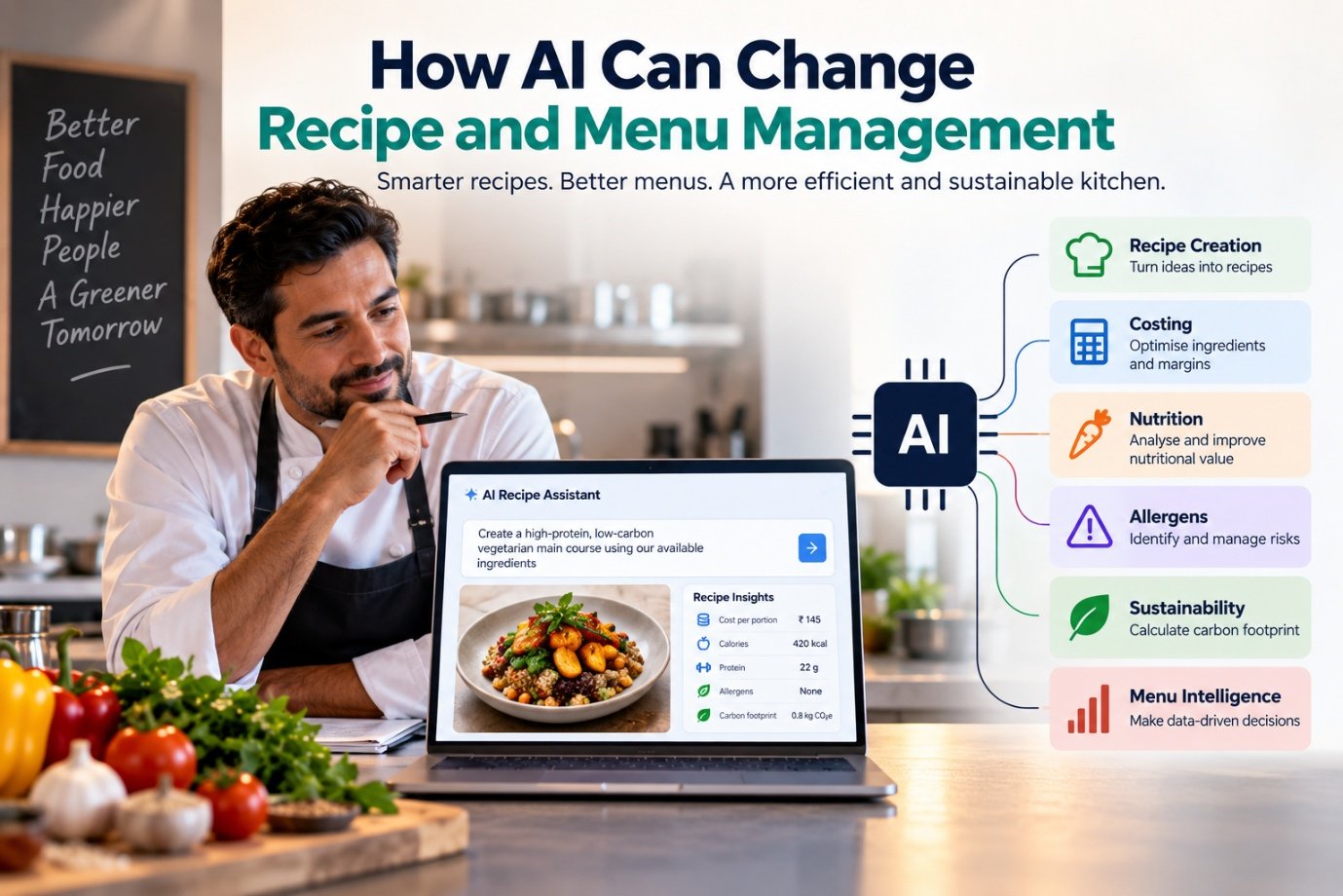
For decades, recipes have been managed in notebooks, spreadsheets, folders and, more recently, digital recipe management systems.
Menus have followed a similar path. A chef creates a recipe. Someone enters it into a system. A menu is prepared. Prices are added. Recipes are updated. And when something changes, people manually update the information across different places.
Artificial intelligence can change this workflow. But the biggest opportunity isn't simply asking AI to "create a recipe."
The real opportunity is to connect AI with the structured recipe and menu data that restaurants already depend on.
When that happens, AI can potentially help restaurants create, analyse, manage and improve recipes and menus in ways that were previously difficult to scale.
AI Recipe Creation Is Only the Beginning
One of the most obvious applications of AI is recipe creation. A chef could provide a request such as, "Create a high-protein vegetarian main course using ingredients already available in our kitchen." An AI system could generate a starting concept. But a commercially useful recipe requires much more than a list of ingredients — the same structured foundation we describe in Why Restaurants Need More Than a Digital Recipe Book. It may need to consider:
This is where restaurant-specific data becomes important. An AI model that knows only general cooking knowledge may produce an interesting recipe. An AI system connected to the restaurant's own data can potentially produce a more context-aware starting point.
The Restaurant's Data Makes AI More Useful
Imagine two restaurants asking AI to create a new chicken dish.
- "Create a chicken dish."Generic Food Ideas
- Existing ingredients, costs, recipes, equipment, portion standards, nutrition, allergens, preferences, pricing, salesContext-Aware Recipe
The second environment provides much more context. The AI isn't simply generating food ideas. It is working within the restaurant's operating environment. This is an important principle for restaurant AI:
The quality of the output depends heavily on the quality and availability of the underlying data.
From Recipe Generation to Recipe Engineering
AI can potentially move beyond generating recipes to helping teams engineer them. Consider a recipe that costs ₹180 per portion. The restaurant wants to bring the cost closer to ₹150 without significantly changing the dish. Instead of manually testing dozens of combinations, an AI-assisted system could potentially evaluate:
The chef still decides what is acceptable. AI helps explore the possibilities. This distinction matters.
AI can assist with exploration without replacing culinary judgement.
AI Can Understand Recipe Relationships
A restaurant rarely has completely independent recipes. There may be:
One sub-recipe may be used by ten different menu items. This creates a recipe hierarchy — the same layered structure we cover in What Happens When Recipes Become Data?. For example:
A change to the tomato gravy could affect multiple dishes. A structured recipe system can represent these relationships. AI can then potentially help answer questions such as:
- Which menu items use this ingredient?
- Which recipes will be affected if this preparation changes?
- Which dishes contain this allergen?
- Where are we using the same ingredient under different names?
The value comes from combining AI with connected recipe data.
AI Can Help Identify Recipe Data Problems
Recipe databases often contain inconsistencies. For example:
These may represent the same ingredient—or they may represent different products. There can also be inconsistencies in:
AI can potentially help identify these patterns. Instead of simply storing information, the system can flag: "These five ingredients appear to refer to similar products. Review before merging." The final decision remains with the user.
It surfaces likely duplicates and inconsistencies for review — it does not make the merge decision on its own.
Menu Management Can Become More Dynamic
Menus traditionally behave like documents. A restaurant creates a menu, publishes it and updates it when necessary. But a structured digital menu can become much more dynamic. AI can potentially help teams:
Current restaurant technology is already using AI for areas such as menu creation, descriptions, translations and ongoing menu updates. The important distinction is that these capabilities become much more useful when the AI works from the restaurant's actual menu and recipe data.
From Menu Description to Menu Intelligence
Writing a description is one use of AI. Understanding the menu is another. Imagine asking:
- Which dishes are expensive to produce but have low sales?
- Which ingredients appear in our highest-cost recipes?
- Which menu items contain the most common allergens?
- Which dishes could be affected if this ingredient becomes unavailable?
These are not simply content-generation questions. They are business intelligence questions. AI can make interacting with that information more natural. Instead of opening multiple reports and filtering spreadsheets, a manager could potentially ask a question in plain language.
AI Can Connect Recipe Data With Costing
Recipe costing is one of the most structured areas of restaurant management. A recipe may contain:
- Ingredient Quantity × Ingredient CostIngredient Cost Contribution
The system can calculate the recipe cost. But AI can potentially help interpret the result. For example: "Why has the food cost of this recipe increased?" The system could investigate:
It could then present the relevant factors for review. The calculation remains deterministic. AI helps with the interpretation. That distinction is important.
AI and Nutrition Analysis
Recipe data can also connect to nutrition. A structured recipe contains:
This can be linked to an ingredient nutrition database. The system can calculate nutritional values — the same principle we cover in Nutrition Analysis Is Only Valuable When It Becomes Actionable Data. AI can then potentially help with tasks such as:
But nutrition information should not simply be generated from an AI model and assumed to be accurate. Where nutritional values are being used for customer communication or regulatory purposes, the underlying calculation and source data need to be properly controlled and reviewed.
AI and Allergen Management
Allergen management is another area where structured data is essential. If ingredients are linked to allergen information, the system can trace allergens through recipes and sub-recipes. For example:
AI could help answer, "Which menu items are affected if this ingredient changes?" or "Show me recipes containing this allergen." But again, AI should assist with the process rather than become the sole source of truth. Allergen information can have serious consequences if incorrect, so verification and controlled data remain essential.
AI Can Bring Carbon Data Into Menu Decisions
The same principle applies to environmental information. If ingredients are connected to emissions factors, a recipe can have an estimated carbon footprint — the same connected approach we describe in From Spreadsheets to Carbon Intelligence. AI can potentially help explore:
For example: "Find recipes where changing one ingredient could materially reduce the estimated carbon footprint." The AI could identify candidates. The chef and sustainability team can then evaluate whether the proposed alternatives make culinary and commercial sense. This creates a much more practical form of carbon intelligence.
AI Can Help With Menu Innovation
Creating a new menu can involve significant manual research. Teams may need to consider:
AI can potentially help bring these datasets together. For example: "Suggest five new vegetarian dishes using ingredients already purchased by the business, avoiding duplication with the current menu." That is a very different request from "Give me five vegetarian recipes." The first is based on the restaurant's actual operating context.
AI Can Help With Menu Optimisation
Menu optimisation is another area where connected data becomes valuable. A restaurant may know:
AI can potentially analyse these factors together. For example: "Identify menu items that have low sales, high preparation time and relatively high food cost." The output isn't necessarily a decision. It is a starting point for management review. The restaurant may decide to modify the dish, reposition it, replace it or keep it for strategic reasons. AI provides information. People make the business decision.
AI Can Help With Multi-Location Restaurants
Recipe and menu consistency becomes increasingly difficult as restaurants grow. A restaurant group may have:
A centralised recipe system can provide a common source of truth, connected through the same integration layer we describe in APIs: The Missing Link Between Your Business Applications. AI can potentially help identify differences between locations. For example: "Which outlets are using a different version of the standard tomato sauce?" Or: "Which locations haven't updated the new recipe?" This can make central recipe governance more practical.
AI Can Turn Recipe Changes Into Business Events
Consider a simple change:
That change may affect:
In a disconnected environment, someone may need to update each item manually. In a connected recipe platform, the change can trigger downstream calculations. AI can then help explain the consequences: "This recipe change reduces estimated food cost by X, changes the nutritional profile, and reduces the estimated carbon footprint. Review the customer-facing menu information."
The important technology isn't AI alone. It is the combination of:
Structured Data + Automation + AI
AI Needs Guardrails
Restaurant AI should not be treated as an autonomous chef or business manager. There are areas where human review remains important. For example:
AI can generate recommendations. A qualified person should validate important outputs before they become operational or customer-facing. This is particularly important because generative AI can produce plausible but incorrect information. Restaurant AI guidance increasingly emphasises human review for areas such as allergen and ingredient claims — the same judgement principle we cover in AI Agents vs Traditional Automation: What's the Difference?.
Don't Start With "We Need AI"
The best starting point isn't "How can we add AI to our restaurant?" Instead ask:
"Where does our team spend time interpreting information?"
Then identify the data behind that process — the same discipline behind The AI Journey: What Businesses Should Automate First:
This creates a much stronger foundation than simply adding a chatbot to an existing system.
The Recipe Becomes an AI Data Object
This may ultimately be the biggest change.
The recipe can connect to:
AI can then interact with this information. That is a much bigger opportunity than AI-generated recipes alone.
The Future of Menu Management
The traditional workflow looks something like:
The emerging model can look very different:
The technology does not remove the chef. It gives the chef and management team more information to work with.
The TRUIX Perspective
At TRUIX, we believe the most valuable restaurant AI will not exist separately from recipe and business data. It will be connected to it.
A restaurant shouldn't have to ask AI to invent information that the business already knows. The system should already understand:
- What ingredients do we use?
- What do they cost?
- Which suppliers provide them?
- Which recipes use them?
- What are the nutritional values?
- What allergens are involved?
- What is the estimated carbon footprint?
- Which menus contain the recipe?
- How is the menu performing?
Once this information is structured and connected, AI becomes much more useful. The future isn't simply AI-generated recipes. It is AI-powered recipe intelligence. And that means the real starting point isn't the AI model.
Related Reading
- Why Ingredient Data Is a Strategic Business Asset
- Why Restaurants Need More Than a Digital Recipe Book
- What Happens When Recipes Become Data?
- Why Ingredient Data Is a Strategic Business Asset
- The AI Journey: What Businesses Should Automate First
- AI Agents vs Traditional Automation: What's the Difference?
- From Spreadsheets to Carbon Intelligence
- Nutrition Analysis Is Only Valuable When It Becomes Actionable Data
- APIs: The Missing Link Between Your Business Applications
- Recipe Analytics