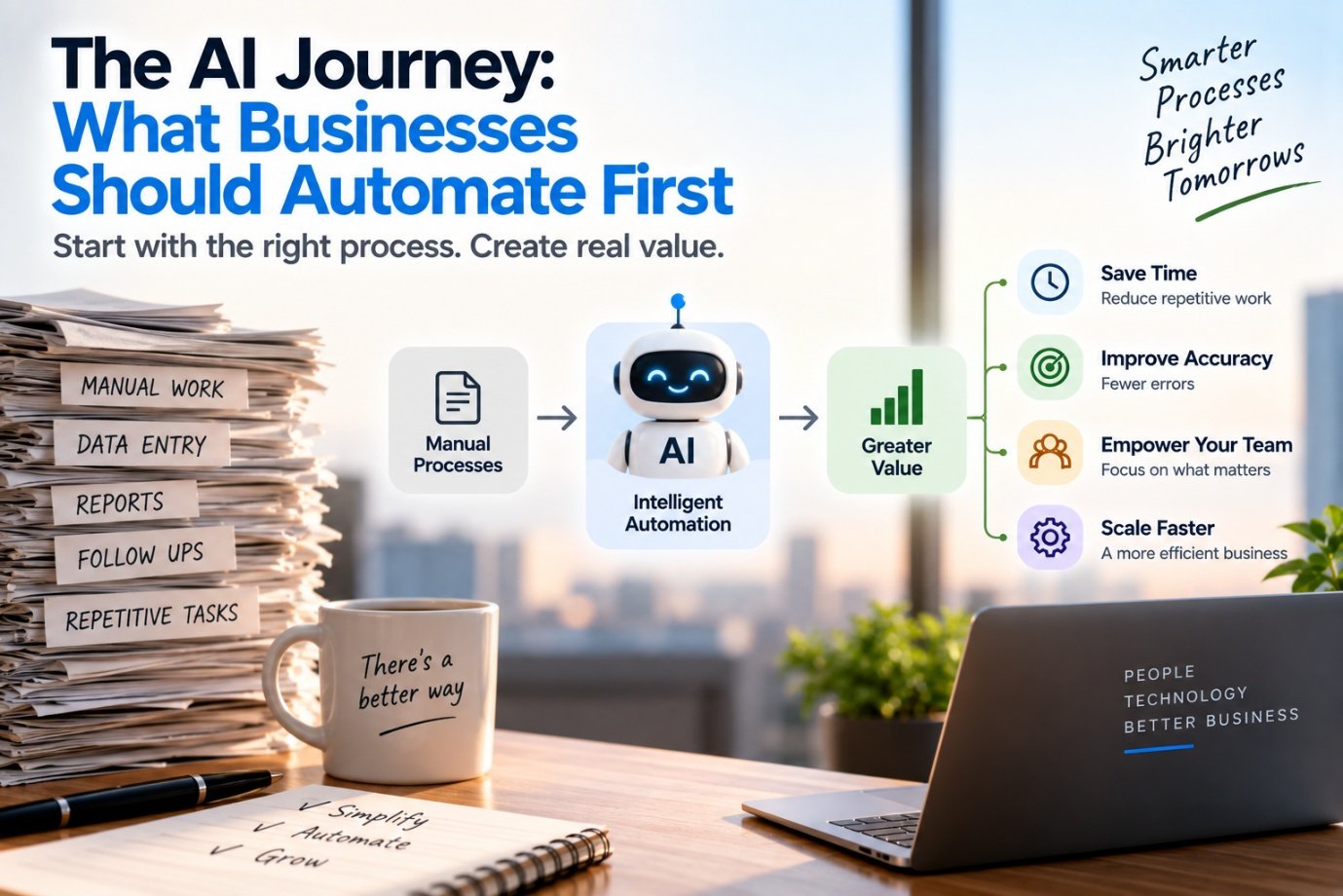
Almost every business is talking about AI.
But there is a more important question than:
"How can we use AI?"
It is:
"What should we automate first?"
That distinction matters. A business can spend months experimenting with AI and still create very little operational value if the technology is applied to the wrong problems. The best starting point is usually not the most impressive AI application. It is the business process where technology can remove meaningful friction.
AI Should Start With a Business Problem
Imagine a company has employees spending several hours every week:
These activities may not sound particularly exciting. But they can represent a significant amount of organisational effort — the same hidden cost explored in The Hidden Cost of Manual Business Processes. AI and automation can potentially help with some of them. The opportunity is not to make AI the centre of the business. The opportunity is to make the business less dependent on unnecessary manual work.
Not Every Process Should Be Automated
This is one of the most important principles of an AI strategy. Just because something can be automated doesn't mean it should be. Some processes require:
Trying to automate these processes simply because AI technology is available can create more complexity rather than less. A better approach is to evaluate the process first. Ask:
- How repetitive is it?
- How much time does it consume?
- How predictable is the process?
- How much data is involved?
- How frequently does it occur?
- What happens when something goes wrong?
- How much human judgement is genuinely required?
- What would happen if the process were faster?
These questions help identify where automation may actually make sense.
Start With the Repetitive Work
The easiest opportunities are often tasks that happen repeatedly and follow reasonably consistent rules. For example:
Traditional automation can often handle highly predictable tasks. AI becomes particularly interesting when the process also involves information that is more difficult to structure. For example:
This is where AI can potentially complement traditional automation.
Automation and AI Are Not the Same Thing
The terms are often used interchangeably. They shouldn't be.
Traditional Automation
Traditional automation is generally strongest when the rules are known. For example:
- Invoice is approvedSend to accounting
- Stock falls below thresholdCreate alert
- Payment is receivedUpdate status
The process is predictable.
AI
AI becomes more useful when the system needs to interpret information. For example:
AI + Automation
The most interesting applications often combine the two. For example:
This creates a workflow rather than simply an AI feature.
Look at the Whole Workflow
One of the biggest mistakes businesses make is automating an individual step without looking at the process around it. Imagine an employee spends 20 minutes preparing a report. You automate the report generation. Excellent. But the employee still spends another hour:
You automated one step. The workflow is still inefficient. Recent research on AI transformation increasingly emphasises redesigning end-to-end workflows rather than simply accelerating individual tasks. This is why businesses should ask:
"Where does the process begin and where does it end?"
rather than:
"Which task can we automate?"
Find the Handoffs
One of the most interesting places to look for automation opportunities is between systems and teams. Consider:
Every handoff creates the possibility of:
These interfaces can create what is effectively a coordination cost. AI and automation can increasingly help with verification, reconciliation and routing across workflow boundaries, provided the data, controls and escalation rules are properly designed — the same connective principle behind Scalable IT Infrastructure: Building for Growth Without Overbuilding.
A Simple Way to Identify Automation Opportunities
Businesses don't need an expensive AI strategy exercise to begin. Start by listing important processes. For each process, document:
How often does it happen — daily, hourly, weekly or monthly?
How many transactions or cases are processed?
How much employee time does it consume?
How much of the work follows the same pattern?
How much information needs to be collected, compared or processed?
How often does the process require unusual judgement?
What happens if the process becomes faster, cheaper or more accurate?
This gives you a much better starting point than simply asking employees "Where can we use AI?"
A Practical Automation Matrix
You can think about processes in four broad categories.
High Volume + Low Complexity — often strong candidates for automation.
High Volume + Moderate Complexity — may be good candidates for AI-assisted automation.
Low Volume + High Complexity — may benefit more from AI assistance than full automation.
High Risk + High Judgement — generally require stronger human oversight.
The exact boundary depends on the business, the process and the consequences of an error. The important principle is: automation should be matched to the nature of the work.
The Data Problem
AI is only as useful as the information it can access. Suppose a business wants an AI system to answer:
"Which customers haven't paid their invoices?"
The AI needs access to reliable financial information. If the accounting data is incomplete, inconsistent or scattered across spreadsheets, the AI cannot magically fix the underlying system — a problem we explored in When Your Business Has Outgrown Excel. The same applies to every industry.
For a hotel:
"Which recipes have the highest estimated carbon footprint?"
requires structured recipe and ingredient data.
For a retailer:
"Which products are running low?"
requires reliable inventory data.
For a service company:
"Which support tickets require escalation?"
requires access to the relevant customer and ticket information. AI needs context. And context comes from data.
This Is Where APIs Become Important
This connects directly to our previous blog, APIs: The Missing Link Between Your Business Applications. An AI system becomes much more useful when it can securely interact with the systems that contain the information it needs. For example:
- CRMCustomer information
- AccountingFinancial information
- InventoryStock information
- Recipe DatabaseIngredient and recipe information
- CCTV PlatformVideo and event information
APIs and other integration mechanisms can allow these systems to communicate. AI can then become an intelligence layer on top of connected business systems.
Don't Start by Building an AI Agent
The phrase AI agent is everywhere. But businesses should resist the temptation to begin with "Let's build an AI agent." Instead ask "What job should this system perform?"
- AI agent for financeReview incoming invoices, check required fields, identify discrepancies and route exceptions to the finance team
- AI agent for customer serviceClassify incoming enquiries, retrieve relevant information, draft responses and escalate unusual cases
- AI agent for recipesAnalyse structured recipe information and identify nutrition, allergen, costing or carbon-related changes when ingredients are modified
The second approach produces a much clearer business requirement — the same discipline behind treating ingredient data as a strategic business asset.
Give AI Boundaries
Automation should not mean removing every human from the process. A better model is often:
For example:
This approach keeps people involved where judgement matters while reducing repetitive work. Current AI operating-model research similarly emphasises clearly defining where AI operates and where human oversight, approval and escalation remain necessary.
Measure the Process Before Automating It
Another important step is establishing a baseline. Before automation, measure:
Then measure the same indicators after implementation. Otherwise, the business may end up with an impressive AI demonstration but no evidence that the underlying process actually improved.
Start Small — but Think End-to-End
There is a difference between starting small and thinking small. A pilot should be manageable. But the process should be understood from beginning to end. For example:
Instead of automating only the classification step, understand the complete workflow. This makes it easier to identify where AI, APIs, automation and human intervention should each be used.
Don't Automate a Bad Process
This is perhaps the most important rule. If a process is unnecessarily complicated, automating it may simply make the complicated process happen faster. Before automation, ask:
- Can we simplify this?
- Can we remove a step?
- Can two systems be connected?
- Can we eliminate duplicate data?
- Can the approval structure be simplified?
- Does this report actually need to exist?
- Does this information need to be entered twice?
Process redesign should often come before automation — much like the systems-first thinking described in Why Businesses Should Stop Buying Software and Start Building Systems. Recent AI transformation research similarly points to workflow redesign, data foundations and organisational changes as important prerequisites for scaling AI effectively.
The Recipe Example
Consider a hotel recipe workflow. Today:
There are multiple handoffs. Now imagine a connected system:
The technology isn't simply replacing people. It is removing unnecessary movement of information between people and systems. That is a much more valuable form of automation.
The CCTV Example
The same principle applies to CCTV. A traditional system may simply record video. A modern system can potentially:
For example, a system may identify a predefined event and send it to the appropriate person or workflow. The camera provides the data. The network transports it. The software processes it. AI may interpret it. The workflow determines what happens next. Again, AI is only one component of the overall system.
The Best AI Projects May Not Look Like AI
This is an interesting consequence of good automation. A successful implementation may eventually become almost invisible. Employees don't think "The AI is working." They simply notice "This process is easier now."
- The report appears automatically.
- The customer receives a faster response.
- The right information is already in the system.
- Exceptions are highlighted.
- Duplicate data entry disappears.
- Managers have better visibility.
That is often what useful technology looks like.
A Practical AI Roadmap
Businesses can approach AI adoption in stages.
Understand your important business processes.
Find repetitive, high-volume and time-consuming activities.
Remove unnecessary steps and reduce duplication.
Integrate the systems and data involved — the same shift described in Digital Transformation Isn't About Buying More Software.
Use traditional automation where rules are predictable.
Use AI where interpretation, classification, summarisation or contextual reasoning adds value.
Define permissions, monitoring, escalation and human oversight.
Track whether the process actually improved.
Expand successful patterns to other workflows.
This creates an AI journey based on business value rather than technology excitement.
The Future Is Human + AI
The objective of automation should not simply be "Remove humans from the process." A better objective is "Remove unnecessary work from humans." People can then spend more time on:
AI and automation handle more of the repetitive coordination and information processing where appropriate. This human-plus-technology model is increasingly becoming a central theme in how organisations think about AI-enabled operations.
The TRUIX Perspective
At TRUIX, we believe the AI journey should begin with a business process — not with a technology demo. Before asking which AI model to use, we ask "What problem are we solving?" Then:
- Where does the process begin?
- Where does it end?
- Which systems are involved?
- What data is required?
- Which steps are repetitive?
- Where is human judgement necessary?
- What happens when something goes wrong?
Only then does the technology conversation begin. Sometimes the answer will be traditional software. Sometimes it will be an API integration. Sometimes it will be workflow automation. Sometimes it will be AI. And increasingly, it may be a combination of all four.
The goal isn't to make a business look more advanced because it uses AI. The goal is to make the business work better because technology is being used intelligently.
Automate what makes sense. Add AI where it creates real value.
Related Reading
- Digitisation vs Digital Transformation: What's the Difference?
- Why Businesses Don't Need More Software — They Need Better Systems
- How Technology Can Automate Carbon Accounting
- Why Your Business Data Is More Valuable Than You Think
- Cloud vs On-Premise Infrastructure: What Should Your Business Choose?
- Why Your Business Network Is the Backbone of Digital Transformation
- How AI Can Change Recipe and Menu Management
- From Spreadsheets to Carbon Intelligence
- AI Agents vs Traditional Automation: What's the Difference?
- Network Security Starts With Infrastructure
- Why Restaurants Need More Than a Digital Recipe Book
- Why Businesses Should Stop Buying Software and Start Building Systems
- Digital Transformation Isn't About Buying More Software
- The Hidden Cost of Manual Business Processes
- APIs: The Missing Link Between Your Business Applications
- Scalable IT Infrastructure: Building for Growth Without Overbuilding
- When Your Business Has Outgrown Excel
- Why Ingredient Data Is a Strategic Business Asset
- Software Solutions