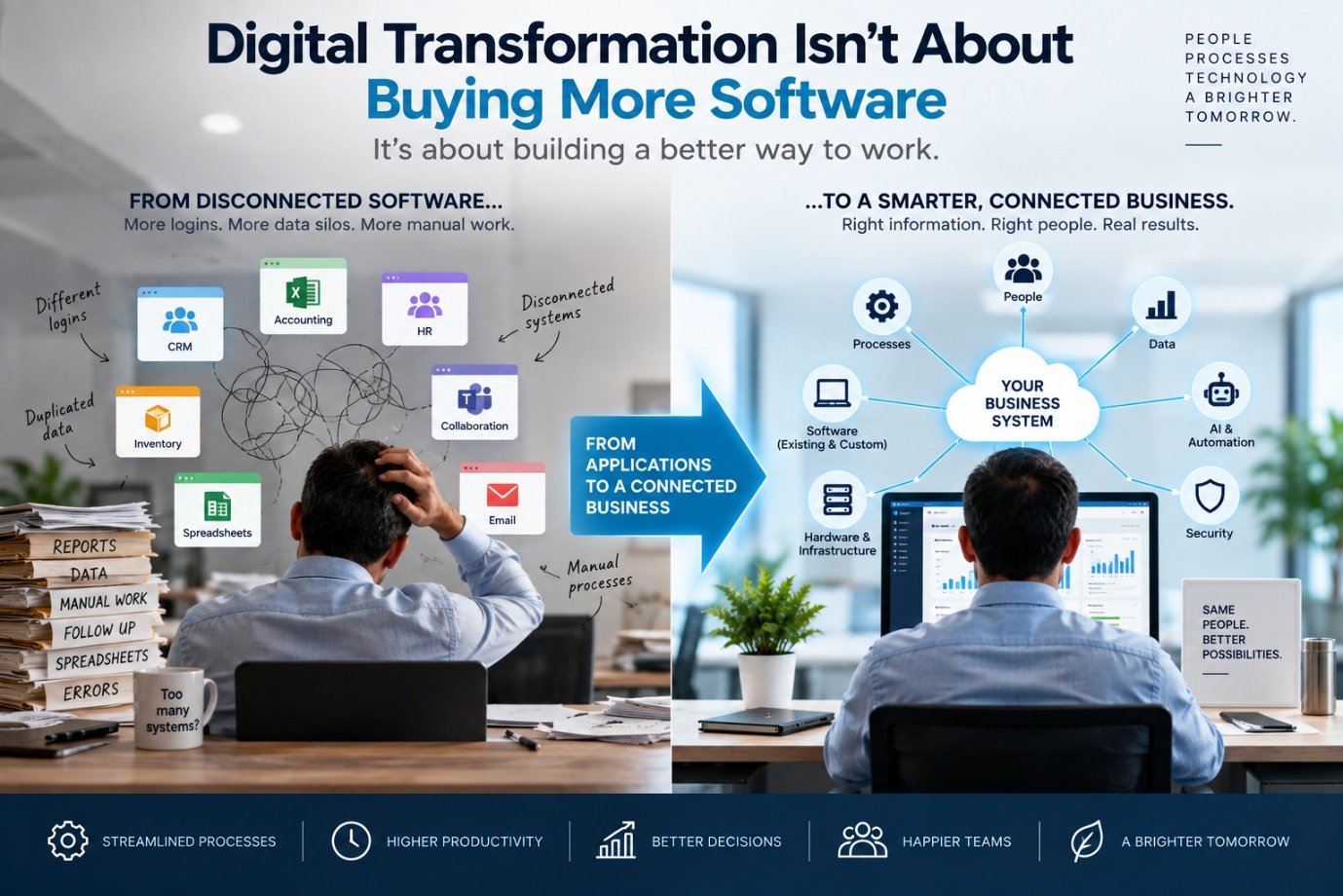
Digital transformation has become one of the most widely used phrases in business.
Companies talk about transforming their operations, modernizing their technology and becoming more digital. And yet, for many organizations, digital transformation still looks remarkably similar to one thing:
Buying more software.
The technology keeps growing. But the business doesn't necessarily become better. That is because digital transformation isn't fundamentally about how much software a company uses.
It is about how the business operates.
Digitizing Something Doesn't Automatically Transform It
Consider a simple example. A company previously used paper forms to approve purchase requests. It replaces the paper form with an online form. The employee fills it in digitally. The manager receives an email. The manager approves it. Someone in finance downloads the information and enters it into another system.
The process is now digital. But has it been transformed? Not necessarily. The paper has disappeared. The underlying process hasn't.
The Technology Trap
Technology makes it incredibly easy to add another application. A business identifies a problem. Someone searches for software that solves it. A product is selected. Employees are trained. The application goes live. Then another problem appears. Another application is purchased.
Over time, the organization accumulates technology. But each new system introduces another consideration:
Eventually, the business can find itself managing its software rather than using software to manage the business.
Start With the Process
Real digital transformation should begin with a much simpler question: How does this part of the business work today? Map the process. For example:
Now ask:
- Where does information enter the process?
- Where is it duplicated?
- Where are employees manually entering data?
- Where are approvals delayed?
- Where are spreadsheets being used?
- Where do errors occur?
- Where do different departments lose visibility?
Only after understanding the process should technology enter the discussion.
Technology Should Remove Friction
A good digital transformation project should make work easier. It should ideally reduce unnecessary:
Imagine an employee currently spends two hours every Friday creating a management report. They collect information from three applications. Export spreadsheets. Clean the data. Combine the files. Check the numbers. Format the report. Email it to management.
Buying another dashboard may not necessarily solve the problem. The better solution might be connecting the underlying systems so that the report is generated automatically.
Data Is at the Centre of Transformation
Almost every business process generates data. A customer creates a record. A salesperson creates an opportunity. An employee creates a timesheet. A purchase creates a transaction. A warehouse movement changes inventory.
A recipe contains ingredient and quantity information. A CCTV system generates video data. A network generates operational information.
The challenge is that this data often exists in separate systems. Digital transformation creates value when organizations can make their data more accessible, consistent and useful. The question becomes:
Can the right person access the right information at the right time?
If the answer is no, buying another application may not be the solution. Connecting what already exists might be.
Integration Is Often More Valuable Than Replacement
Businesses don't always need to replace their existing technology. Sometimes they need to connect it. For example:
Each application can continue doing what it does well. The integration layer allows information to move between them. This can be more practical than replacing multiple systems simply because they don't communicate with one another. It also reinforces an important principle:
A business system is bigger than any individual software application.
What About Legacy Systems?
Many businesses have technology that has been around for years. It may not be fashionable. It may not have a modern interface. But it may still perform an important business function reliably. Replacing it simply because it is old can be expensive and risky.
The better question is: Does the system still provide business value, and can it participate in the future technology architecture?
Sometimes the answer is to replace it. Sometimes it is to integrate it. Sometimes it is to gradually modernize it. Digital transformation doesn't require destroying everything that came before.
It requires creating a better path forward.
AI Doesn't Automatically Equal Transformation
AI has created another version of the same problem. Businesses are asking, "Where can we use AI?" That is a useful question, but it can easily lead to AI being added simply because everyone else is doing it.
A better approach is to ask: Which business problems could AI solve better than our current process?
Perhaps employees spend hours searching through documents. Perhaps customer enquiries require repetitive responses. Perhaps management reports require manual analysis. Perhaps a large dataset contains patterns that are difficult to identify manually. These may be genuine opportunities for AI. But AI should be connected to the business process.
Automation Is About the Entire Workflow
Businesses often automate individual tasks. For example: send an email when a form is submitted. Useful. But what happens after the email? A more valuable approach may be to look at the entire workflow.
This is more than task automation. It is workflow transformation.
Employees Shouldn't Be the Integration Layer
One of the strongest indicators that a business's technology environment needs attention is when employees are responsible for moving information between systems. Consider:
Every manual transfer introduces the possibility of:
People should be making decisions. They shouldn't spend their day acting as APIs between disconnected applications.
Transformation Requires Infrastructure Too
Digital transformation isn't only about applications. It also depends on the infrastructure underneath them. Employees need reliable networks. Cloud applications need dependable connectivity. CCTV systems need appropriate network infrastructure. Servers and storage need to be managed. Devices need to be secured. Remote users need secure access. Data needs to be protected.
This is why software, hardware, networking and security cannot always be treated as independent projects, as we explored in Why Your IT Infrastructure Matters More as Your Business Grows. They are components of the same technology environment.
Transformation Should Be Measurable
A digital transformation project should have a business outcome. For example:
These are meaningful outcomes. Simply saying "We implemented a new platform" is not a business outcome. The technology is the means.
The improvement is the result.
Don't Transform Everything at Once
Another common mistake is attempting to transform the entire organization simultaneously. Large projects can become expensive, complicated and difficult to manage. A better approach can be to identify areas where technology can create the greatest impact. Start with one process. Understand it. Improve it. Measure the result. Then expand. For example:
Transformation can become an ongoing process rather than a single massive technology project.
The Human Element Still Matters
Technology alone doesn't transform a business. People do. Employees need to understand why a change is being made. They need appropriate training. Processes may need to change. Responsibilities may need to evolve. Management needs to support the transformation. A technically excellent system can fail if employees don't adopt it. That is why successful transformation considers:
People + Process + Technology
not technology alone.
Build Systems, Not Software Collections
This connects directly to a broader principle we introduced in Why Businesses Should Stop Buying Software and Start Building Systems. Businesses shouldn't evaluate technology as a collection of individual applications. They should think about the system as a whole. A modern business environment might look like:
Supported by: Infrastructure + Security
The objective is to make these layers work together. That's where technology starts becoming a competitive advantage.
What Does Successful Digital Transformation Look Like?
It may actually look surprisingly ordinary.
- Employees don't complain about the system.
- Information is available when needed.
- Reports don't require hours of spreadsheet manipulation.
- Customers receive faster responses.
- Management has better visibility.
- Systems communicate with each other.
- Processes require fewer manual steps.
- Security is built into the environment.
- New technology can be added without rebuilding everything.
The technology becomes almost invisible. And that may be the best measure of success.
The TRUIX Perspective
At TRUIX, we don't see digital transformation as a race to acquire the newest software. We see it as an opportunity to understand how a business operates and identify where technology can make it better.
Sometimes that means implementing existing software. Sometimes it means integrating systems. Sometimes it means developing custom applications. Sometimes it means improving infrastructure. Sometimes it means automation or AI. And sometimes the best decision is to leave an existing system exactly where it is.
The technology should follow the business objective. Because digital transformation isn't about having more applications. It isn't about replacing everything you already have. And it certainly isn't about using technology simply because it is new.
Digital transformation is about building a better way for the business to operate.
The question shouldn't be:
"What software should we buy?"
It should be:
and what role should technology play in making it happen?"
Related Reading
- Digitisation vs Digital Transformation: What's the Difference?
- Why Businesses Don't Need More Software — They Need Better Systems
- Why Your Business Data Is More Valuable Than You Think
- Common CCTV Installation Mistakes Businesses Make
- AI Agents vs Traditional Automation: What's the Difference?
- Network Security Starts With Infrastructure
- The AI Journey: What Businesses Should Automate First
- APIs: The Missing Link Between Your Business Applications
- Scalable IT Infrastructure: Building for Growth Without Overbuilding
- When Your Business Has Outgrown Excel
- Better Carbon Data Starts With Better Emissions Factors
- AI Video Surveillance: What Modern CCTV Can Actually See
- 5 Common Networking Mistakes Growing Businesses Make
- Nutrition Analysis Is Only Valuable When It Becomes Actionable Data
- The Hidden Cost of Manual Business Processes
- Why Food Carbon Accounting Starts With the Recipe
- Why Businesses Should Stop Buying Software and Start Building Systems
- Why Your IT Infrastructure Matters More as Your Business Grows
- Custom Software vs Off-the-Shelf Software
- How to Build a Reliable IT Network for a Growing Business
- What Happens When Recipes Become Data?
- Software Solutions