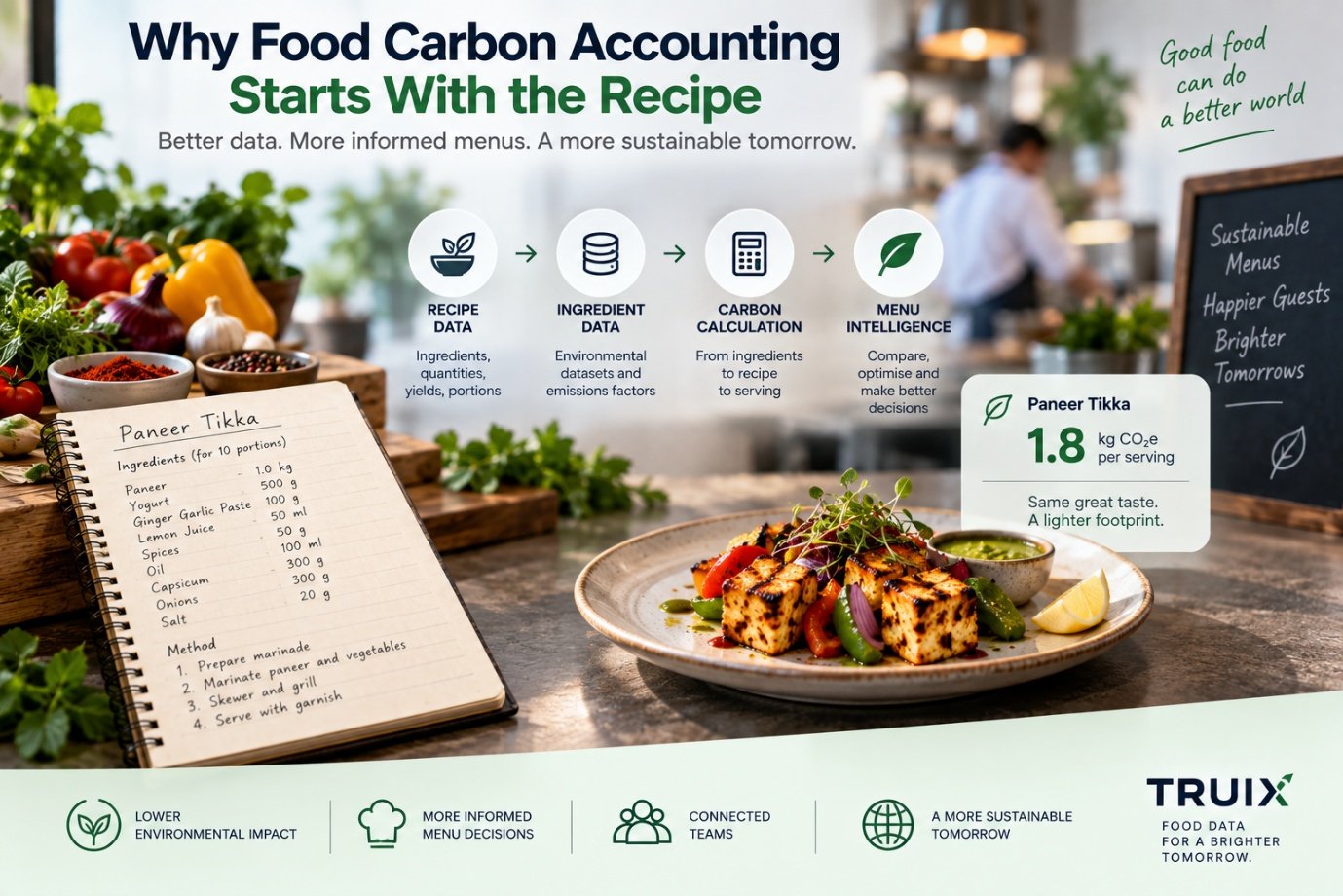
A reliable food carbon footprint is only as good as the recipe and ingredient data behind it.
When businesses begin measuring their environmental impact, the conversation often starts at a high level.
- How much carbon does the hotel generate?
- What is the carbon footprint of the restaurant?
- Which menu items have the highest environmental impact?
- How can the business reduce emissions?
These are important questions. But when it comes to food, answering them accurately requires going much deeper.
The starting point is often sitting quietly inside the kitchen: the recipe.
A recipe is not just a set of cooking instructions. When properly structured, it contains the information needed to connect ingredients, quantities, portions, yields and preparation methods to environmental data.
That makes the recipe one of the most important building blocks for food carbon accounting.
The Carbon Footprint of a Dish Doesn't Start With the Dish
Consider a seemingly simple dish on a restaurant menu. A guest sees one item: Paneer Tikka.
But the kitchen may actually be working with several ingredients and sub-recipes:
Each ingredient can have a different environmental footprint. The quantity used matters. The source of the ingredient can matter. The geographical context can matter. The emissions factor used can matter. And the amount of the finished recipe that ultimately becomes one serving matters as well.
So the carbon footprint of the dish cannot simply be assigned to the menu item as a standalone number. It needs to be calculated from the data underneath it. And that data starts with the recipe.
A Recipe Is a Carbon Data Structure
Traditionally, recipes have been treated as operational documents. They tell a chef: what ingredients do I need, how much do I need, and how do I prepare them?
For carbon analysis, the recipe needs to become something more structured. At its simplest, a carbon calculation can be represented as:
The emissions associated with the ingredients can then be aggregated to estimate the footprint of the recipe, subject to the chosen methodology and system boundary. But this simple equation depends on the quality of the information going into it. For example:
| Recipe Information | Why It Matters |
|---|---|
| Ingredient | Determines which emissions factor may apply |
| Quantity | Determines the amount contributing to the footprint |
| Unit | Allows quantities to be interpreted correctly |
| Yield | Connects raw ingredients to finished recipe quantity |
| Portion Size | Determines footprint per serving |
| Sub-Recipes | Captures ingredients hidden inside preparations |
| Geography | Helps determine the appropriate data assumptions |
| Emissions Factor | Provides the environmental intensity used |
| System Boundary | Defines what the calculation includes |
This is why food carbon accounting is fundamentally a data problem as much as it is a sustainability problem — a point we explored in more depth in Understanding the Carbon Footprint of a Recipe.
Ingredient Data Is the Foundation
If a recipe says "Chicken — 2 kg" that is useful. But for a meaningful carbon calculation, the system needs to understand what "chicken" represents and which environmental dataset or emissions factor should be associated with it.
The same issue applies across thousands of ingredients. A hotel or restaurant may use:
If ingredient names are inconsistent, carbon calculations become difficult to automate and maintain. For example, Tomato, Tomatoes, Fresh Tomato, Tomato – Local and Tomato 5 kg may all refer to the same underlying ingredient — or they may represent different products with different characteristics.
The Problem Gets Bigger With Sub-Recipes
Professional kitchens rarely operate with only simple recipes. A menu item may contain a sauce. The sauce may contain a stock. The stock may contain vegetables and other ingredients. A garnish may be prepared separately. A marinade may be made in batches.
This creates a recipe hierarchy. For example:
Each of these can contain its own ingredients. If the carbon footprint is calculated only from the top-level recipe, some of the ingredients can easily be missed.
A structured recipe system can instead follow these relationships and roll the underlying ingredient data upward. This is one of the reasons digital recipe management becomes particularly important when organisations start looking beyond basic recipe costing — a theme we explored in depth in What Happens When Recipes Become Data?
Portion Size Changes the Story
A carbon footprint can be expressed at different levels — for example, kg CO₂e per recipe or kg CO₂e per serving. These are not the same thing.
Imagine two recipes that use similar quantities of ingredients but produce very different yields. If one recipe produces 20 portions and another produces 10, their carbon footprint per serving will be very different.
This makes yield and portion information critical. A business that wants to understand the environmental impact of what it actually sells needs to connect the recipe to the serving size — particularly important for hotels and restaurants, where the same base recipe may be prepared in large batches but sold across many different menu formats.
The System Boundary Matters
One of the easiest ways to create confusion around food carbon calculations is to present a number without explaining what it represents.
Different methodologies can define different boundaries. Therefore, two apparently precise carbon-footprint numbers may not necessarily be directly comparable if they have been calculated using different boundaries or assumptions.
A credible carbon analysis should make its methodology clear. That means documenting things such as:
Transportation Is Not the Whole Story
Food sustainability conversations often focus heavily on food miles. Transportation is certainly relevant, but it is only one potential component of a food product's environmental footprint. For many food categories, production can be a major contributor.
This is why simply asking "How far did this ingredient travel?" does not necessarily tell us "How environmentally intensive was this ingredient?"
A recipe-level approach allows businesses to look at the composition of the dish itself rather than relying on a single broad assumption about the menu item. That opens the door to much more useful analysis.
Carbon Data Can Become Menu Intelligence
Once recipes are structured and carbon information is connected to them, the business can start asking better questions.
- Which dishes have the highest estimated footprint per serving?
- Which ingredients contribute most to our menu footprint?
- What happens if we change an ingredient?
- Which recipes have similar customer appeal but a lower estimated footprint?
- How does portion size affect environmental impact?
- Which menu categories are contributing disproportionately to our footprint?
These are no longer questions that belong exclusively to the sustainability department. They can involve:
The recipe becomes the common data layer connecting them.
The Same Recipe Data Can Do Much More
This is where food data becomes particularly powerful. The same structured recipe can support multiple analytical applications.
Ingredient quantities and nutritional composition can be used to estimate calories, macronutrients, vitamins, minerals and other nutritional information, as explored in The Hidden Nutritional Complexity of a 5-Star Hotel Menu.
Ingredients can be mapped to relevant allergen information and dietary requirements.
Ingredient quantities can be connected to purchasing prices and recipe yields to calculate recipe and portion costs.
Ingredients can be connected to environmental datasets and emissions factors to estimate carbon footprint.
Structured recipe information can support reporting, labelling and other operational or regulatory requirements where applicable.
The combined information can help management understand the nutritional, financial and environmental characteristics of the menu.
This means a business doesn't necessarily need five completely separate datasets. It can build different intelligence layers around a common underlying recipe and ingredient structure.
From Carbon Calculation to Carbon Intelligence
There is an important distinction between calculating carbon and using carbon data intelligently.
A carbon calculation might produce: Chicken Biryani — X kg CO₂e per serving. That is useful. But the real business value comes from being able to understand:
- Why is it X?
- Which ingredients contribute most?
- What assumptions were used?
- What happens if the recipe changes?
- How does it compare with another dish?
- What is the footprint of the entire menu?
- What is happening across multiple outlets?
- How does procurement affect the result?
- Can lower-impact alternatives be evaluated?
This is where technology becomes important. The objective is not simply to create a carbon number. It is to create a system in which carbon information can be understood, updated, compared and acted upon.
What Happens When a Recipe Changes?
Consider a restaurant that changes a recipe. The chef replaces one ingredient. The quantity of another ingredient is increased. The portion size changes. A sauce is reformulated. A supplier changes.
From a traditional recipe-book perspective, these may simply be operational changes. From a data perspective, they can have multiple consequences. The change could affect:
A connected recipe-data system can identify these dependencies and make it possible to reassess the relevant outputs. This is far more powerful than maintaining independent spreadsheets for every analysis.
Why Spreadsheets Become Difficult at Scale
A small restaurant with 50 recipes may be able to manage recipe information manually. A large hotel group may have:
At that scale, manually maintaining separate nutrition, costing and carbon spreadsheets becomes increasingly difficult. The problem isn't necessarily the spreadsheet itself.
Better Carbon Accounting Starts With Better Data
There is a temptation to begin a sustainability project by searching for the best carbon calculator. But the more fundamental question should be: how good is the underlying food data?
Before asking for sophisticated analytics, organisations should examine:
- Are recipes available in a structured format?
- Are ingredients standardised?
- Are quantities and units consistent?
- Are yields documented?
- Are portion sizes defined?
- Are sub-recipes captured?
- Are ingredient sources or assumptions documented?
- Are emissions factors traceable?
- Is the geography appropriate?
- Is the system boundary clearly defined?
- Can recipe changes be tracked?
- Can the resulting information actually be used by the business?
If the answer to these questions is no, a sophisticated carbon dashboard may simply produce sophisticated-looking numbers from weak data.
The Future of Food Sustainability Is Connected Data
The food industry is increasingly being asked to understand more than what a dish costs. Businesses are becoming interested in:
These areas may appear separate, but they often originate from the same underlying information: the recipe. That makes recipe data an important foundation for a broader food intelligence platform.
Once recipes, ingredients and supporting datasets are structured, technology can begin connecting them. And that creates something more valuable than a collection of reports. It creates a living information system for the menu.
The Role of AI
AI will make this even more interesting. An AI system could eventually answer questions such as:
- Which five menu items have the highest estimated carbon footprint per serving?
- What are the major ingredients driving the footprint of our menu?
- Show me recipes where replacing an ingredient could potentially reduce the estimated footprint without significantly changing the dish.
But AI does not eliminate the need for structured data. Quite the opposite. The quality of AI-driven analysis depends heavily on the quality, consistency and context of the underlying information — a challenge that runs through nearly every technology decision, as we discussed in Digital Transformation Isn't About Buying More Software.
If recipes are incomplete, ingredients are inconsistent and assumptions are undocumented, AI can make the analysis faster — but not necessarily more reliable.
The Bigger Opportunity for Hotels and Restaurants
For hospitality businesses, carbon analysis should not be viewed as another isolated reporting exercise. It can become part of a broader approach to menu intelligence.
Imagine a management team being able to look at a menu and understand, in one connected system:
- What does it cost?
- What are its nutritional characteristics?
- What allergens are present?
- What is its estimated carbon footprint?
- Which ingredients drive those results?
- How does it compare with alternatives?
- What happens if the recipe changes?
That is much more powerful than simply placing a carbon number beside a dish. It turns sustainability data into operational intelligence.
The TRUIX Perspective
Food carbon accounting does not really begin with carbon. It begins with data. And in a food business, one of the richest sources of that data is the recipe.
When recipes are structured properly, they can become the foundation for multiple layers of intelligence — nutrition, allergens, costing, carbon, compliance and menu analysis. This is why we believe food technology should not stop at digitising recipes. The bigger opportunity is to connect the information contained within those recipes to the decisions businesses need to make — the same connected-systems philosophy we set out in Why Businesses Should Stop Buying Software and Start Building Systems.
A carbon footprint is valuable. But connected carbon intelligence is far more valuable.
a well-structured recipe.
Related Reading
- Why Ingredient Data Is a Strategic Business Asset
- Why Restaurants Need More Than a Digital Recipe Book
- Building More Sustainable Menus With Better Data
- How Hotels Can Use Menu Data to Understand Environmental Impact
- Why Ingredient Data Is a Strategic Business Asset
- Better Carbon Data Starts With Better Emissions Factors
- Nutrition Analysis Is Only Valuable When It Becomes Actionable Data
- Understanding the Carbon Footprint of a Recipe
- What Happens When Recipes Become Data?
- The Hidden Nutritional Complexity of a 5-Star Hotel Menu
- Why Businesses Should Stop Buying Software and Start Building Systems
- Digital Transformation Isn't About Buying More Software
- Carbon Footprint Analysis
- Nutrition Analysis