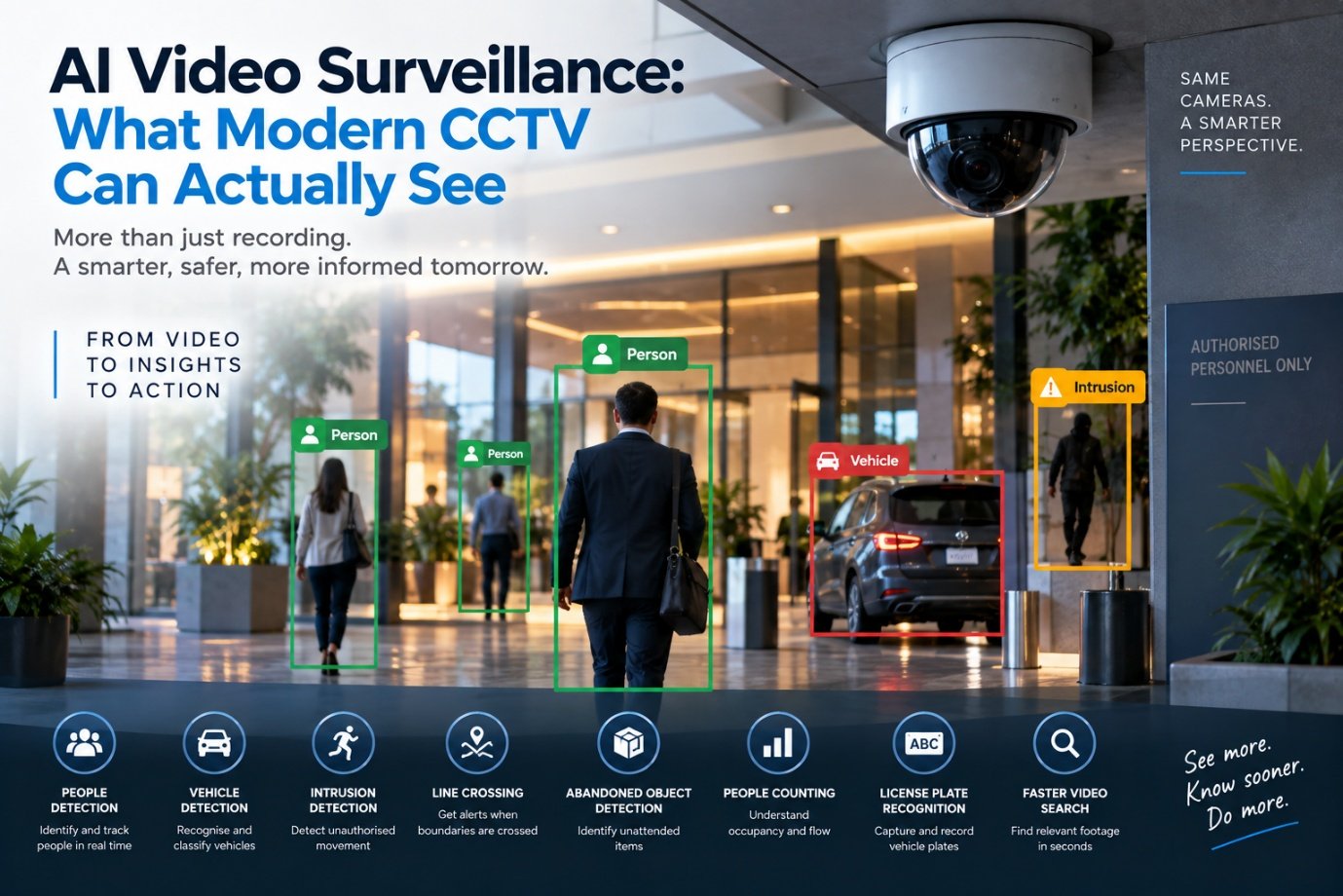
A CCTV camera can record what happened. AI can help businesses understand what is happening.
For decades, CCTV had one primary job: record video. If something happened, someone could review the footage later. That model still has an important place in security. But modern surveillance systems are capable of much more.
With advances in video analytics and artificial intelligence, cameras can increasingly become sources of structured information rather than simply sources of video. A surveillance system can potentially identify events, detect patterns, generate alerts and help people find relevant footage faster. This changes the role of CCTV.
The question is no longer only "Can the camera record what happened?"
It can increasingly become "Can the system help us understand what is happening?"
From Recording to Understanding
Traditional CCTV follows a relatively simple model, as we explored in Modern CCTV Is More Than a Security Camera:
The camera captures video. The recorder stores it. A person watches it when necessary. Modern intelligent surveillance can introduce another layer:
The video becomes data that can be analysed. Instead of requiring a person to continuously watch every camera, analytics can help identify specific events that deserve attention. This doesn't mean that AI understands everything happening in a scene. It means that properly configured video analytics can identify particular patterns or objects within defined conditions. That distinction is important.
What Can AI Video Analytics Actually Do?
The capabilities depend heavily on the camera, analytics platform, environment and configuration. But modern systems can support functions such as:
The exact capabilities vary significantly between systems. AI surveillance should therefore be evaluated based on the specific use case, rather than simply asking whether a camera is "AI-enabled."
AI Doesn't Make Every Camera Intelligent
This is another important distinction. A camera being marketed as an AI camera doesn't automatically mean it can perform every type of intelligent analysis. Different systems may process analytics:
The processing architecture affects:
The Camera Is Only One Part of the System
A common mistake is to think of AI surveillance as simply buying an AI-enabled camera. But a surveillance system has multiple layers:
The AI component sits within this larger ecosystem. A sophisticated camera connected to a poorly designed network — the kind explored in How to Build a Reliable IT Network for a Growing Business — is still part of a poorly designed surveillance system.
Why Real-Time Alerts Matter
Traditional CCTV is often reactive. Something happens. Later, someone discovers it. Then they search the footage. AI-assisted surveillance can introduce a proactive element. For example:
The value isn't simply that the camera recorded the event. The value is that the business was able to become aware of it more quickly. This can be particularly useful for environments where continuously watching every camera isn't practical.
But More Alerts Don't Mean Better Security
There is a major problem with poorly configured analytics: too many alerts. If a system generates notifications every time something moves, users quickly stop paying attention. This is often called alert fatigue. Imagine a security team receiving hundreds of notifications every day. Eventually, an important alert may look exactly like another routine notification.
The objective should therefore not be maximum alerts.
It should be useful alerts.
Good analytics configuration should focus on events that matter to the business.
Context Matters
AI doesn't operate in a vacuum. The same movement can mean very different things depending on the environment. A person entering an office during business hours may be normal — the same movement at 3 AM may deserve attention. A vehicle entering a parking area may be routine — a vehicle entering a restricted service area may be significant. A person standing in a hotel lobby for several minutes may be completely normal — a person repeatedly entering a restricted area may be worth investigating.
AI Can Make Video Search Faster
One of the most practical applications of intelligent video analytics may actually happen after an incident. Consider a large property with hundreds of cameras. Something happens at approximately 4:30 PM. Traditional investigation might require someone to manually review hours of footage across multiple cameras. That's time-consuming. Video analytics can potentially help narrow the search. For example:
Instead of watching everything, investigators can potentially search for relevant events. This can significantly change how surveillance teams interact with video.
Searchable Video Is Different From Stored Video
There is an important distinction here. A recording system may store thousands of hours of footage. But storing video doesn't automatically make the footage easy to search. The more useful question is: what information is associated with that video? If analytics generate structured event information, the system can potentially associate events with:
This turns video from a massive collection of files into something that can be queried more intelligently.
AI Surveillance Beyond Security
Another interesting development is the use of video analytics for operational purposes. Depending on the environment and technology, businesses can potentially analyse:
This doesn't mean every camera should become an analytics device. It means that businesses can increasingly consider whether their visual data has operational value beyond security.
Hotels Are a Particularly Interesting Example
Consider a large hotel. It may have cameras covering:
Traditionally, these cameras primarily provide security footage. With appropriate analytics, different areas can potentially support different use cases:
- ParkingVehicle detection and defined access events
- EntrancePeople movement and occupancy information
- Restricted AreasIntrusion or line-crossing alerts
- Service AreasDefined operational events
- LobbyOccupancy or movement analysis where appropriate
The important point is that analytics should be designed around the business environment. One analytics configuration does not fit every camera.
The Network Becomes Even More Important
AI surveillance can increase the importance of network design. High-resolution video generates data. Multiple cameras generate more data. Multiple high-resolution cameras generate substantially more data. Add:
…and the network becomes a critical part of the architecture. This is why CCTV and networking should not be treated as completely separate projects — a principle explored in both 5 Common Networking Mistakes Growing Businesses Make and How to Build a Reliable IT Network for a Growing Business. The camera may be the visible component. The network is the infrastructure underneath it.
Storage Requirements Also Change
Video analytics doesn't eliminate the need for storage. Businesses still need to determine:
Higher-quality video generally requires more storage. Longer retention requires more storage. More cameras require more storage. The correct storage design therefore depends on the actual surveillance requirements. A business shouldn't decide storage based simply on "How many terabytes does this recorder have?" It should start with "How much video do we need to retain, at what quality, for how long?"
Edge AI vs Centralised AI
There are different ways of processing video analytics:
There is no universal architecture that is right for every organisation. The appropriate design depends on:
Privacy and Governance Matter
The more intelligent surveillance becomes, the more important governance becomes. Video systems can potentially process sensitive information about people and activities. Businesses should therefore consider:
- Who can access footage?
- Who can access analytics?
- How long is information retained?
- Where is it stored?
- Who can export footage?
- How are accounts protected?
- What audit logs exist?
- What policies govern use?
- What legal and regulatory requirements apply?
Cybersecurity Is Part of CCTV Security
An IP camera is a network-connected device. That means CCTV security isn't only about physical security. It also involves cybersecurity, part of the wider IT infrastructure picture we explored in Why Your IT Infrastructure Matters More as Your Business Grows. Important considerations can include:
A surveillance system can contain valuable information. Protecting the cameras and recordings is therefore part of protecting the business. This is another reason CCTV and networking increasingly need to be designed together.
Don't Buy AI for the Sake of AI
The word AI has become a powerful marketing term. But businesses should resist buying capabilities simply because they sound impressive. Instead, start with the problem:
- Unauthorised access to a restricted areaDefined intrusion analytics
- Security staff spend too much time reviewing footageSearchable video analytics
- Management wants to understand occupancy patternsAppropriate people-counting or occupancy analytics
- Parking incidents are difficult to investigateVehicle-focused analytics and searchable events
The technology should follow the business requirement. Not the other way around.
A Practical Framework for Evaluating AI CCTV
Before investing in an intelligent surveillance system, ask:
The Future of CCTV Is Connected Intelligence
The evolution of surveillance is increasingly moving through several stages:
The camera remains important. But it is no longer necessarily the whole system. The future is likely to involve increasingly connected combinations of:
The value comes from how those components work together.
The TRUIX Perspective
We believe the future of CCTV isn't simply about putting better cameras on walls. It is about building surveillance systems that can provide useful information to the people responsible for security and operations — the same principle behind The Hidden Cost of Manual Business Processes and Digital Transformation Isn't About Buying More Software: technology should solve a real business problem, not simply add another product. That means looking at the entire environment:
A camera can capture an event. Analytics can help identify it. Software can help present it. A network can move the information. Storage can preserve it. And people can decide what to do about it. That is the real opportunity behind intelligent surveillance. Not more technology for the sake of technology. Better information when it matters.
It can help you understand what is happening, where it is happening, and which events deserve attention.
Related Reading
- CCTV Design Mistakes That Can Cost Businesses More Than the Cameras
- Modern CCTV Is More Than a Security Camera
- IP Cameras vs Analog CCTV: What Should Businesses Choose?
- 5 Common Networking Mistakes Growing Businesses Make
- How to Build a Reliable IT Network for a Growing Business
- Why Your IT Infrastructure Matters More as Your Business Grows
- The Hidden Cost of Manual Business Processes
- Digital Transformation Isn't About Buying More Software
- CCTV Surveillance