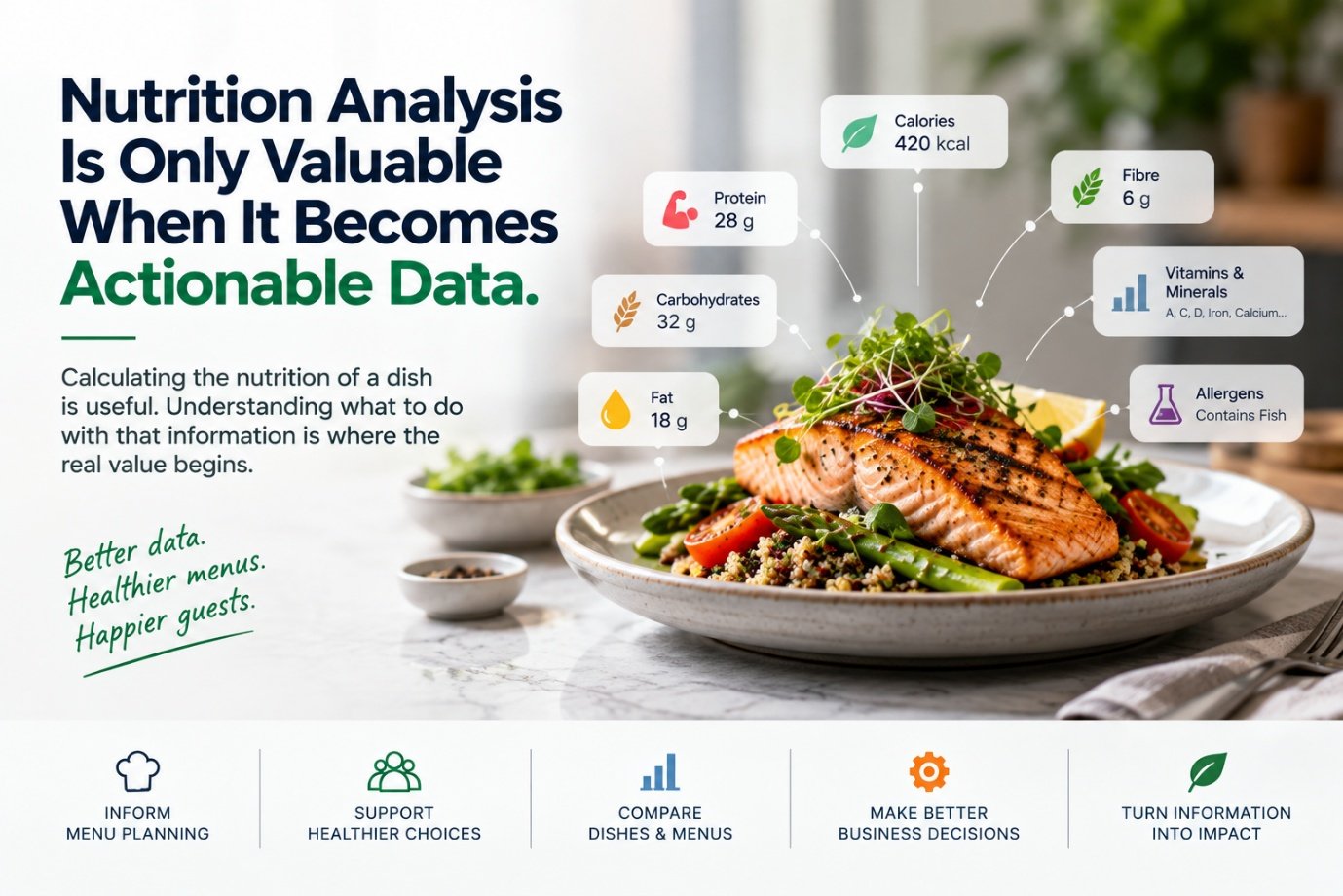
Calculating the nutrition of a dish is useful. Understanding what to do with that information is where the real value begins.
For many food businesses, nutrition analysis starts with a fairly straightforward question: how many calories does this dish contain? The answer can be useful. But it is only the beginning. A professional kitchen may want to know much more:
- How much protein does the dish provide?
- What are the carbohydrates and fats?
- Which vitamins and minerals are present?
- Does it contain allergens?
- How does it compare with another dish?
- What happens if an ingredient or portion changes?
- Which dishes are particularly energy-dense?
- How does the nutritional profile of the menu look as a whole?
- Can this information support customer communication?
- Can it help chefs and menu planners make better decisions?
At this point, nutrition analysis stops being a calculation exercise. It becomes a data and decision-making problem. And that distinction matters.
A Nutrition Number Is Not the Same as Nutrition Intelligence
Imagine a restaurant analyses one recipe and receives the following result: Calories: 620 kcal. That is useful information. But by itself, it doesn't answer very many business questions. What if the same report also provides:
Now there is more context. And when this information is available across an entire menu, the business can begin comparing dishes and identifying patterns. That is the difference between nutrition analysis and nutrition intelligence. Analysis tells you what the numbers are. Intelligence helps you understand what those numbers mean for the business.
It Starts With the Recipe
Just as carbon analysis starts with recipe and ingredient data, nutrition analysis starts there too. A recipe typically contains:
Each of these can influence the nutritional result. Consider a simple pasta dish. The nutritional calculation may depend on:
A dish that appears straightforward on a menu may actually contain dozens of data points. And if the underlying recipe changes, the nutritional result may change as well. That is why nutrition analysis shouldn't be treated as a one-time document. The recipe is a living data source.
Portion Size Changes Everything
One of the most overlooked aspects of nutrition analysis is portion size. Suppose a recipe produces 10 portions. The total nutritional composition of the recipe is not necessarily the information a guest needs. The guest is eating one portion. Therefore, the system needs to understand the relationship between:
This is why nutritional information without clear portion context can be misleading.
The Hidden Complexity of Professional Kitchens
For a home cook, maintaining nutritional information for ten recipes may be relatively simple. For a hotel, restaurant group or food business, the scale can be completely different — a complexity we explored in The Hidden Nutritional Complexity of a 5-Star Hotel Menu. A large hospitality operation may have:
And behind those recipes are sub-recipes. A sauce may be a recipe. A stock may be a recipe. A marinade may be a recipe. A dressing may be a recipe. A garnish may be a recipe. This creates a hierarchy of food data. If the system does not understand that hierarchy, maintaining accurate nutrition information becomes increasingly difficult.
Ingredient Standardisation Is Critical
Nutrition analysis depends heavily on ingredient data. But professional kitchens don't always maintain ingredients in a perfectly standardised format. The same ingredient may appear as:
Depending on the organisation, these may represent the same ingredient or genuinely different products. A nutrition system therefore needs a consistent way of identifying ingredients and associating them with nutritional information.
Cooking Changes the Data
Another complication is that ingredients do not necessarily retain the same physical characteristics after preparation. Rice absorbs water. Vegetables lose or gain weight depending on preparation. Meat loses moisture during cooking. Sauces reduce. Ingredients can be fried, baked, boiled, grilled, steamed or otherwise processed.
This means nutrition calculations need to be considered in the context of the recipe and its yield. The question isn't simply "What nutrients are in these raw ingredients?" It is "What nutritional composition does this recipe represent at the defined serving level?" That requires a structured methodology.
Nutrition Data Has Multiple Layers
Calories are often the first thing people think about when they hear "nutrition analysis." But nutrition is much broader. A comprehensive nutritional analysis can potentially include:
This creates a large amount of information for every recipe. The challenge isn't simply calculating it. The challenge is making it useful.
From Recipe to Menu
A single recipe can provide useful information. But a menu provides something much more interesting. Imagine analysing 300 recipes. The business can now begin asking:
- Which dishes are highest in protein?
- Which contain significant amounts of sodium?
- Which dishes provide particular nutrients?
- Which categories have the highest average energy per serving?
- How does the nutritional profile differ between breakfast and dinner?
- How do vegetarian and non-vegetarian offerings compare?
- What happens when portion sizes change?
The information has moved from recipe-level analysis to menu-level intelligence.
This Can Change How Menus Are Designed
Nutrition data doesn't have to be used only after a menu has been created. It can become part of the menu-development process. A chef may be developing three versions of a dish. Instead of evaluating them only on taste, appearance, cost and kitchen practicality, the business can also understand their nutritional profiles.
This doesn't mean choosing the dish with the lowest calories. It means having more information available when making the decision. The culinary decision remains a culinary decision. Technology simply provides better information.
Nutrition Doesn't Mean "Healthy"
This distinction is important. A nutritional analysis describes the nutritional characteristics of a recipe. It does not automatically mean "this dish is healthy." Health is contextual and depends on factors such as the individual, overall diet, portion, frequency and other considerations. Similarly, a dish containing more calories isn't automatically a bad dish.
Allergens Are Another Data Layer
Nutrition is also only one dimension of recipe intelligence. Consider the same recipe. The ingredient structure that supports nutrition analysis can also support allergen analysis. For example, a recipe may contain ingredients associated with:
The exact allergen requirements and declarations depend on the applicable regulatory framework and the way ingredients are sourced and formulated. But from a technology perspective, the important point is clear: the recipe is the common source of information. This is why nutrition and allergen management should not necessarily exist as completely disconnected processes.
One Recipe Can Support Multiple Business Functions
Once recipe data is structured, it can become a shared foundation, as we explored in Understanding the Carbon Footprint of a Recipe and Why Food Carbon Accounting Starts With the Recipe. For example:
The same underlying information can support multiple teams. Culinary teams can use it for recipe development. Nutrition teams can analyse nutritional composition. Procurement can understand ingredient requirements. Finance can evaluate costs. Sustainability teams can examine environmental impact. Management can compare menu performance. This is where structured food data becomes much more valuable than a static nutrition report.
The Problem With Static Reports
PDF reports have their place. They are useful for sharing information. But a PDF is generally an output. It is not necessarily the underlying data system.
The important distinction is report — information at one point in time versus connected data — information that can evolve with the business. For organisations managing large menus, the second approach becomes increasingly powerful.
What Happens When Recipes Change?
Recipe changes happen constantly. A supplier changes. An ingredient becomes unavailable. The chef modifies a preparation method. Portion size changes. A recipe is reformulated. A new menu is introduced. A seasonal ingredient is substituted. Each change potentially affects multiple outputs. For example:
This is an example of why food data should be treated as connected information rather than isolated documents.
Technology Can Make Nutrition More Useful
Technology can help businesses move through several stages:
The goal isn't necessarily to reach the final stage everywhere. The important thing is understanding that digitising a recipe is only the beginning.
Where AI Can Add Value
AI creates interesting possibilities once the underlying recipe data is structured. For example, an AI-powered system could potentially help users ask:
- "Show me high-protein vegetarian dishes under 600 calories."
- "Which menu items contain dairy and wheat?"
- "Compare the nutritional profile of these three recipes."
- "What happens to the nutritional profile if we reduce the portion size by 15%?"
- "Find dishes with similar ingredients but different nutritional characteristics."
The important word here is structured. AI becomes much more useful when it has reliable data to work with. Without structured recipe information, an AI system may have to interpret inconsistent documents, spreadsheets and free-text descriptions before it can even begin analysing them.
Nutrition Data Can Also Improve Customer Transparency
Consumers increasingly want more information about what they eat. Depending on the business model and applicable requirements, nutritional information can potentially be presented through:
But transparency requires confidence in the underlying data. Publishing a number simply because a system produced it isn't enough. Businesses should understand:
- Where did the number come from?
- What recipe version was analysed?
- What portion size was used?
- What assumptions were made?
- What nutritional database was used?
- When was it last updated?
Data governance matters.
The Bigger Opportunity: A Food Intelligence Layer
The most interesting opportunity isn't simply to produce nutritional reports faster. It is to build a food intelligence layer around the recipes a business already uses. That layer can connect:
Once this information is connected, the business can begin to understand its food operation in a completely different way. The menu stops being just a collection of dishes. It becomes a dataset. And that dataset can be analysed, compared, updated and connected to other business systems.
What Businesses Should Ask Before Starting Nutrition Analysis
Before purchasing a nutrition-analysis solution, it is worth asking a few fundamental questions.
The Future Isn't More Nutrition Reports
The future of food technology isn't necessarily about generating increasingly complicated reports. It is about making food information increasingly connected and useful. Imagine a hotel manager being able to select a menu and immediately understand:
That isn't simply nutrition analysis. That is menu intelligence. And it becomes possible when the underlying food data is structured properly.
The TRUIX Perspective
We believe nutrition analysis should not end with a PDF containing a list of numbers. The real opportunity is to turn recipe information into a reusable business asset. A properly structured recipe can support nutrition analysis today and potentially support allergen management, costing, carbon analysis, compliance and menu intelligence tomorrow.
That changes the role of nutrition technology. It moves from "Tell me the calories in this dish" to "Help me understand my menu." And that is a much more powerful question — the same principle behind Why Businesses Should Stop Buying Software and Start Building Systems and Digital Transformation Isn't About Buying More Software: technology should improve the business process, not simply add another application.
Because businesses don't need more data simply for the sake of having data. They need better information to make better decisions. That is where nutrition analysis becomes nutrition intelligence.
a genuine business technology.
Related Reading
- Why Ingredient Data Is a Strategic Business Asset
- How AI Can Change Recipe and Menu Management
- Why Restaurants Need More Than a Digital Recipe Book
- Building More Sustainable Menus With Better Data
- How Hotels Can Use Menu Data to Understand Environmental Impact
- Why Ingredient Data Is a Strategic Business Asset
- When Your Business Has Outgrown Excel
- Better Carbon Data Starts With Better Emissions Factors
- The Hidden Nutritional Complexity of a 5-Star Hotel Menu
- What Happens When Recipes Become Data?
- Understanding the Carbon Footprint of a Recipe
- Why Food Carbon Accounting Starts With the Recipe
- Why Businesses Should Stop Buying Software and Start Building Systems
- Digital Transformation Isn't About Buying More Software
- Nutrition Analysis