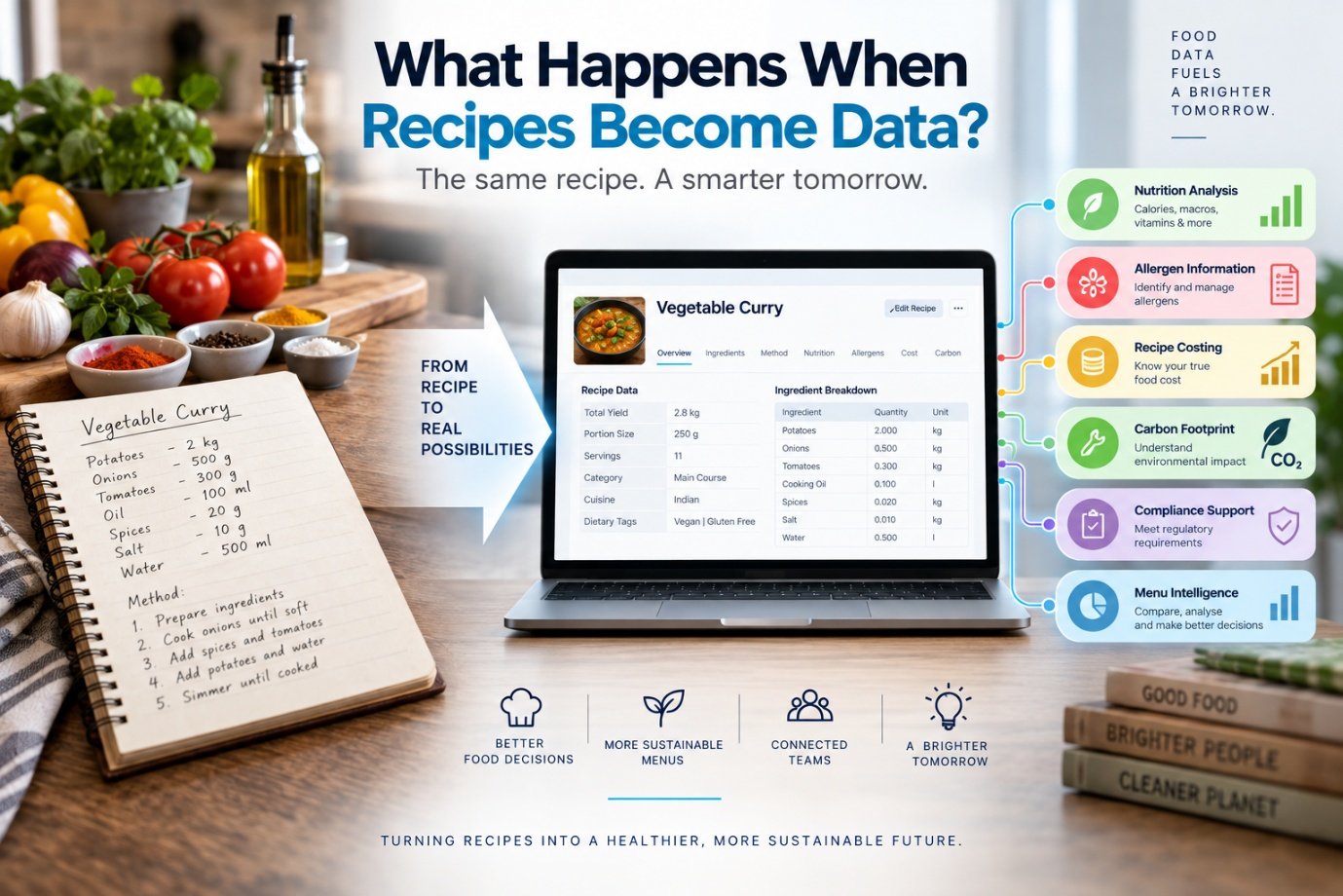
A recipe has traditionally been thought of as a set of instructions.
Ingredients. Quantities. Preparation methods. Cooking time. Serving instructions.
For a chef, that is exactly what a recipe needs to be.
But from a technology perspective, a recipe can be much more than a document. It can be data.
And once recipes become structured data, they can be connected, analyzed and used to generate information that goes far beyond the kitchen. A recipe can become the starting point for understanding nutrition, allergens, cost, sustainability, menu performance and much more.
The real transformation happens when a recipe stops being just something you read and becomes something a system can understand.
A Recipe Already Contains Data
Consider a simple recipe for a vegetable curry. It might contain:
A chef sees a recipe. A technology system sees a structured collection of data. Each ingredient has:
Once that information is captured consistently, it can be processed by software. And that opens up many possibilities.
From Recipe Document to Data Structure
A traditional recipe might simply read: Vegetable Curry — Potatoes 2 kg, Onions 500 g, Tomatoes 300 g, Oil 100 ml, Spices 20 g.
A structured recipe understands each ingredient individually — Potato at 2,000 g, Onion at 500 g, Tomato at 300 g, Cooking Oil at 100 ml — as distinct, connected records rather than a single block of text.
Now the system can connect each ingredient to additional information. For example:
The recipe becomes a collection of connected information rather than a static document.
One Recipe Can Generate Multiple Insights
This is where the value starts to become interesting. The same recipe data can potentially support:
The important point is that these don't necessarily require completely separate recipe databases. They can be different applications of the same underlying data, as we explored in Why Recipe Data Matters for SEHHI Compliance.
The Recipe Becomes a Data Object
This is a subtle but important change in thinking. Instead of treating a recipe as a document, imagine treating it as a data object. A recipe could have relationships with:
Now changing one piece of information can potentially have consequences across the connected system. For example, if an ingredient is replaced, the system could identify which recipes use that ingredient. Those recipes could then be reassessed for their nutritional profile, allergens, cost or environmental impact.
The recipe is no longer isolated. It becomes part of a larger information network.
Sub-Recipes Make This Even More Powerful
Professional kitchens frequently use sub-recipes. A hotel may prepare a sauce, dressing, stock or spice blend separately and use it across several dishes. Consider a chicken dish that contains a house sauce, which itself contains oil, tomato, herbs and spices.
If the house sauce is treated simply as "50 g sauce," the system knows very little. But if the sauce itself is structured as a recipe, the relationship becomes:
This makes it possible to trace information through multiple levels. The same principle can apply to pastry components, marinades, stocks, dressings, fillings and other preparations — as we cover in The Hidden Nutritional Complexity of a 5-Star Hotel Menu.
Standardization Becomes Important
Turning recipes into useful data isn't simply about typing them into a database. The information needs to be structured consistently. Consider these examples, which may represent different ingredients depending on the context:
The same problem occurs with measurements. One recipe might use 1 kg, another 1,000 g, another 10 × 100 g. A technology system needs a consistent way of understanding these values. This is where data normalization becomes important.
Ingredient Data Is the Foundation
A recipe is only as useful as the ingredient information behind it. If an ingredient is connected to an appropriate dataset, the system can potentially retrieve information about it. That could include:
But this also means that the source and quality of the underlying data matter. A system shouldn't create the illusion of accuracy simply because it can produce a number. For nutrition, carbon footprint and other analytical outputs, methodology and source data need to be considered carefully.
What Happens When a Recipe Changes?
Now imagine a chef changes a recipe. The original dish uses 100 g of Ingredient A. The chef replaces it with 100 g of Ingredient B.
In a traditional recipe book, the change is simple. In a connected recipe system, the change could trigger a series of questions:
- Has the nutritional profile changed?
- Have the allergens changed?
- Has the cost changed?
- Has the estimated carbon footprint changed?
- Are there other recipes using the same sub-recipe?
- Does the menu information need updating?
- Does a compliance report need to be reviewed?
This is where structured recipe data becomes particularly valuable.
From Data to Automation
Once information is structured, businesses can begin automating tasks that previously required manual effort. For example:
The exact workflow will depend on the system and methodology being used. But the underlying principle is powerful:
Structured data creates the possibility of automation.
What About AI?
AI makes structured recipe data even more interesting. Imagine asking a system:
These questions become much easier for technology to answer when the underlying recipe information is structured. AI can provide the interface. But the quality of its answers depends heavily on the quality and structure of the data behind it.
From Individual Recipes to Menu Intelligence
One recipe can provide useful information. Hundreds of recipes can provide something much more powerful. Consider a hotel with:
If those recipes are structured consistently, the organization can begin looking at its food operation at multiple levels:
This is where recipe data starts becoming a strategic business asset.
The Connection Between Recipes and Sustainability
One of the most interesting applications is sustainability. Every recipe contains ingredients. Ingredients have environmental implications. Once recipe quantities are structured and connected to appropriate environmental datasets, businesses can begin estimating the environmental impact associated with their dishes. This creates a chain:
The same architecture can support carbon-footprint analysis and broader sustainability initiatives, as we explored in Understanding the Carbon Footprint of a Recipe. This is why food sustainability is increasingly becoming a data challenge as much as a culinary one.
Recipe Data Can Connect Different Departments
A structured recipe doesn't only benefit chefs. It can potentially connect information used by several parts of an organization:
Instead of every department maintaining its own version of the information, a connected data model can create a more consistent foundation.
The Challenge of Data Ownership
Once recipe data becomes important to multiple departments, another question emerges: who owns the data?
A recipe may be created by a chef. Ingredient information may come from procurement. Nutritional information may come from a food database. Carbon information may come from an environmental dataset. Cost information may come from purchasing.
This means recipe intelligence requires more than technology. It requires clear processes for:
Technology can make these processes easier, but the organization still needs to define how information should be managed.
The Future of Food Technology Is Connected
The next generation of food technology won't simply digitize recipe books. It will connect the information contained within recipes to the wider business. Imagine being able to move seamlessly from:
That is a very different concept from simply storing recipes electronically. It is a connected food-data ecosystem — the same principle behind why businesses should stop buying software and start building systems.
The TRUIX Perspective
At TRUIX, we believe recipes represent an overlooked source of structured business information.
For hospitality and food-service organizations, the recipe can become a common data layer connecting culinary operations with nutrition, allergens, costing, sustainability and menu intelligence.
The objective isn't to replace the chef or turn food into a spreadsheet. It is to give the organization better information while allowing culinary teams to continue doing what they do best.
When recipe information is structured properly, technology can do more than store it. It can connect it, analyze it and turn it into intelligence.
Because a recipe may begin in the kitchen.
its value can extend far beyond the kitchen.
Related Reading
- Why Your Business Data Is More Valuable Than You Think
- Why Ingredient Data Is a Strategic Business Asset
- How AI Can Change Recipe and Menu Management
- From Spreadsheets to Carbon Intelligence
- AI Agents vs Traditional Automation: What's the Difference?
- Why Restaurants Need More Than a Digital Recipe Book
- Building More Sustainable Menus With Better Data
- How Hotels Can Use Menu Data to Understand Environmental Impact
- Why Ingredient Data Is a Strategic Business Asset
- When Your Business Has Outgrown Excel
- Better Carbon Data Starts With Better Emissions Factors
- Nutrition Analysis Is Only Valuable When It Becomes Actionable Data
- The Hidden Cost of Manual Business Processes
- Why Food Carbon Accounting Starts With the Recipe
- Why Recipe Data Matters for SEHHI Compliance
- The Hidden Nutritional Complexity of a 5-Star Hotel Menu
- Understanding the Carbon Footprint of a Recipe
- Why Businesses Should Stop Buying Software and Start Building Systems
- Recipe Analytics
- Nutrition Analysis
- Carbon Footprint Analysis