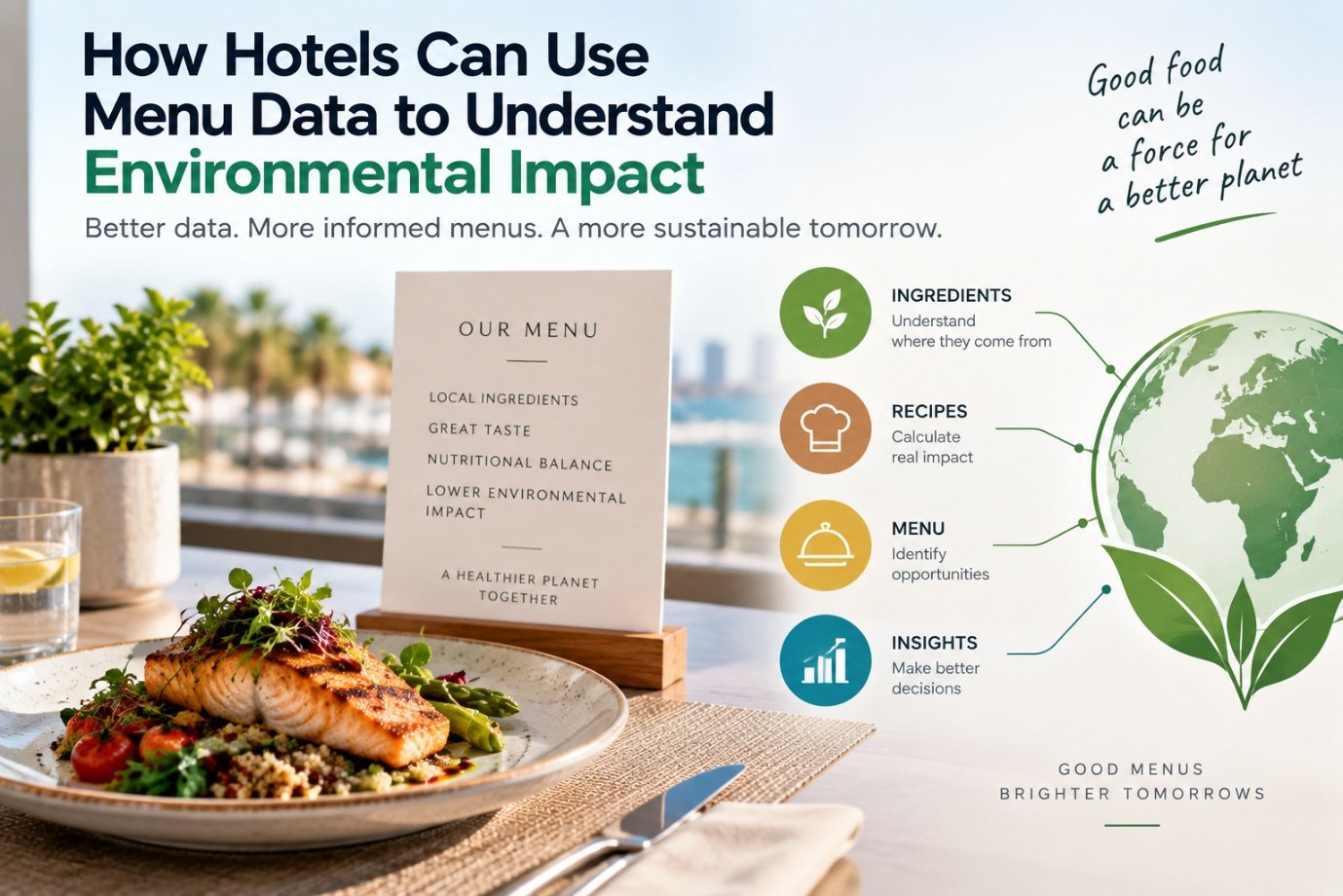
A hotel menu is usually designed around taste, presentation, guest expectations and commercial considerations. But there is another dimension that is becoming increasingly important: environmental impact.
Hotels serve food at a scale that makes small changes meaningful. A single recipe may be prepared hundreds or thousands of times across restaurants, banquets, room service, cafés and other outlets. Multiply that by hundreds of recipes, and the ingredients used across a hotel operation can represent a significant environmental footprint.
The challenge is understanding that footprint. And the starting point isn't a sustainability report. It is the menu.
The Menu Is More Than a List of Dishes
A hotel menu may appear to be a simple document containing dish names and prices. Behind every dish, however, is a structured chain of information:
Each layer contains information that can potentially be used to understand environmental impact. Consider a simple dish such as a chicken curry. The environmental calculation does not begin with the words "Chicken Curry." It begins with the ingredients:
The quantity of each ingredient matters. The recipe yield matters. The portion size matters. And the environmental data associated with each ingredient matters. This is why understanding the environmental impact of a menu is fundamentally a data problem.
From Recipe to Environmental Data
A recipe can be converted into a structured data model. For example:
- Chicken1,000 g
- Onion300 g
- Tomato400 g
- Oil100 g
- Spices50 g
Once the ingredient quantities are structured, they can be connected to appropriate emissions factors. A simplified calculation can be expressed as:
The individual ingredient results can then be added to estimate the emissions associated with the recipe. The same process can be applied across the menu. But this is where the complexity begins.
One Recipe Is Simple. A Hotel Menu Isn't.
A hotel may have:
Each operation may contain dozens or hundreds of recipes. And recipes often contain sub-recipes. A sauce may be used in several dishes. A stock may be used in multiple preparations. A dressing may appear across several salads. A pastry component may be used in desserts and breakfast items. If the underlying data is not structured, calculating environmental impact becomes difficult very quickly.
Ingredient Data Is the Foundation
The quality of menu-level environmental analysis depends heavily on the quality of ingredient data. An ingredient database may need to contain information such as:
This is important because two ingredients that appear to have similar names may not necessarily represent the same product. For example, milk could refer to different processing methods, packaging formats, fat levels or supply chains. Likewise, rice could represent different varieties, production systems and geographic sources. Environmental data therefore needs context.
Emissions Factors Are Not Universal Numbers
One of the biggest misconceptions about food carbon calculations is that every ingredient has one universally correct carbon value. In practice, emissions factors can vary depending on:
This means a carbon value should not be presented as an unquestionable fact without explaining the underlying methodology. A robust system should therefore maintain the source and assumptions behind the number. That makes the calculation more transparent and easier to update.
Why Geography Matters
A hotel in Abu Dhabi may not source its ingredients in the same way as a hotel in Mumbai, London or Singapore. Even when the ingredient is the same, the supply chain may be different. This creates an important question: which emissions factor should be used?
Ideally, the factor should represent the relevant geography and production system. But ingredient-level local data is not always available. In those situations, a regional or broader proxy may be necessary. The important principle is transparency. If a proxy is used, the methodology should clearly identify:
A transparent approximation is generally more useful than a highly precise-looking number with an unclear origin.
Portion Size Changes the Story
Consider two dishes. Dish A has a relatively low environmental impact per kilogram of ingredients. Dish B has a higher impact per kilogram. But if Dish A is served in a much larger portion, the environmental impact per serving may look different.
- Per Kilogramkg CO₂e per kg of ingredient
- Per Servingkg CO₂e per recipe or serving
For hotels, serving size is particularly important because the same recipe may be offered in different formats. A restaurant portion, banquet portion and tasting-menu portion may not be identical.
Buffets Create Another Layer of Complexity
Hotel buffets present an interesting data challenge. A buffet may contain dozens of dishes available simultaneously. But the quantity prepared is not necessarily equal to the quantity consumed. There may be:
This means there are potentially several environmental questions:
- What is the environmental impact of the food prepared?
- What is the environmental impact of the food served?
- What is the environmental impact of the food actually consumed?
These are different measurements. A mature sustainability programme may eventually need to distinguish between them. The first step, however, is having reliable recipe and production data.
Sub-Recipes Matter
Consider a simple restaurant dish: Grilled Chicken with Sauce. The sauce may itself be a recipe. The garnish may have its own ingredients. The side dish may be another recipe. The final menu item therefore becomes a combination of multiple data objects. A robust recipe-data system can represent these relationships. For example:
Each component can have its own ingredients and environmental information. This creates a much more accurate data structure than treating the final dish as a single line item.
Menu Changes Can Change Environmental Impact
One of the most useful benefits of structured menu data is the ability to understand the impact of recipe changes. Suppose a chef changes Ingredient A to Ingredient B. That change may affect:
The impact therefore extends beyond the kitchen. It can affect procurement, finance, nutrition information, sustainability reporting and customer communication. This is one reason ingredient data should be treated as a strategic business asset rather than simply a purchasing list.
Finding Environmental Hotspots
Once recipes and ingredients are structured, hotels can begin looking for patterns:
- Which ingredients contribute most to the menu's estimated emissions?
- Which recipes have the highest impact?
- Which menu categories have the largest environmental footprint?
- Which ingredients appear across the greatest number of high-impact dishes?
- Which recipes could potentially be redesigned?
- Which substitutions could reduce environmental impact while maintaining the desired culinary characteristics?
These questions move the organisation from measurement to intelligence. The objective is not simply to produce a number. It is to understand what the number means.
Carbon Data Can Support Menu Development
Environmental analysis can become part of the recipe-development process. Imagine a chef developing a new dish. The traditional process might consider:
Structured recipe intelligence — the same kind of intelligence described in Nutrition Analysis Is Only Valuable When It Becomes Actionable Data — can add additional dimensions:
The chef can then evaluate the dish across multiple dimensions before it reaches the menu. This does not mean that carbon should dictate culinary decisions. Food is complex. Taste, culture, nutrition, price, availability, guest preferences and operational practicality all matter. Environmental data is another piece of information that can support better decisions.
The Opportunity for Menu Engineering
Menu engineering traditionally focuses on factors such as:
Environmental information can become another analytical layer. A hotel could potentially examine relationships between:
Popularity + Profitability + Nutrition + Allergens +
Environmental Impact
This creates a broader concept of data-driven menu engineering. Instead of looking at a menu only from a financial perspective, hotels can begin examining it from multiple operational and sustainability perspectives.
From Individual Recipes to the Hotel Portfolio
The real value appears when recipe data can be aggregated. Imagine a hotel group with:
- Properties10
- Outlets50
- Recipes5,000
If recipe and ingredient data is structured consistently, the organisation can begin analysing the portfolio at different levels:
Which ingredients are used most frequently?
Which recipes have the highest estimated impact?
Which outlets have the greatest environmental footprint?
How does one hotel compare with another using the same methodology?
What patterns appear across the entire hotel portfolio?
This is where data becomes much more powerful than individual reports.
Standardisation Is Critical for Hotel Groups
Large hotel groups often face another challenge: different properties may describe the same ingredient differently. For example:
If these are actually the same or similar ingredients, inconsistent naming can make analysis difficult. Ingredient standardisation creates a common language. That can help connect:
Without standardisation, the organisation may have large amounts of data but limited ability to use it consistently.
What About Food Waste?
Recipe and menu data can also become an important foundation for understanding food waste. A hotel could potentially connect:
This can help distinguish between different types of waste and identify where further investigation may be useful. For example, if a particular dish is repeatedly overproduced, the solution may not be changing the recipe. It may be changing production planning. This is an important distinction.
Good sustainability data should help identify the problem before prescribing the solution.
The Role of Technology
Managing hundreds or thousands of recipes manually is difficult. This is where technology becomes important. A connected food-data platform, built on the same foundation described in Why Food Carbon Accounting Starts With the Recipe, can potentially bring together:
The objective is not simply to create another dashboard. It is to create a reliable underlying information system. Dashboards are useful because they visualise data. But the real value is in the data architecture underneath them.
Where AI Can Help
AI can add another layer to structured food data. For example, AI could potentially help identify:
If ingredient names are inconsistent, quantities are missing and emissions factors are poorly documented, an AI system can make the process faster without necessarily making the underlying information more reliable. Good AI starts with good data.
The Bigger Picture
Environmental impact should not be treated as a separate spreadsheet maintained by a sustainability team. The information can be connected to the operational data the hotel already uses. A recipe can simultaneously contain information about:
That means the same underlying data can support multiple business functions. This is where food technology becomes particularly interesting. The goal isn't to create more data. It is to make the data that already exists connected, structured and useful.
The TRUIX Perspective
At TRUIX, we see menu sustainability as a technology and data challenge as much as a sustainability challenge. The first step is not necessarily a complicated sustainability dashboard. It is getting the fundamentals right:
Once that foundation exists, environmental information can be connected with nutrition, allergens, costing and other operational data. Hotels can then move beyond asking "What is the carbon footprint of this dish?" and start asking more useful questions:
- Why is it high?
- Which ingredients are driving it?
- Where are the biggest opportunities?
- What happens if the recipe changes?
- How does this compare across our outlets and properties?
That is the difference between having a carbon number and having carbon intelligence. For hotels, the menu is no longer just a customer-facing document. It can become a powerful source of operational, nutritional and environmental intelligence.
and better decisions can support a more informed approach to sustainable hospitality.
Related Reading
- How Technology Can Automate Carbon Accounting
- From Spreadsheets to Carbon Intelligence
- Building More Sustainable Menus With Better Data
- Why Food Carbon Accounting Starts With the Recipe
- Understanding the Carbon Footprint of a Recipe
- Better Carbon Data Starts With Better Emissions Factors
- Why Ingredient Data Is a Strategic Business Asset
- What Happens When Recipes Become Data?
- The Hidden Nutritional Complexity of a 5-Star Hotel Menu
- Nutrition Analysis Is Only Valuable When It Becomes Actionable Data
- Scalable IT Infrastructure: Building for Growth Without Overbuilding
- Carbon Footprint Analysis